Alternate Splicing
| Eukaryotic Regulation | Table of Contents |
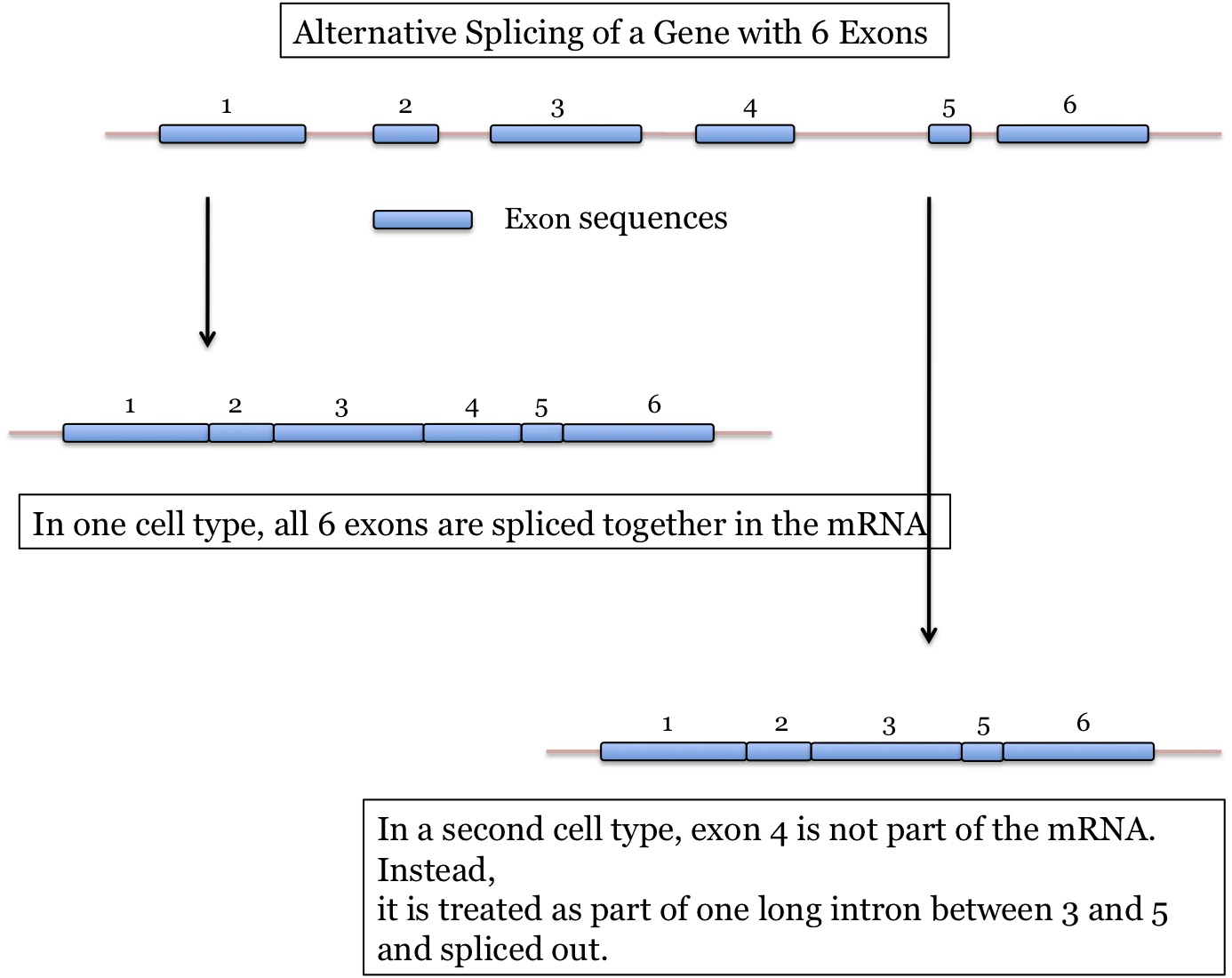
Alternate splicing refers to the ability to splice together different exon sets during RNA processing. Any gene with multiple introns could potentially undergo alternate splicing: all it requires is that an exon be treated as an exon in one splicing event but as part of a longer intron in another. For example, alternate splicing of a hypothetical gene is shown here:
|
|
The two mature mRNAs that are produced by the alternate splices obviously code for quite different amino acid sequences. Therefore, splicing is tightly controlled to ensure that a specific polypeptide is produced. Eukaryotes control splicing such that in different cell types, sexes or at different developmental stages, a particular pre-mRNA can be alternately spliced so as to produce a different polypeptide sequence. This is regulated by other cellular components that influence the splicing machinery in such a way as to alter what sequence is recognized as an intron. It is important to note that in a particular cell type at a specific time, or at a particular developmental stage, all of the pre-mRNAs for a particular gene are spliced the same way, the alternate part refers to variation across cell types or stages, or responses to regulatory changes.
The only alternative is to include an exon or to splice it out. Exon order cannot be changed.
Examples
One classic example is the Sex-lethal (Sxl) gene in Drosophila.There are 8 exons in the gene: in males all 8 are spliced together in the mature mRNA while in the female, exon 3 is spliced out. Exon 3 contains a stop codon in-frame so the resulting polypeptide is significantly shorter in males. The product plays an important role in the overall sex-determination process; very early in development, the X:A chromosome ratio (discussed in the Sex-Determination section) triggers changes that subsequently affect Sxl splicing so that it differs between individuals with an X:A ratio of 1 (proto-females) and those with an X:A ratio less than 1 (proto-males). In turn, the Sxl protein influences the splicing of other pre-mRNAs that code genes that contribute to sex-determination.
Another example is the troponin T gene in rats. There are 18 exons in this gene and 64 different mRNAs that are alternately spliced from this. The protein functions in skeletal muscles and the different potential forms allow for significant functional diversity.
| Eukaryotic Regulation | Table of Contents |