Loss-of-Function Alleles
The general outcomes of allele interaction that are given on the Allele Interactions page are the result of the interactions between the allele products at the molecular level within the organism (such as the heterozygote in a diploid organism). As you might guess, the ways in which the produce can interact are numerous but there are some general patterns that you should learn. The first of these involves loss-of-function alleles.
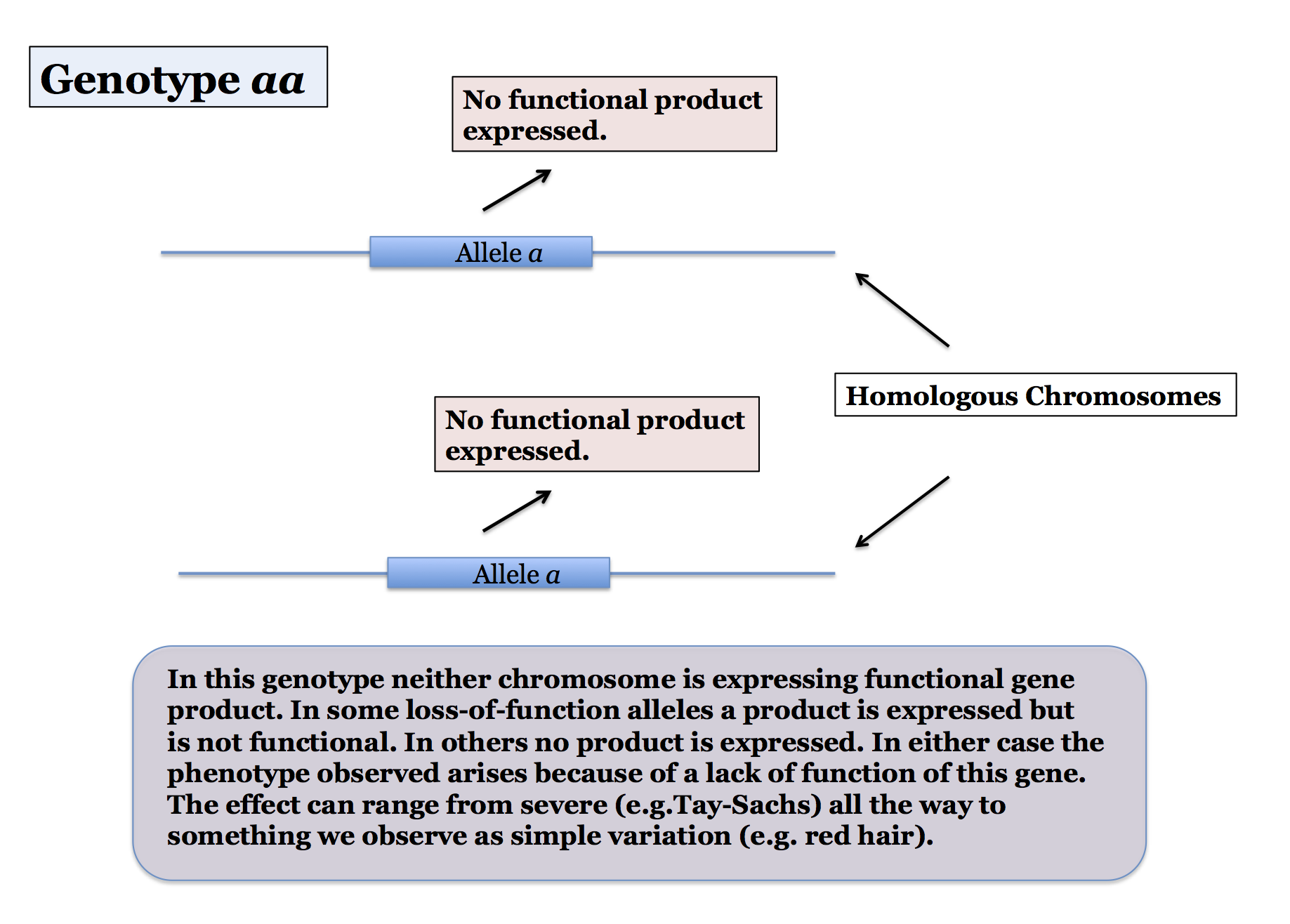
Loss-of-function alleles: A common reason - but not the only reason - that we observe a dominant allele and a recessive allele (remember you cannot have one without the other) is that the product of the recessive allele does not function. These are commonly referred to as loss-of-function mutations or alleles but they are also called amorphic alleles. In many case, loss-of-function arises because the mutant allele is never expressed, and so there is no product to function. In some case, however, the mutant allele is expressed but the protein product fails function, perhaps because it fails to fold up into a functional structure.
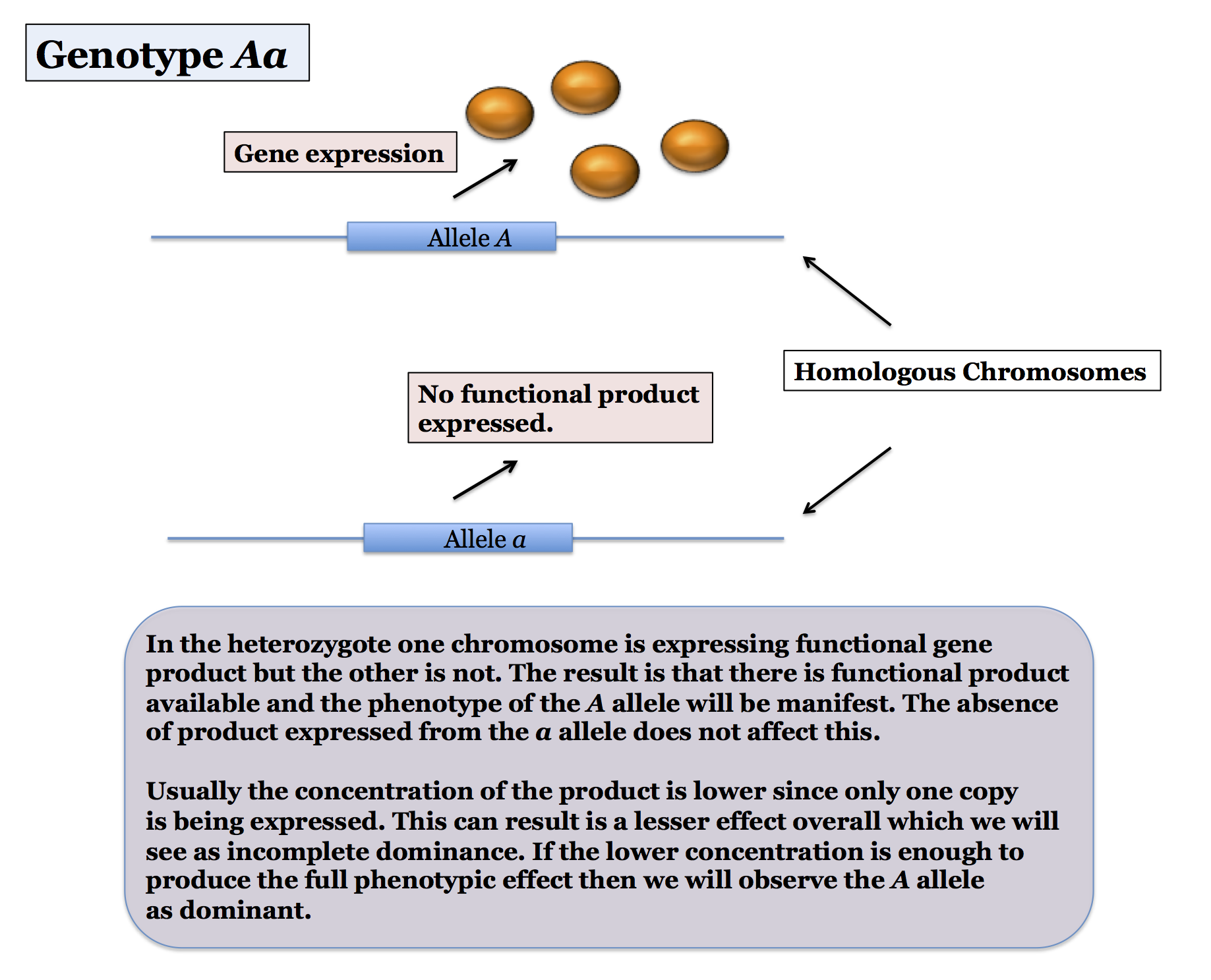
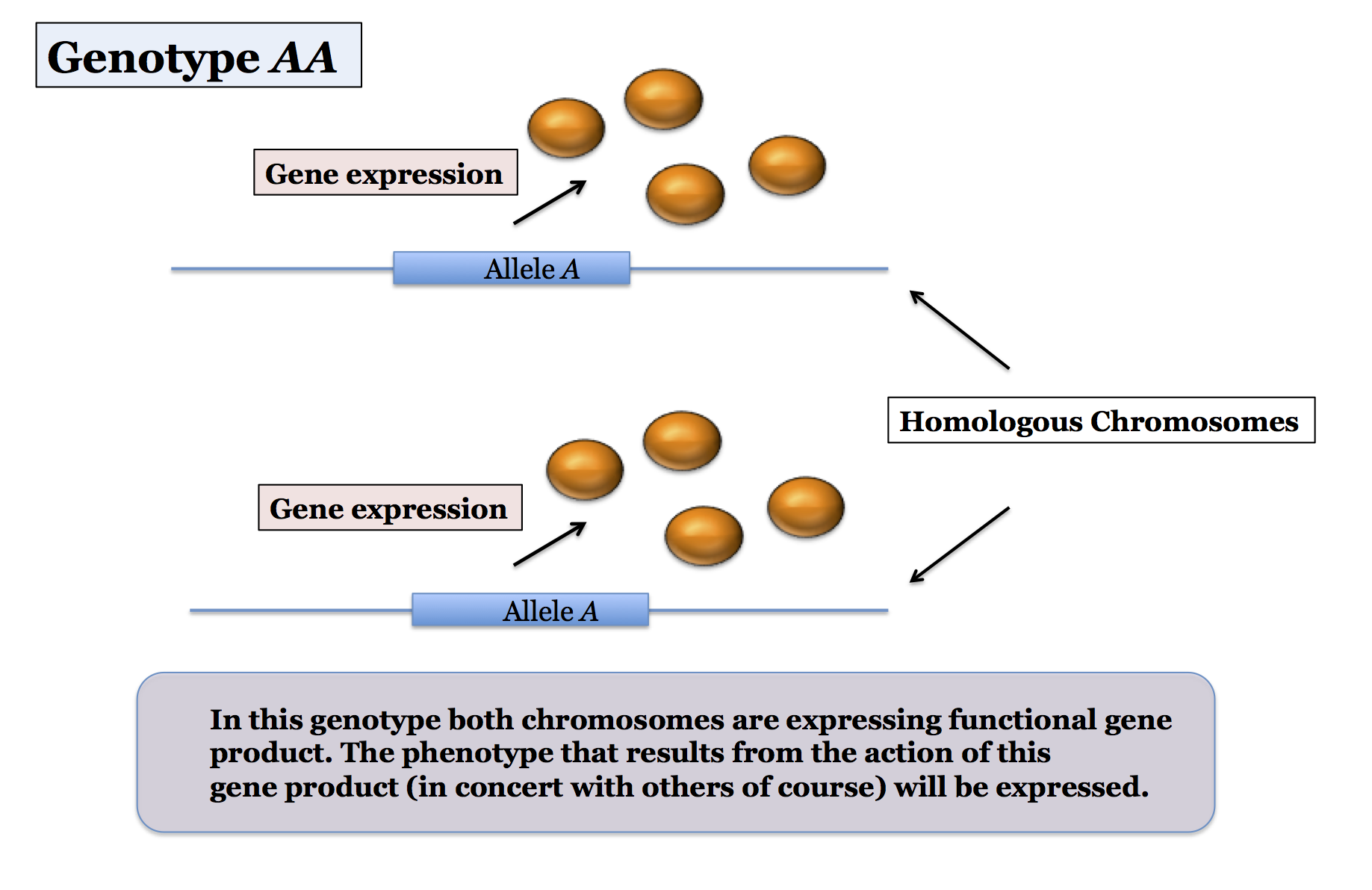
The way that this leads to dominant/recessive alleles is that, since the amorphic allele does not produce a functioning protein or RNA molecule, in a heterozygote only the product for the other allele is present. Therefore, it is the only one acting biologically. The result is that the phenotype is determined by that product - and so that allele is dominant. Essentially, the amorphic allele is simply not contributing to the phenotype as shown in these figures.
|
|
|
|
|
|
An amorphic allele refers to one that codes for a non-functional product. Related to this is a hypomorphic allele which is an allele that codes a product that has some function but that function is at a level far below the dominant allele (or, often, it is expressed relative to a wild type allele) product. For example, consider an enzyme that fails to catalyze a reaction (amorphic) or catalyzes the reaction at a drastically reduced rate (hypomorphic) or a transport protein that does not transport etc. In the case of the hypomorphic allele the phenotypic effect would not be an absence of function, just drastically reduced. So, for example, if the wild type phenotype is red flowers, the homozygous hypomorphic genotype might be pale pink flowers.