Eukaryotic Chromosome Structure
Eukaryotic chromosomes are composed of a single linear molecule of DNA and a host of associated proteins and RNA. We tend to focus on the DNA component but as we will see in the molecular section the other components play very important roles. At this stage of the course we are not going to focus on molecular details of chromosome structure but, instead, discuss some general overall structural features.
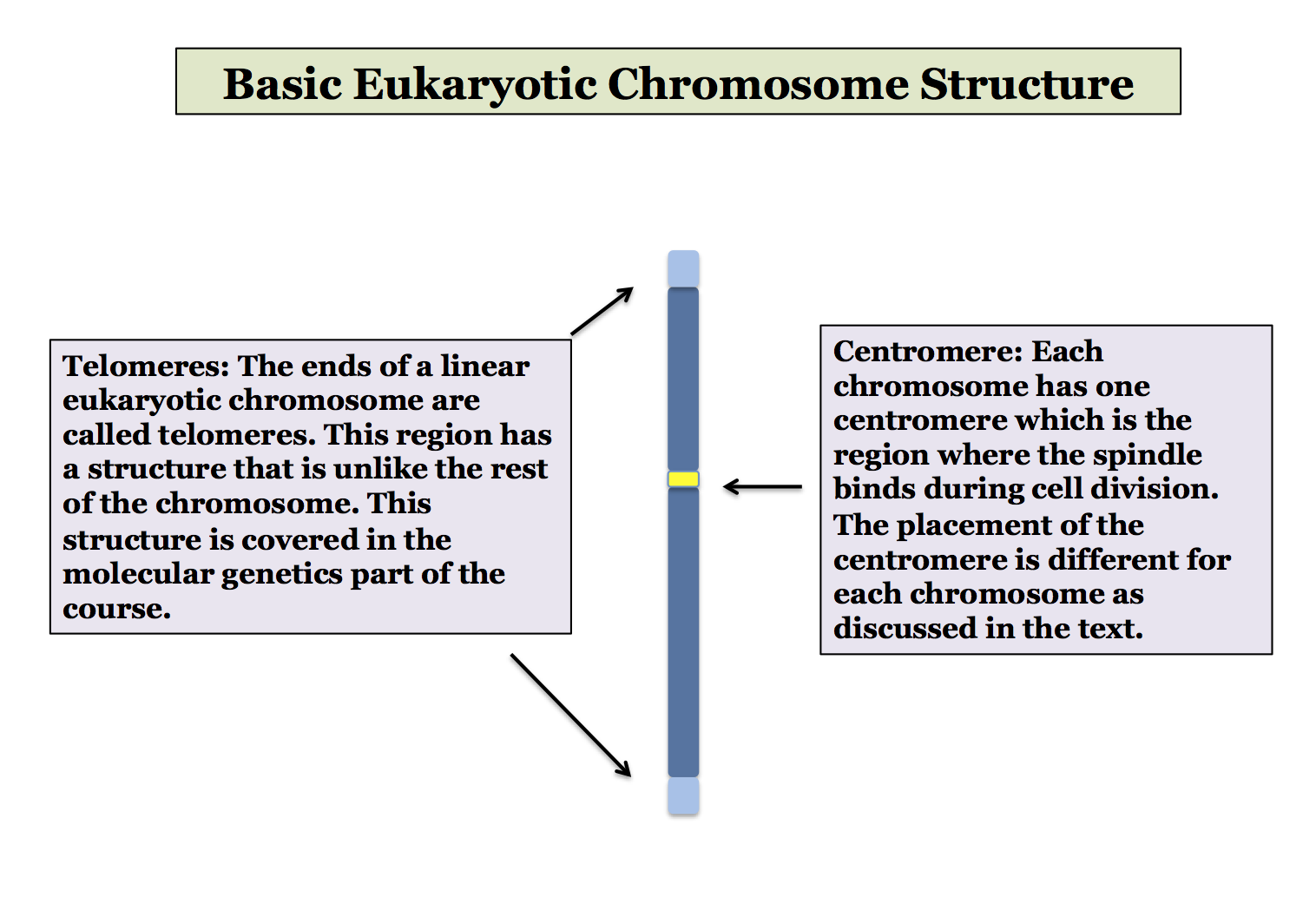
There are two main features you should know: the centromere and the telomeres. The centromere plays an important role during cell division and the telomeres (at the two ends of the linear DNA molecule) have important structures, covered in the molecular genetics part of the course, to maintain the integrity of the chromosome.
|
|
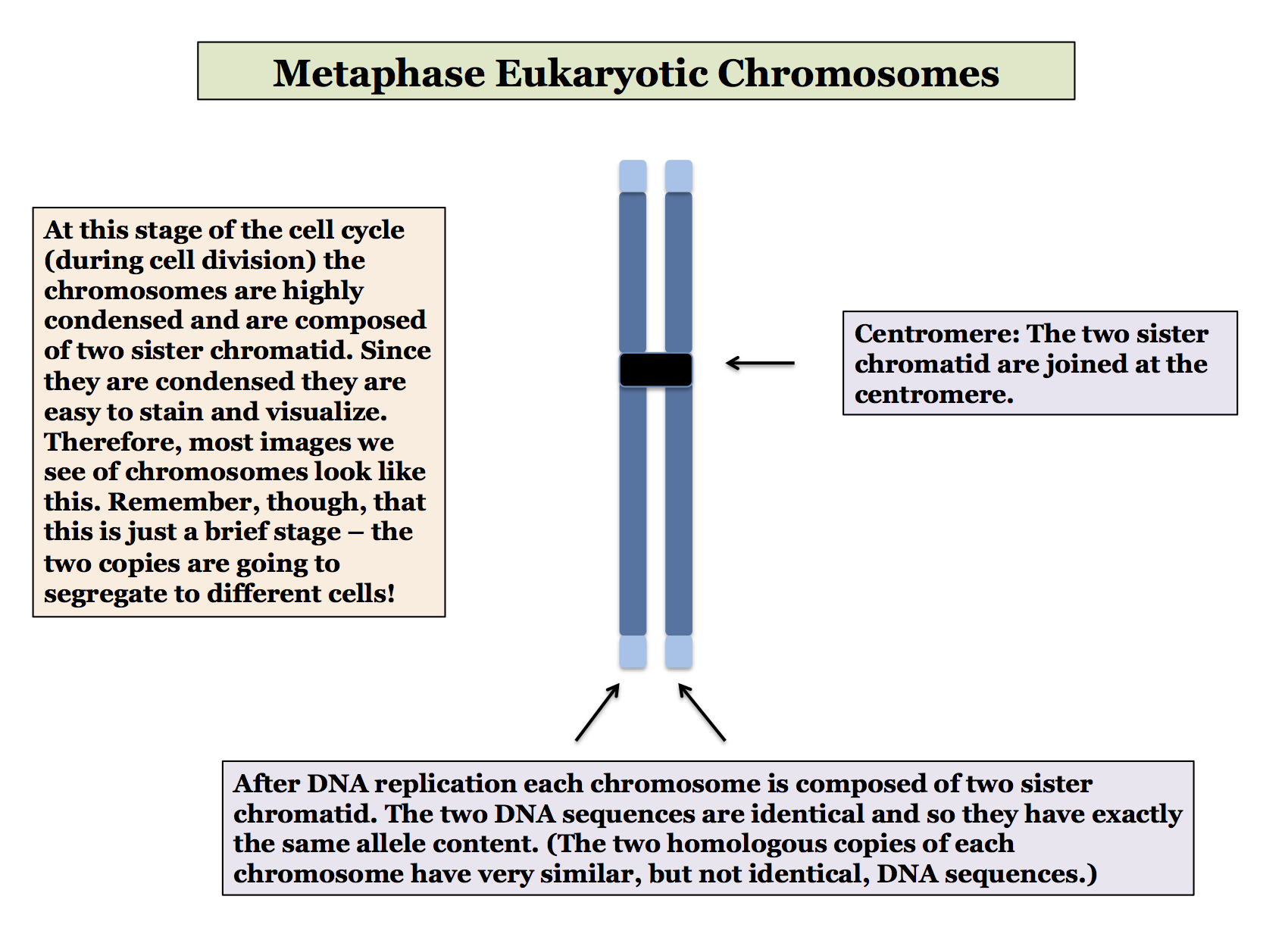
Keep in mind that for much of the cell cycle each chromosome has a single DNA molecule. When the cell beings dividing it replicates each chromosome. The DNA becomes condensed and the two replicates of each chromosome are maintained as a single structure joined at the centromere. This gives the familiar X structure we often see in pictures of chromosomes. This is because the condensed nature of the chromosome at this stage makes it easy to visualize. However, it is just a transient structure!
|
|
Centromere placement
Each chromosome has a centromere, the small region where the spindle attaches during cell division, which is found in a specific location. Depending upon the location of the centromere, a chromosome can be referred to as:
Chromosome arms
The centromere divides the chromosome into two arms, either equal or unequal in length. The short arm is referred to by p and the long arm by q. If the chromosome is metacentric then the designations p and q have been set arbitrarily by geneticists.
We can now refer to a specific chromosome arm by the chromosome number and either p or q. So, 5p is the short arm of chromosome 5.
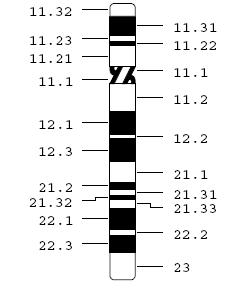
Chromosome arms are further divided by numbers that specify bands as shown here for human chromosome 18.
|
|
We can, therefore, refer to a very specific region, such as 18q22.2. Although this reference is to a specific region you should keep it in mind that a human chromosome has on the order of tens to hundreds of megabase (million) pairs. Therefore, if there were 50 bands (which is a high estimate as you can see from the diagrams) then each band would have several hundred thousand or even millions of base pairs.
The Nature Scitable page on cytogenetics.