Central Dogma
| General Expression | Table of Contents |
The material covered in the section on General Expression involve a significant part of what is known as the Central Dogma of Molecular Biology. First put forward by Francis Crick in 1958, the Central Dogma is often stated as "DNA makes DNA and RNA, and RNA makes Protein". Of course, DNA and RNA are generally just templates for the action of proteins so it might be more accurate to say that "Proteins use DNA to make DNA and RNA, and then Proteins use RNA to make more Proteins."
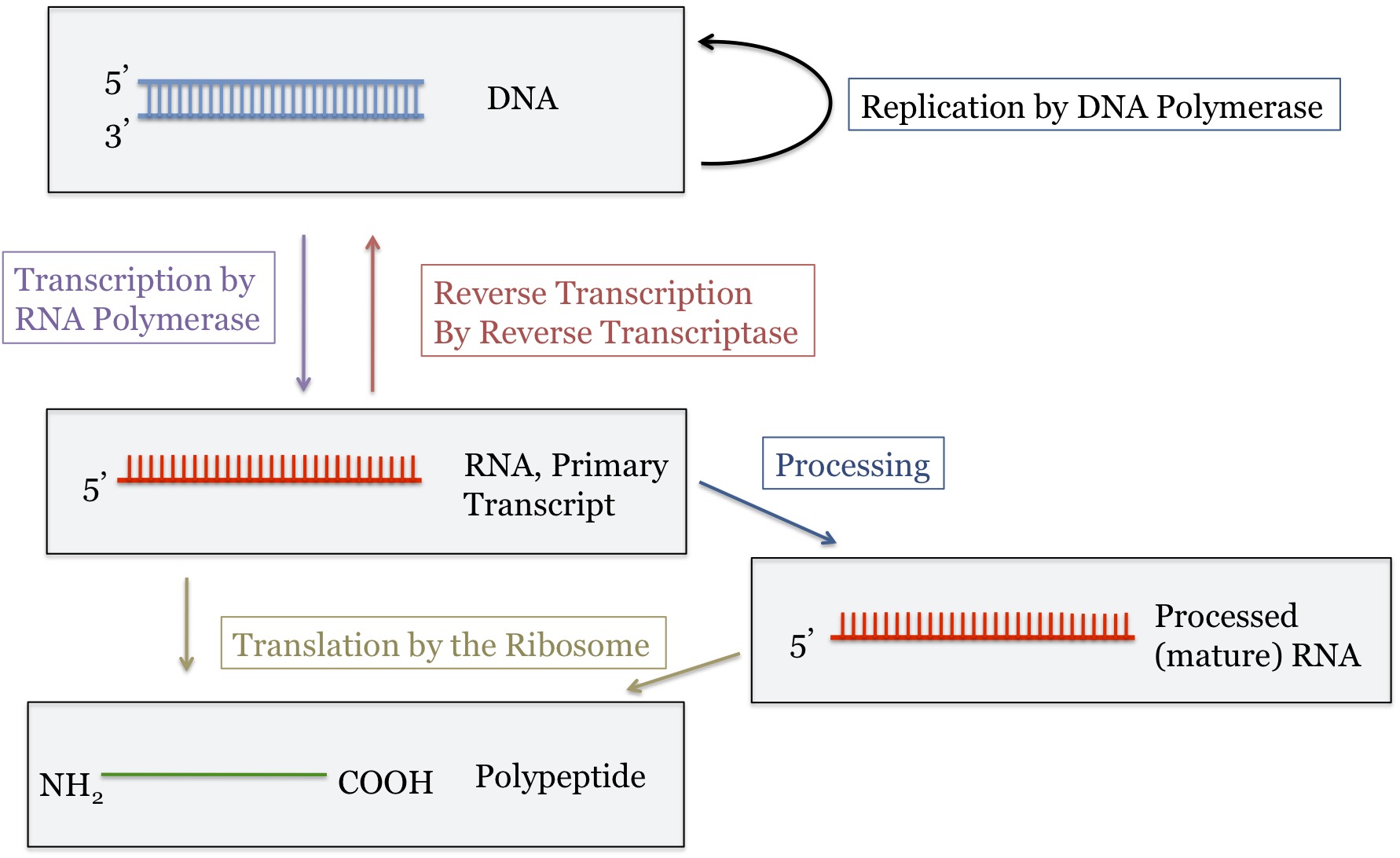
Regardless of these semantics, the major point is that the Central Dogma summarizes what we think of as the flow of information in molecular biology. Information in this context is simply the sequence of nucleotides in a nucleic acid or the sequence of amino acids in a polypeptide: just as different words contain different information for you, the sequence GAT contains different information for a cell than does the sequence GGG. Basically, the information contained in DNA is converted into a sequence of nucleotides (information) in RNA which is then converted into information in the form of an amino acid sequence, or polypeptide. The polypeptide (protein) then folds into a functional form, which can play a role in determining the phenotype of the organism. What we cover in this Topic are the processes that take place during this expression.
It should be stressed that genetics is a lot more than just information in the form of sequences. As geneticists learn more about chromatin structure and how changes in chromosome organization affect gene expression and function, it is clear that such factors play a vital role in genetics. (And, of course, for simplification we are not considering important environmental influences here.) However, sequence is still an important component and so you need to understand the basic concepts of gene expression through the flow of information in terms of sequences.
Since the Central Dogma was first declared its universality has been questioned. The discovery of reverse transcription, in which RNA is used to make DNA, the process of RNA editing and the steps in RNA processing have all added to what we know about this "flow". Overall, the basic concept of the Central Dogma are summarized in this Figure:
|
|
A recent discussion of the Central Dogma and some changes it has undergone can be found here.
Beyond being a good summary and point of introduction, the Central Dogma is not of any great importance today. Since we have discovered many additional processes, and it is likely there are others we have yet to discover, it is not clear how "Central" it really is. However, it is still good to get a general understanding of how the different steps are related to one another so that you can break them down, study them independently, and then put them together into the big picture as it is currently understood. Basically, it remains a good framework for organizing your understanding of this part of genetics.
| General Expression | Table of Contents |