Chromosome Territories
| Chromosome Structure |
If you consider the length of DNA within the nucleus of a typical eukaryotic cell it is quite incredible. The human genome is composed of about 3 billion bases and of course there are two copies of every autosome. Remember that a DNA double helix has 10 bases per twist of the backbone and that each twist is about 3.4 nm in length. This means that there are roughly 0.1 meters of DNA that has to fit into a nucleus that has a diameter on the order of 10um, or 10-6m (and this doesn't even take into account all of the proteins and RNA within the nucleus)!
As a result, eukaryotic chromosomes are highly condensed inside the nucleus. Think of it as similar to cramming a very long piece of string into a relatively small box. If we use the numbers mentioned above it would be a bit like taking a piece of string that stretches from the tip of Manhattan (Battery Park) to the other end (Baker Field of Columbia) and back again - a distance of about 25 miles - and trying to cram it into your backpack. As you might imagine the string would be very balled up.
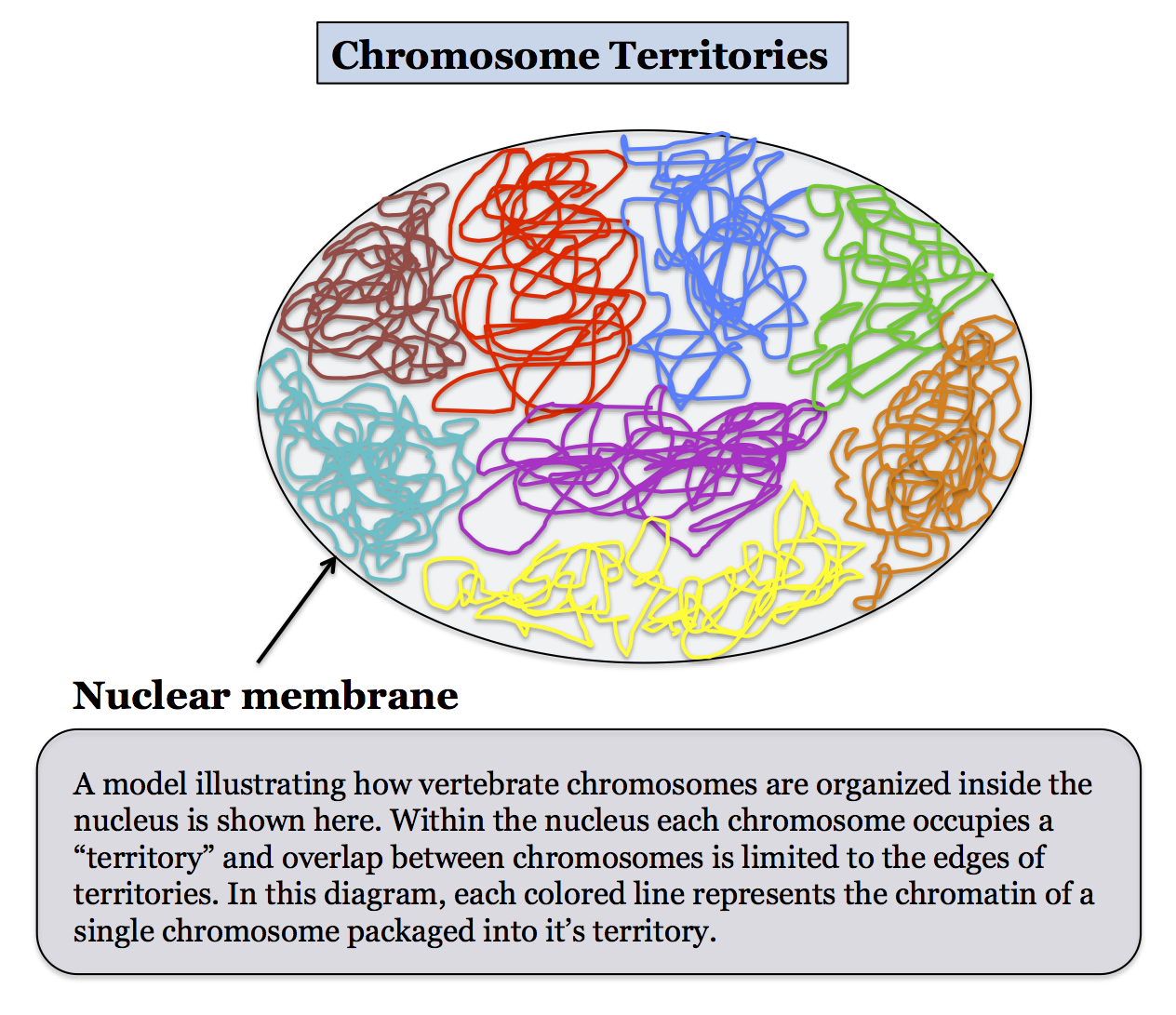
That is essentially the situation inside a eukaryotic nucleus. However, it is very important to understand that the chromosomes are not crammed in randomly. Instead, each chromosome is carefully packaged into a specific region called a Territory. Each chromosome occupies a specific territory and there is little overlap between them as illustrated in the figure here.
|
|
| Chromosome Structure |