Parental Allele Combination
(cis and trans Configurations)
The definition of Parental Allele Combination is given at the end of this page - after we cover the key points! When you are analyzing the inheritance of linked genes you need to know more than simply what alleles an individual carries. When an individual is heterozygous for two linked genes it is critical that you know how the alleles are arranged on the two homologous chromosomes. This is referred to as the allele combination or configuration. The reason it is important to know the configuration is that chromosomes are inherited as a unit and so the arrangement determines what alleles segregate together and, therefore, what alleles are passed together to the progeny.
To see this, consider an organism with the genotype a+ab+b when the two genes are linked. There are two possible ways that the alleles can be configured:
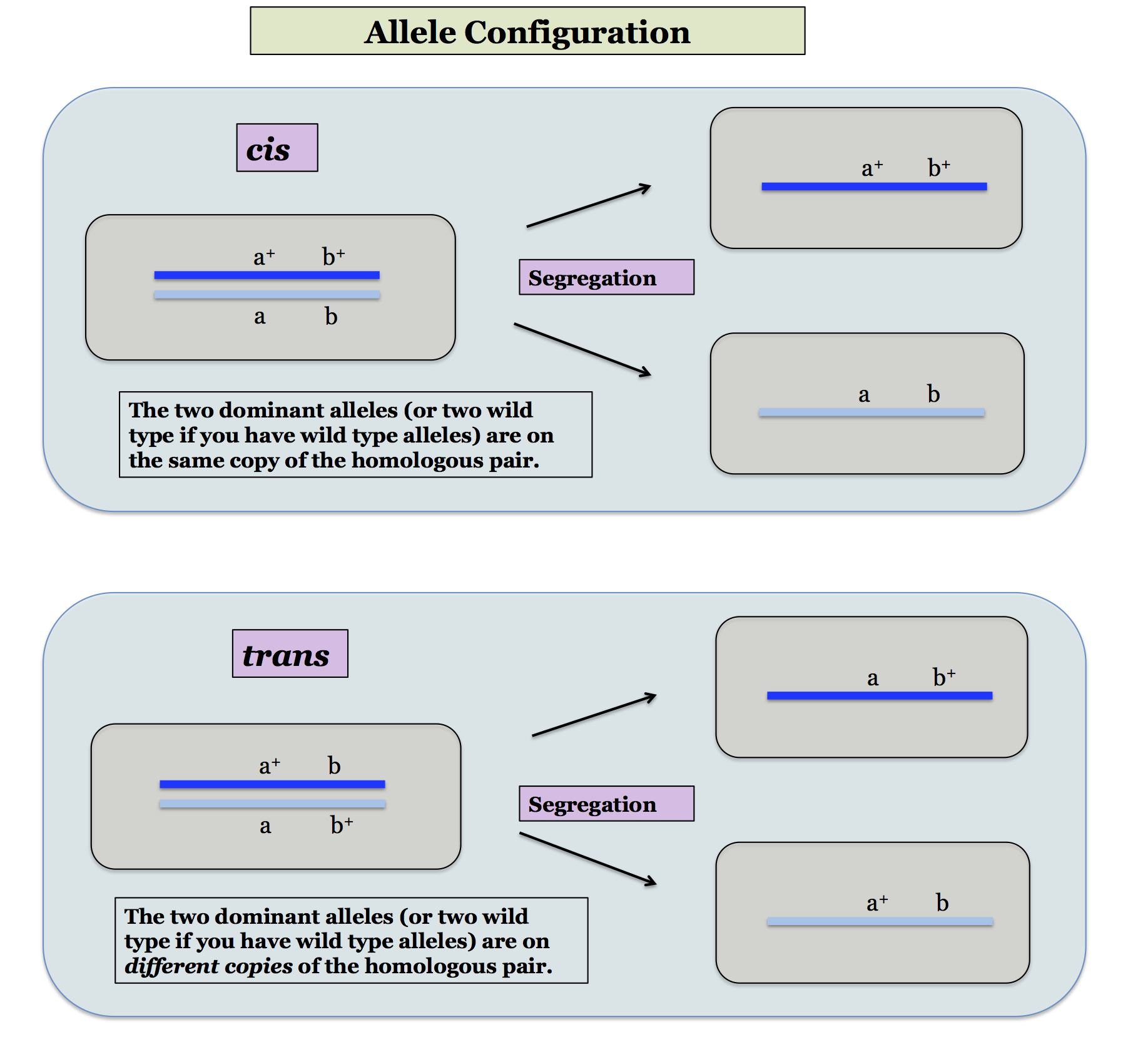
cis Configuration (also known as Coupling). This refers to the situation when an individual with the genotype a+ab+b has the two wild type alleles on the same chromosome. (When wild type is not indicated this configuration is when two Dominant alleles are on the same chromosome.)
trans Configuration (also known as Repulsion). This refers to the situation when an individual with the genotype a+ab+b has the two wild type alleles on different chromosomes.
These are diagrammed in the next figure. The gametes that are generated in each case are shown on the right: notice that they are different in the two cases - this is the key point and it is discussed further below.
|
|
If we wish to write this out in text we could write the two configurations as shown here.
a+ b+/a b (cis)
OR
a+ b/a b+ (trans)
In this notation, the two alleles on one copy of the chromosome are given on the left of the / and the two alleles on the other copy are given on the right.
The two configurations have the same genotype (a+ab+b) and will produce the same phenotype, but the fact that they produce different sets of gametes is very important. As seen in the figure above, when alleles are in cis configuration a+ and b+ will be inherited together since they will segregate to the same gamete during meiosis. At the same time, ab chromosomes will be inherited as a unit. When there alleles are in trans configuration, a+b chromosomes will segregate from ab+ chromosomes, so the gametes will be different from those generated from the cis configuration.
Therefore, it is critical to know the allele arrangement for linked genes. You need to know this arrangement to predict progeny genotypes. In other pages within the Linkage section you will learn how to apply this concept. For now, make sure you see why understanding configuration is important and why configuration determines the gametes generated.
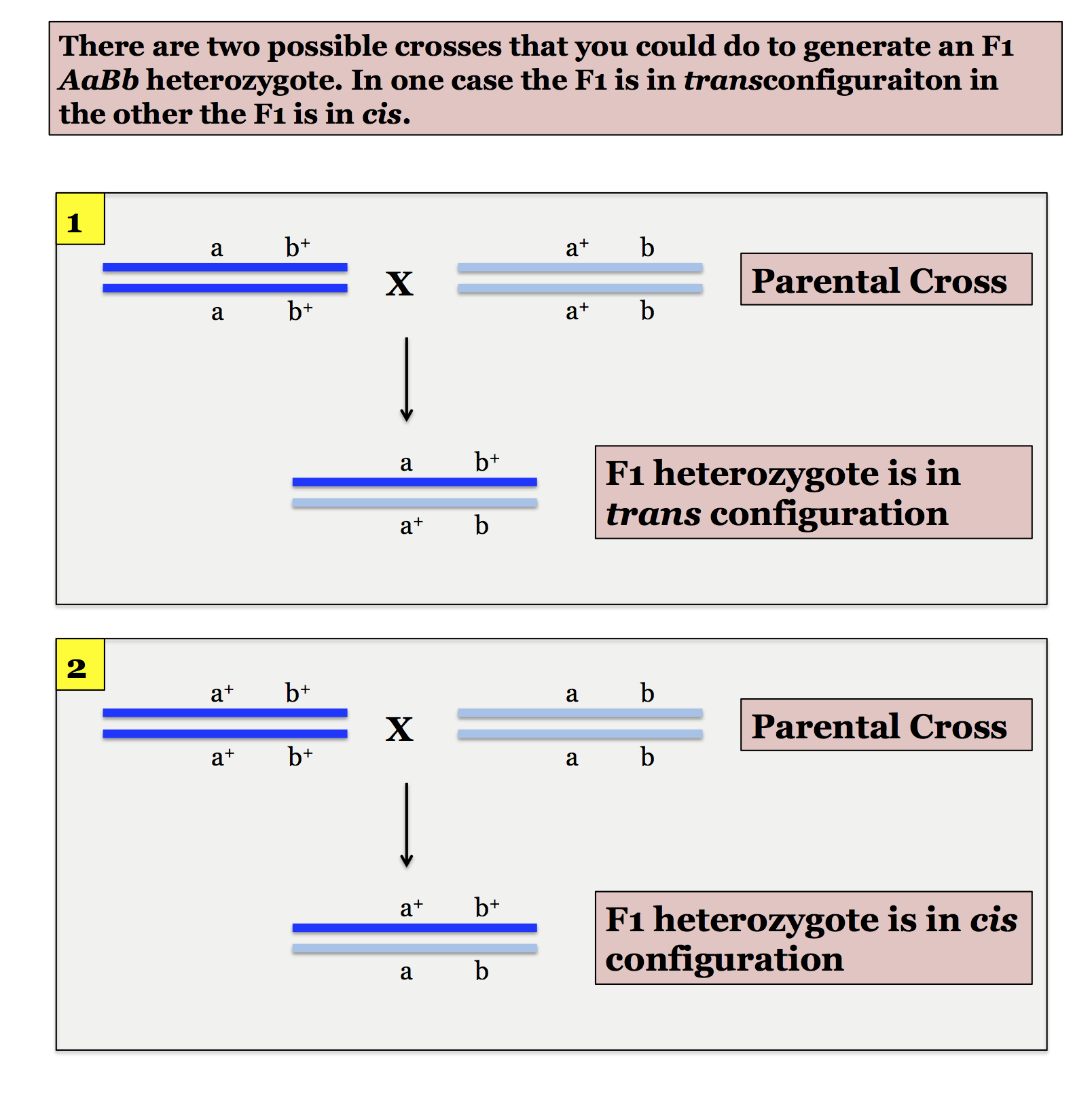
You may be curious how these different configurations arise, that is, why a heterozygote is in cis as opposed to trans configuration. In fact, the configuration of a heterozygote is determined by the genotypes of the parent of that heterozygote:
|
|
Therefore, when dealing with linked genes you can either figure out the combination (if you know the parental cross), or you will be told the configuration in any question you are dealing with. If you don't know the configuration then you are very limited in what you can tell from a cross involving linked genes.
Parental Allele Combinations
We can now define this key term. As we have seen, the allele configuration (combination) in a heterozygote is determined by the chromosomes inherited from the cross that generated that heterozygote. This original cross is called the Parental Cross. The allele combinations in this cross are called the parental combinations (there are always two parental allele combinations in diploid species since there are two copies of each chromosome). The heterozygote will have one chromosome with the first parental allele combination and one with the second parental combination. In any further cross with this heterozygote these two combinations will be referred to as Parental.
Table of Contents