Crossing Over
Genes on the same chromosome will segregate as a unit since it is chromosomes that segregate during meiosis. Therefore, if we know what alleles are together on the same copy of a homologous chromosome (see the page on allele configurations if you want to review this) we can easily predict what allele combinations would be passed on to progeny. So, linked genes are easy to deal with in some ways. However, during meiosis in most eukaryotic organisms a process known as Crossing Over occurs that swaps some of the alleles on the two copies of homologous chromosomes. This results in recombination which is the generation of novel, non-parental, allele combinations. Therefore, we have to learn how to incorporate recombination into our understanding of the inheritance of linked genes.
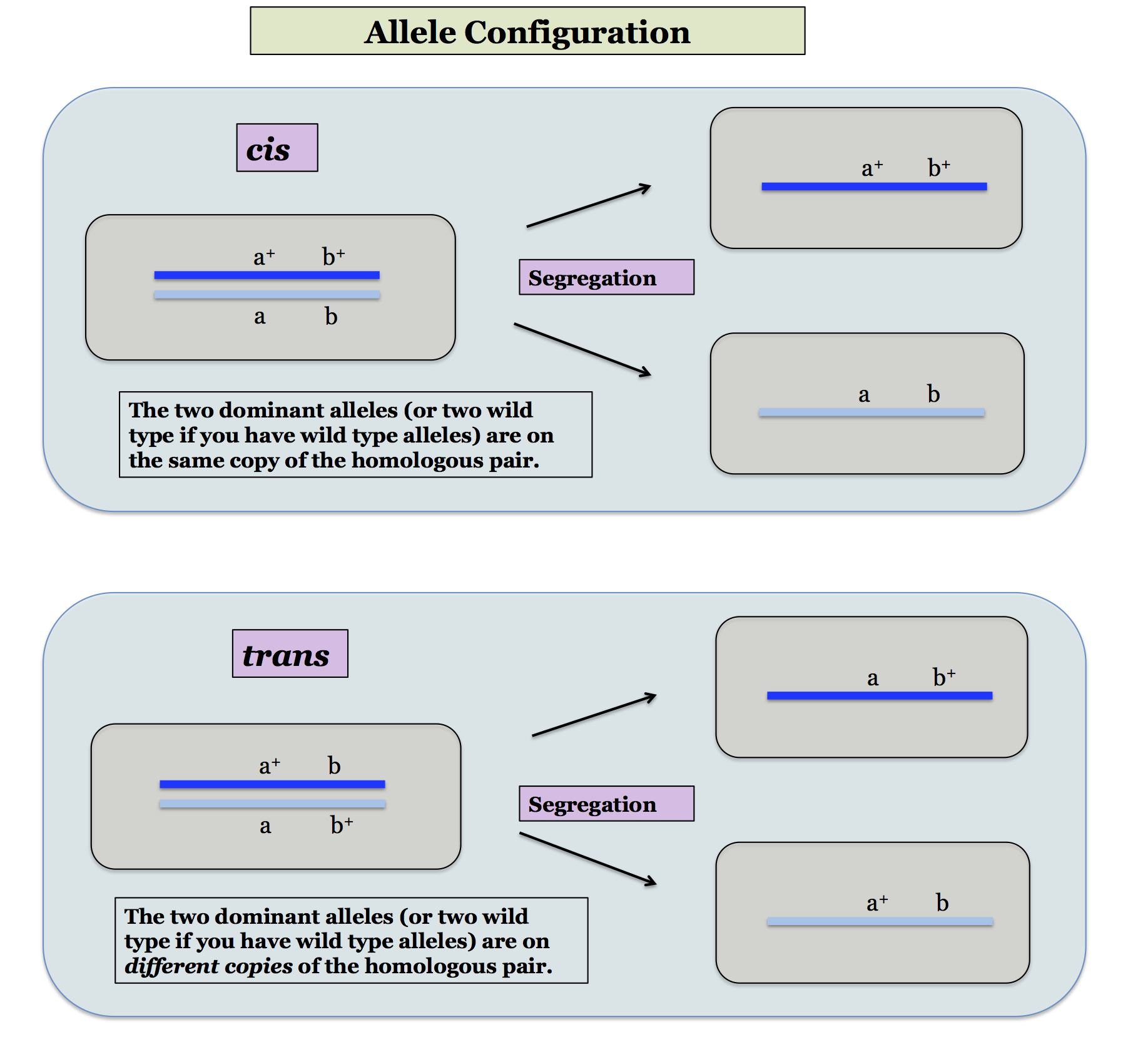
In the absence of Crossing Over, when cells in an individual with the genotype A B/a b (i.e. in cis Configuration) undergo meiosis, only [A, B] and [a, b] gametes are produced. This should make it easy for us to predict genotypes of progeny. The following figure from another page makes this point. (If we are dealing with wild type alleles then a+ b+/a b is the cis configuration.
|
|
Parental allele combination: This is covered on another page if you want to review it. Basically, when you have a an individual who is heterozygous for two linked genes, that individual is either in cis or trans configuration. In dealing with progeny of this individual, the two allele combinations in the heterozygote are defined as parental. For example, in the case of a heterozygote in cis the parental combinations are AB and ab.
Crossing Over
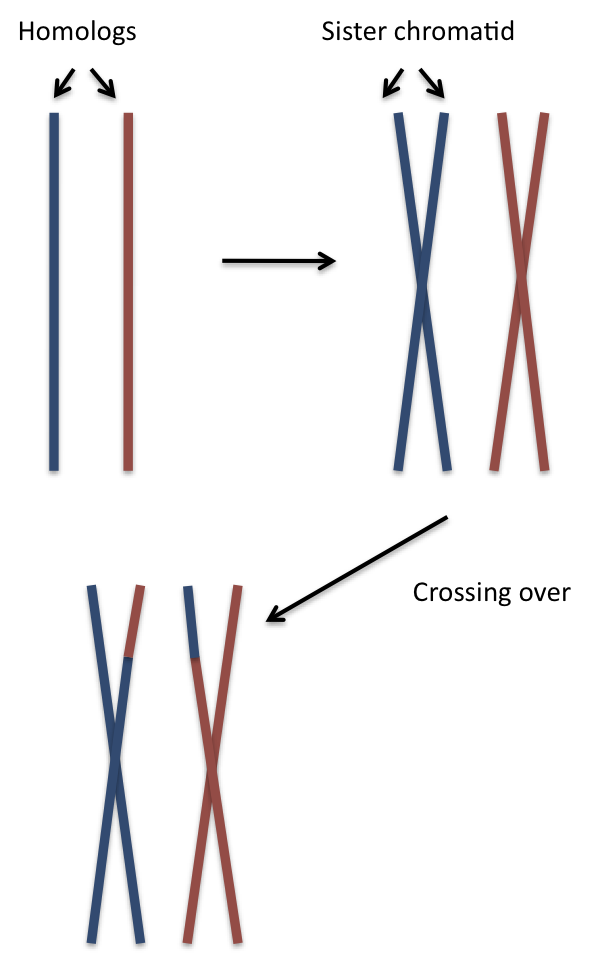
During meiosis in most eukaryotes, homologous chromosomes undergo Crossing Over at random points. Crossing over involves the reciprocal exchange of DNA between non-sister chromatids as shown here:
|
|
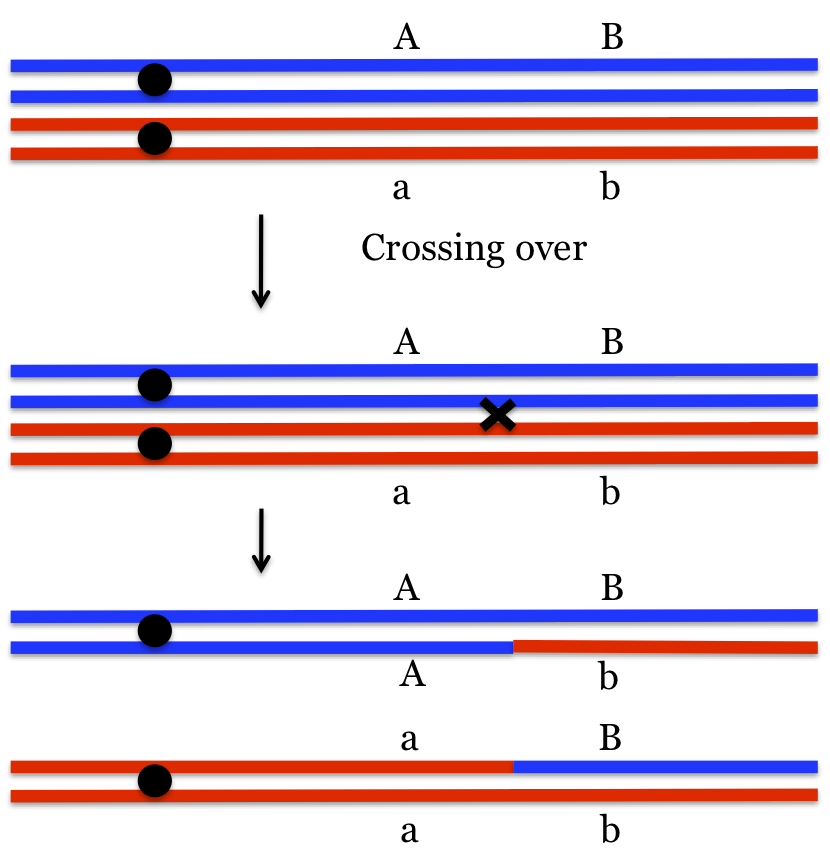
Remember that the chromosomes have undergone replication after which the homologous pairs have aligned, so all four chromatids are lined up. The crossover only involves two of the four chromatids.
If a crossover happens to occur between two genes for which an individual is heterozygous then recombinant (i.e. non-parental) gametes will be produced:
|
|
Once the 4 chromatids have all segregated, the 4 gametes will be:
Of course, if the crossover occur at a point outside of the area between the two genes, or if no crossover occurs, then only parental gametes will be produced. In this case each of the two parental allele combinations will make up 50% of the gametes.
Since the process of crossing over results in some recombinant gametes, the big question is - How do we deal with recombination when predicting progeny genotypes? This is covered on other pages within the Linkage section.