Double Helix
| DNA Structure | Table of Contents |
Nucleic acid can exist in either a single-stranded or a double-stranded for,. In cells, RNA frequently exists in the single-stranded form while DNA usually exists in the double-stranded form. These are only common states, though, not exclusive states.
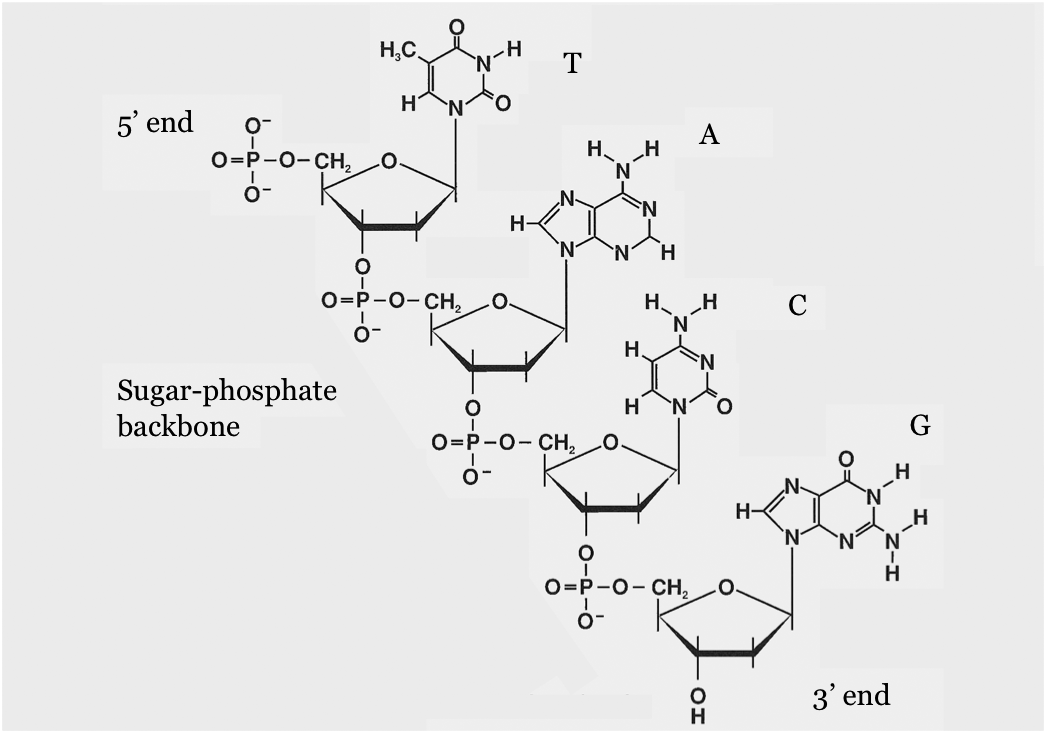
Single-stranded nucleic acid: Nucleic acid is a polymer of nucleotides that are joined by phosphodiester bonds. A phosphodiester bond is formed between the 5' phosphate group of one nucleotide and the 3' OH group of another. The result is a structure with a negatively-charged sugar-phosphate backbone and exposed bases:
|
|
A very important thing to remember is that a single-stranded nucleic acid molecule has polarity. One end has an exposed 5' Phosphate (the upper left in the figure above) while the other end has an exposed 3' OH (the lower right in the Figure). Therefore, if we follow the molecule from the upper left to the lower right we are going in the 5' to 3' direction while if we go from the lower right we are going in the 3' to 5' direction.
This is critical because if we want to refer to the sequence of nucleotides in the strand (by the sequence of bases in the corresponding nucleotides) then the sequence is different depending upon the direction. In the figure above, the sequence in the 5' to 3' direction is TACG while in the 3' to 5' direction it is GCAT. Therefore, it is critical that you give the direction of the strand when you are giving the base sequence. For reasons that will become obvious we usually give the sequence in the 5' to 3' direction.
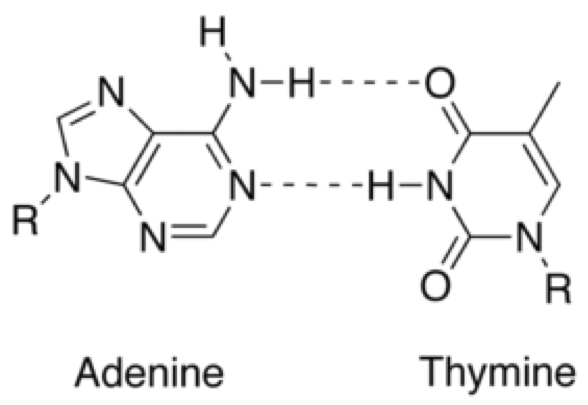
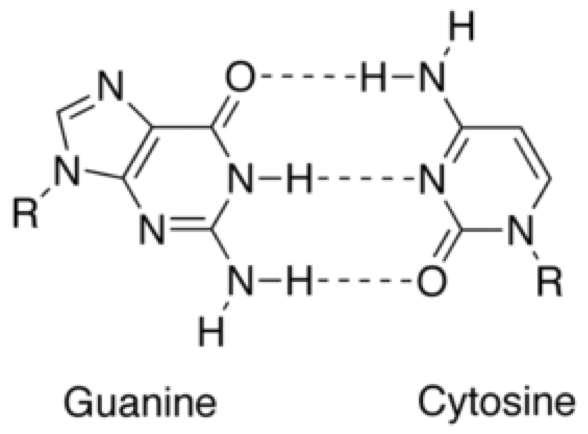
Double-stranded nucleic acid: Double-stranded nucleic acids result from the formation of hydrogen bonds between bases. When two bases are joined by hydrogen bonds they form a base-pair. The base-pairs found in DNA are referred to as Watson-Crick base-pairs and they are A-T and G-C.
|
|
|
|
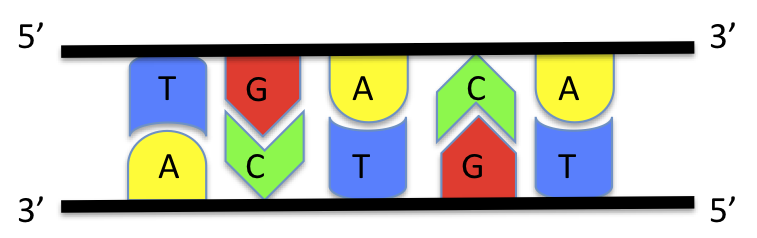
Two single-stranded nucleic acid molecules can form a double-stranded structure when they are complementary. If the two molecules are laid alongside one another in antiparallel configuration (meaning one strand runs 5' to 3' and the other runs 3' to 5'), and there is an A opposite each T and a G opposite each C then the strands are complementary.
|
|
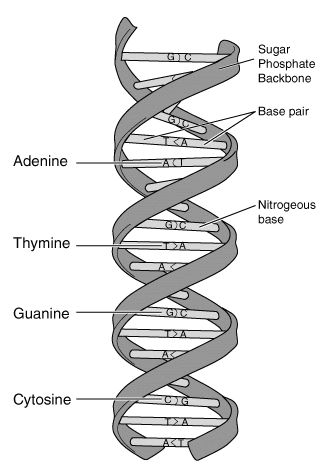
Two complementary strands will naturally form a double helix structure with the sugar-phosphates on the outside and the base-pairs on the inside. Although we often say that two strands must be complementary, it is possible for two strands that are not 100% complementary to form a double helix. Some degree of mismatch is acceptable, a mismatch being a non-Watson-Crick base-pairing such as A-G. This affects the stability of the double-stranded molecule but there need only be enough matches to keep the strands together. This stability is covered more in the section on melting temperature.
|
|
What is shown here is the B form of DNA. In B form DNA there are 10 base-pairs per helix rotation and this is the structure that is generally formed by double stranded DNA in the cell. Double-stranded DNA can form other structures depending upon specific conditions; in low aqueous conditions it takes on the A form while certain skewed base compositions result in the Z form.
| DNA Structure | Table of Contents |