Transcription Initiation in E. coli
| Prokaryotic Transcription | Table of Contents |
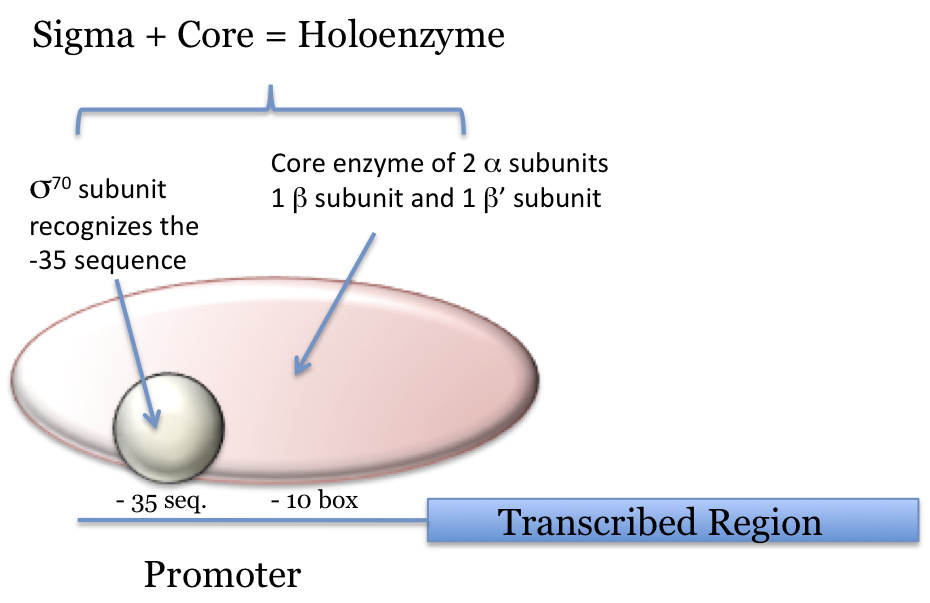
The E. coli RNA polymerase Holoenzyme consists of a Core enzyme bound to a sigma subunit. The Core is composed of two alpha subunits, one beta subunit and one beta' subunit. As discussed in the section on gene regulation, there are actually several different sigma subunits in E. coli. It is the sigma subunit that confers promoter recognition on the Holoenzyme; the Core alone binds to DNA randomly. The sigma subunit specifically recognizes the -35 sequence as shown here; in this case I have diagrammed the sigma-70 subunit which recognizes the consensus sequence shown below. This is the promoter sequence for the majority of genes and thus the Holoenzyme with sigma-70 is responsible for transcription of most genes. Other sigma subunits are utilized in specific conditions as discussed elsewhere under Alternate Sigma Factors.
|
|
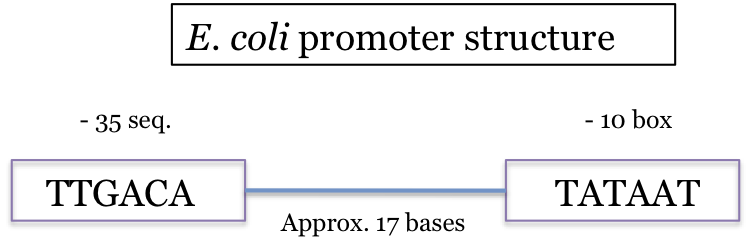
The general structure of the E. coli promoter which is recognized by the sigma-70 Holoenzyme is shown here. It consists of two short sequences that are roughly 17 bases apart. The consensus sequence of each is shown in the figure but the specific sequence varies a bit from one promoter to another. There is a rough correlation between the similarity of a given promoter to the consensus sequence and the frequency with which RNA polymerase binds.
|
|
Once the Holoenzyme has bound the promoter through the sigma-70:-35 interaction, the double-stranded DNA molecule is separated in the region of the -10 box. This separation generates a "bubble" which allows the template strand to be utilized by RNA polymerase. The first nucleotide is incorporated at the +1 site (by definition) which in most transcribed regions is a purine (and, of course, is about 10 nucleotides downstream from the -10 box). The sigma subunit is released and the Core enzyme can continue with Elongation.
| Prokaryotic Transcription | Table of Contents |