Transcription Termination in E. coli
| Prokaryotic Transcription | Table of Contents |
In E. coli transcription terminates by either a Rho-independent process or a Rho-dependent process. As you might suspect, the former does not require the action of the Rho protein while the latter does.
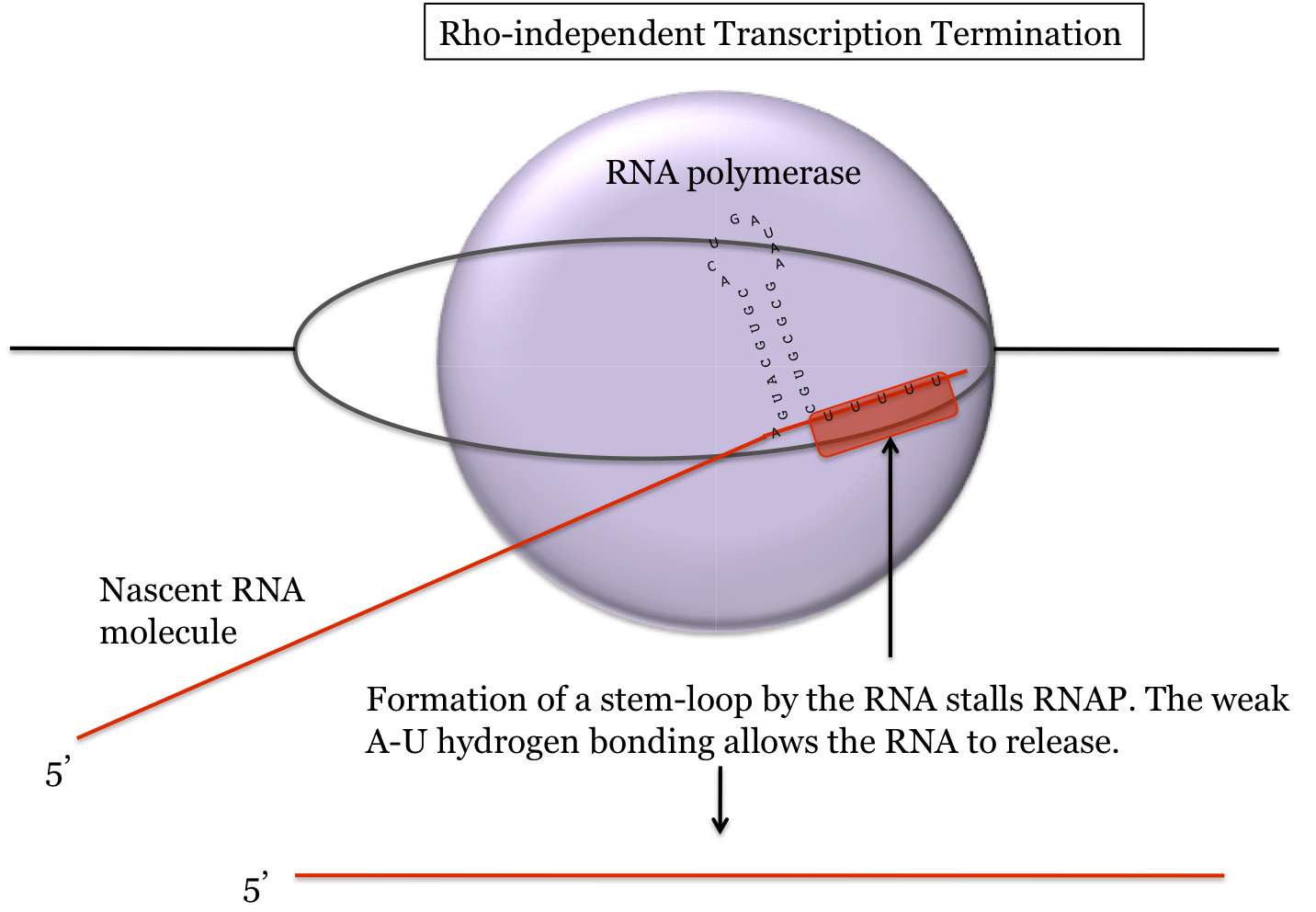
We will start with Rho-independent transcription termination. This process is based on the formation of a stem-loop secondary structure by the RNA molecule. This, of course, requires that the RNA has a sequence that is capable of forming such a structure. In addition, the process requires a U-rich region in the RNA just downstream from the stem-loop.
As the region is transcribed and is exposed in the RNA it will fold up into the secondary structure as shown. This causes the RNA polymerase to pause at which point the U-rich region is the section that is H-bonded to the template. This is a weak interaction (since A:U has only 2 H-bonds) and so the RNA molecule is released during the time that the polymerase is paused.
|
|
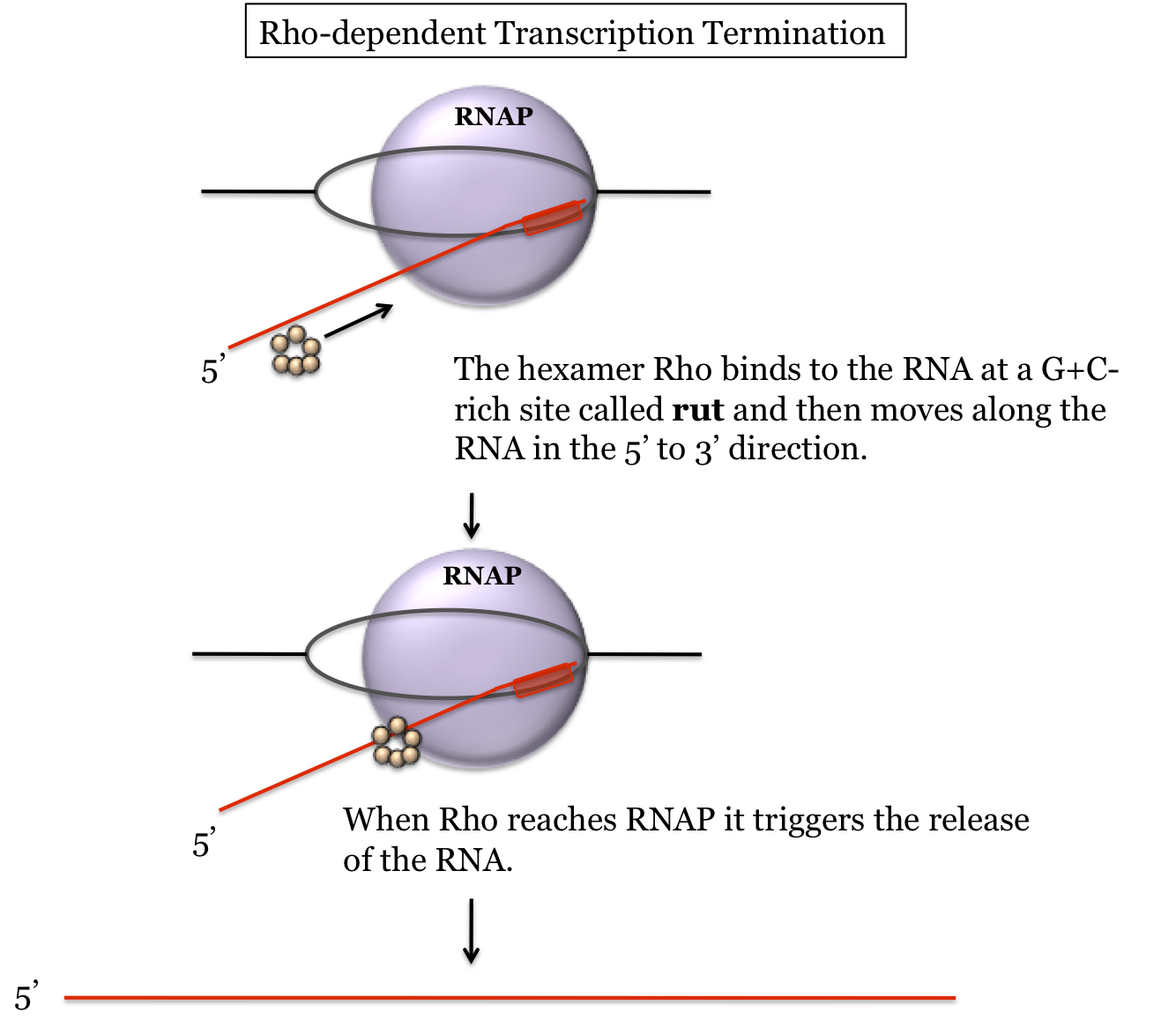
In Rho-dependent transcription termination the RNA molecule has a sequence called rut (for Rho UTilization). When this sequence has been transcribed and is "free" it is bound by the protein Rho which is a hexamer. Rho then utilizes ATP for energy to move along the RNA (although it is not diagrammed due to artistic limitations it actually rolls up the RNA as it moves, akin to a spool with thread). Rho eventually catches up to the RNA polymerase at which point it causes termination.
|
|
| Prokaryotic Transcription | Table of Contents |