Environment and Phenotype
| Intro to Mendel | Table of Contents |
The environment that an organism is exposed to during its lifetime can play an important role in the phenotype that it develops. The fact that the Phenotype results from an interaction between the genotype of an organism and the environment is usually expressed in the following way:
|
|
In introductory genetics courses such as ours we generally do not discuss environmental effects in much depth. A major reason for this is that they can be extremely complex and are often poorly understood and so we ignore them in order to simplify the study of the genetic aspects. This is beneficial for developing an elementary grasp of the field but it is important not to forget that the environment often plays a crucial role in the development of the phenotype.
Here we will limit our study of environmental effects to two basic concepts that are frequently mentioned.
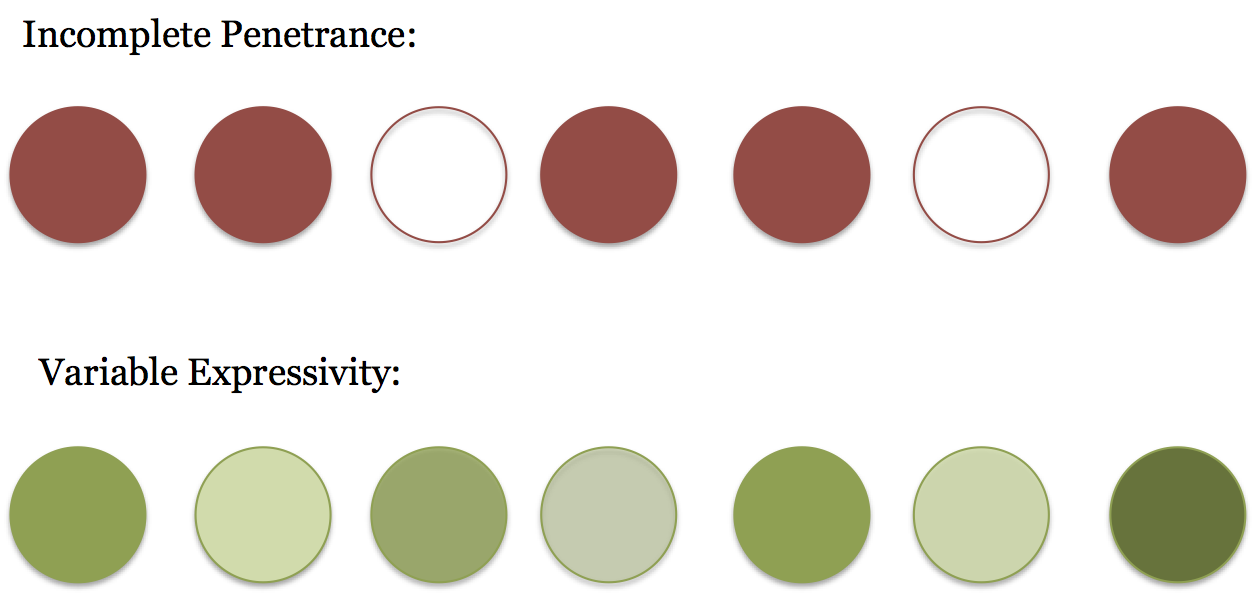
Penetrance: When less than 100% of individuals with a particular genotype manifest the phenotype that we associate with that genotype then we refer to the trait as having incomplete penetrance. Thus, is we associate red flowers with the genotype A1A1 and in a study of 100 plants with that genotype we observe that only 85 have red flowers while the others have white flowers, we would say that the red flower trait displays incomplete penetrance. More specifically we could say that it displays 85% penetrance.
There are two general reasons that a trait can display incomplete penetrance. One is that there are environmental factors that affect the development of the phenotype and so we observe variation as a result of the different environments that the organisms are exposed to. Understanding what these environmental factors are can be very difficult. However, there are some well know examples. One is Phenylketonuria (PKU) which is a metabolic disorder. Individuals who are homozygous for a particular amorphic allele for the gene that codes the enzyme phenylalanine hydroxylase are unable to process the amino acid phenylalanine. As this amino acid builds up in the system it is converted to phenylpyruvate and this can eventually lead to serious medical conditions including mental retardation. However, individuals with this genotype can eat a diet that limits the amount of phenylalanine ingested and as a result they do not develop these effects. In this example diet is an environmental factor that affects penetrance.
A second general reason is that there are sometimes other genes that we are not yet aware of that affect the phenotype we are studying. So, all individuals might be A1A1 but there might be a second gene, we will call it B, that we have never studied but that also contributes to the development of the trait. As an illustration of what can occur in this kind of situation let us say that there are two alleles for this gene, B1 and B2. If individuals with an A1A1 B1B1 genotype have red flowers but individuals with an A1A1 B2B2 genotype have white flowers then we will observe incomplete penetrance among A1A1 individuals. In the future, when we study the B gene it will alter our understanding but without knowledge of how this gene affects the trait we are studying we will just see incomplete penetrance among A1A1 individuals.
Expressivity: This refers to situations when a trait displays a gradient of phenotypes among individuals with the same genotype. So, instead of individuals with, say, the A1A1 genotype having red flowers, these individuals show a variety of shades of red. This trait then shows varied expressivity. As with penetrance, this could be due to complex environmental factors or the effects of other genes that we do not yet understand (or, most likely, a combination of these two things).
The difference between penetrance and expressivity is illustrated in this diagram:
|
|
| Intro to Mendel | Table of Contents |