Eukaryotic Chromosomes
| DNA Structure | Table of Contents |
Introduction
Each eukaryotic chromosome is composed of a long double-stranded DNA molecule that is complexed, or packaged, with numerous other molecules of protein and RNA. Altogether, the DNA and these associated protein and RNA molecules make up chromatin which is the constituent material of a eukaryotic chromosome. (The difference between the terms chromosome and chromatin is like the difference between the words road and asphalt. A chromosome is like a road, it is the overall 'thing'. Chromatin is like asphalt; it is the constituent material that makes up the chromosome or road.) In this section we will examine the basic structural features of chromosomes and chromatin.
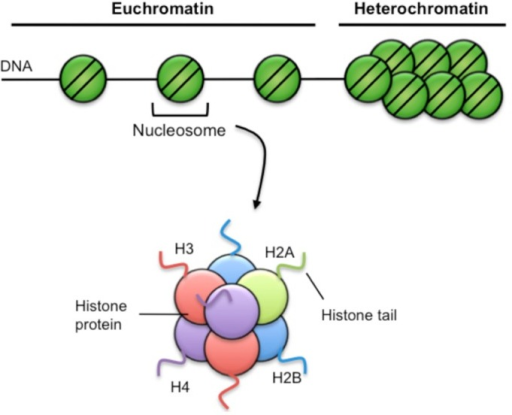
Chromatin takes on two general forms, heterochromatin and euchromatin. Heterochromatin is more condensed, meaning that the DNA is tightly packaged with other chromatin constituents. Because it is more condensed, the DNA in heterochromatin is less accessible to other molecules, such as proteins that are involved in replication or transcription. Heterochromatin is what we generally observe in gene-poor sections of chromosome and is the structure that is generally associated with a lack of gene expression. In euchromatin the DNA is loosely packaged and relatively accessible. Regions of a chromosome that contain actively expressed genes are generally made up of euchromatin. Details on how the DNA is packaged, and how heterochromatin is more condensed than euchromatin, can be found below.
Whether a chromosome region is made up of heterochromatin or euchromatin can change over time. Some sections of chromosome are always heterochromatin - we refer to these regions as constitutive heterochromatin. Other sections can change from euchromatin to heterochromatin and vice versa. These regions are referred to as facultative heterochromatin. Changes in chromatin structure play an important role in genetics, particularly in the area of gene expression. Later in the course we will see how cells can regulate expression by changing chromatin structure.
Chromatin structure
The following are the important features of chromatin and/or chromosome structure in eukaryotes. Further details on each are provided at the links.
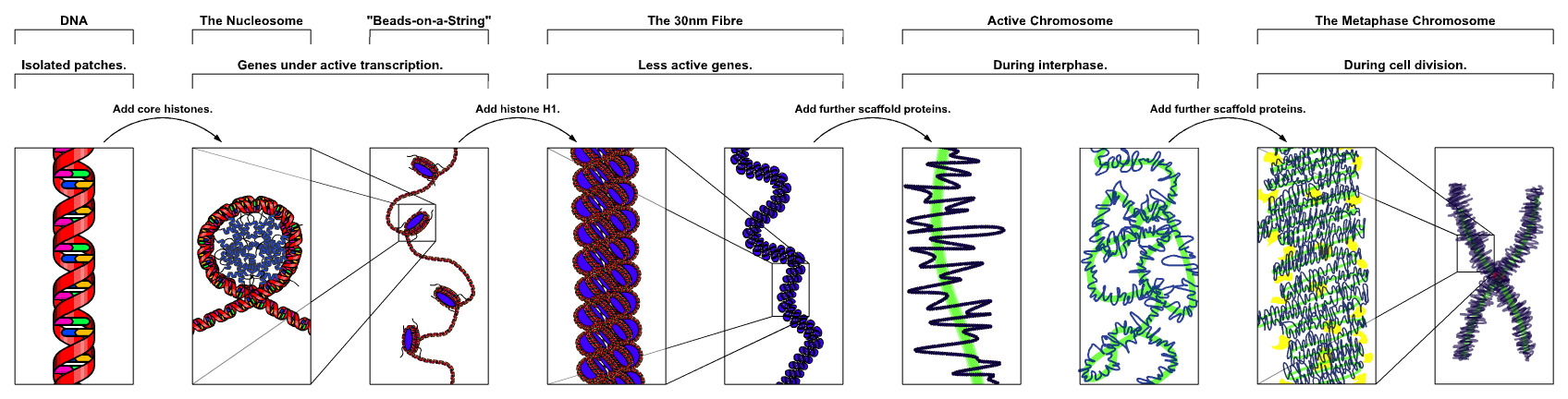
Almost all DNA in eukaryotic chromosomes is packaged into nucleosomes. A nucleosome is composed of a short section of DNA wrapped around a core of histone proteins (see details at the link). Chromatin in this form is sometimes called 10nm fiber since the diameter of a nucleosome is 10nm.
There is some evidence that nucleosomes can be folded into a 30nm Fiber (Solenoid) structure as a result of the action of the histone H1 protein. This is thought to be a structure found in heterochromatin but probably not in euchromatin. 30nm fiber has been observed in vitro in chromatin extracted from cells but there is still some controversy about whether chromatin inside the nucleus actually forms this structure or if it an artifact of the extraction process.
Chromatin contains non-histone proteins, sometimes called scaffold proteins, that function to form higher level structures. This is a bit of a hodgepodge term that covers a lot of things. One of these, which is the one you will probably see most commonly diagrammed in various genetics texts, is the further condensation, or folding, of 10nm or 30nm fiber (or both) into a denser mass of chromatin. Most details of how this folding occurs and the structural features that result are still unclear. Not all chromatin is condensed this way, it is observed in heterochromatin regions; the DNA is essentially highly packaged and not as accessible as when it is relatively unfolded. Actively expressed regions remain unfolded to facilitate the binding of proteins.
Another thing that the term higher level structures covers is the overall organization of chromosomes within the nucleus. Even during interphase chromatin is not randomly strewn around. Instead, it has become increasingly clear in recent years that chromosomes are arranged within the nucleus in a highly regulated manner. There are non-histone proteins that function to make sure that each chromosome section is in the right location and to facilitate specific interactions between distant regions of chromosomes. Details about this type of chromosome organization are covered at this link.
The following diagram, from the Wikipedia page on chromatin (license), relates the different levels of chromatin packaging. Notice that the scaffolding indicated is the first higher level structure discussed above - the further condensation of 30nm fiber in heterochromatin.
|
|
The following diagram is from Open NCBI (license). It shows the relationship between nucleosomes and 30nm fiber and how this is related to euchromatin and heterochromatin.
|
|
Centromere and Telomeres
There are also two important parts of every eukaryotic chromosome, centromeres and telomeres. These regions are made up of heterochromatin but have additional features covered here:
| DNA Structure | Table of Contents |