Eukaryotic RNA PolII Promoters
| Eukaryotic Transcription | Table of Contents |
The three RNA Polymerases in Eukaryotic cells have slightly different processes of transcription initiation and the promoters are different for each. Everything that we cover will be transcription by RNA PolII, which transcribes nuclear pre-mRNAs. The promoter for RNA PolII transcription is much more complex than the E. coli promoter. For one thing, over the past few years it has become well established that there are several general types of promoters in eukaryotes and that there is variation in structure within the types and among major lineages of eukaryotes. The material in this section is based on vertebrate promoters. The basic concepts and general structure are applicable to eukaryotic promoters but some specifics differ in other lineages.
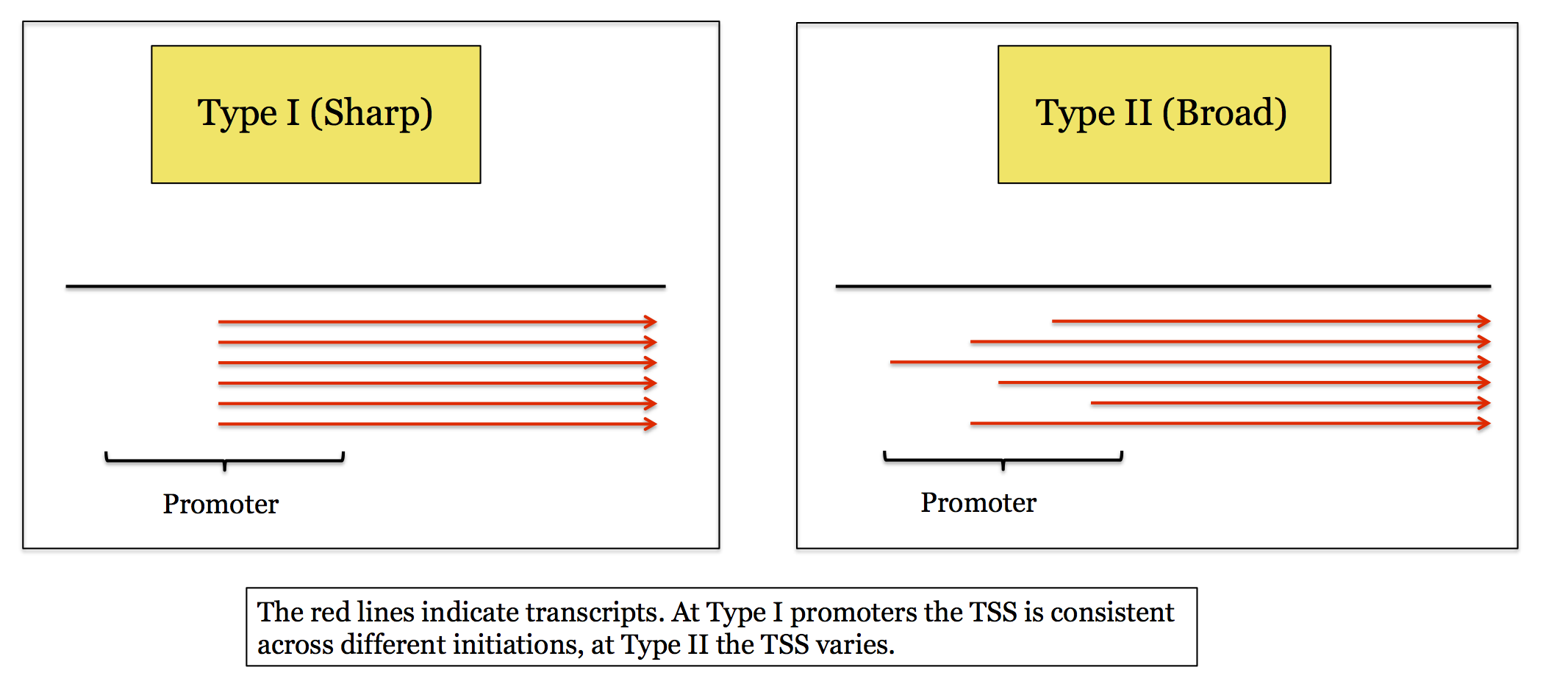
Although there is still some debate about how to classify the diverse eukaryotic promoters that are being discovered, two general types have become well established:
|
|
Not all eukaryotic promoters fall into one of these two classes but the vast majority of genes have a promoter that is Type I or Type II. (The other types that are being uncovered by research appear to control a minority of genes.) Notice that the two types are associated with classes of genes that are regulated quite differently; Type I promoters are associated with regulated genes while Type II promoters are associated with genes that are not really regulated but, instead, constitutively expressed.
Although a large fraction (about 70%) of vertebrate genes appear to have a Type II promoter, most of the work to date on eukaryotic promoters has been on Type I promoters. Since this is the promoter that is most commonly presented in genetics textbooks it is the type that we will cover here. Type II promoters are quite different and are not nearly as well understood. They have a few similarities with Type I but overall the two types share few common features. Many of the differences appear to be in how nucleosomes are arranged near the TSS and what epigenetic markers are found these, not just in the sequence of the promoter itself. Given the current uncertainties about them we will not cover Type II promoters further.
Type I Promoters: The Core and Proximal Promoters
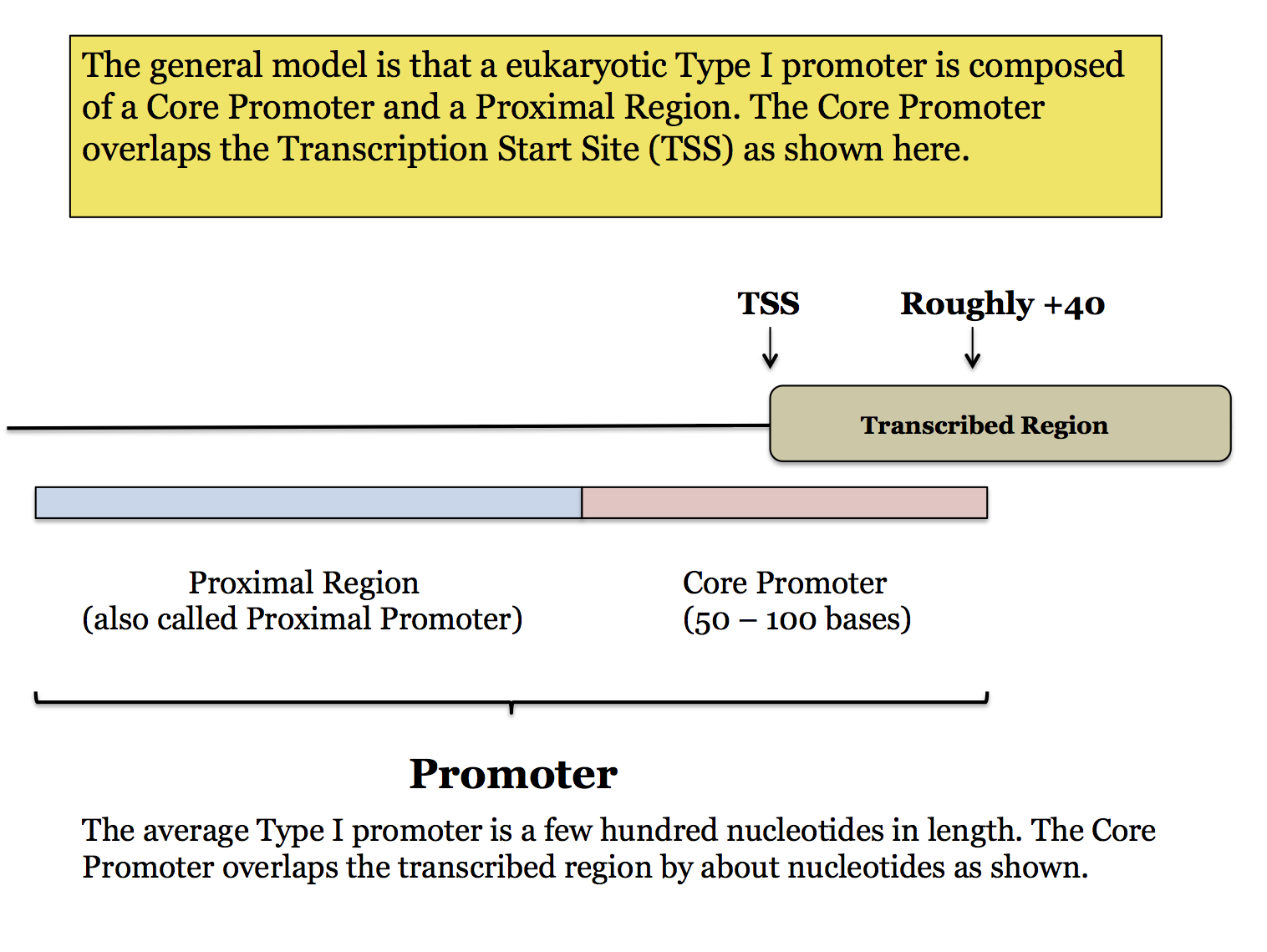
We start with the general structure of a Type I promoter which is shown below. The promoter itself is divided into two regions, the Core Promoter and the Proximal Promoter (or Proximal Region). As shown in the figure the Core Promoter is typically between 50 and 100 nucleotides in length and overlaps with the Transcription Start Site (the +1 nucleotide). The Core Promoter is where the General (or Basal) Transcription Factors bind to recruit RNA PolII for transcription initiation as covered in the section on transcription initiation.
The Proximal Promoter is immediately upstream from the Core Promoter and typically contains several Transcription Factor Binding Sites (TFBS) that play a role in regulation. It is important to note that there are many distal TF binding sites outside of the Proximal Promoter that play a role in regulation; these other binding sites are covered in the section on Eukaryotic Gene Regulation.
The main focus here will be on the structure of the Core Promoter. At the end we will briefly discuss the Proximal Promoter.
|
|
Core Promoter
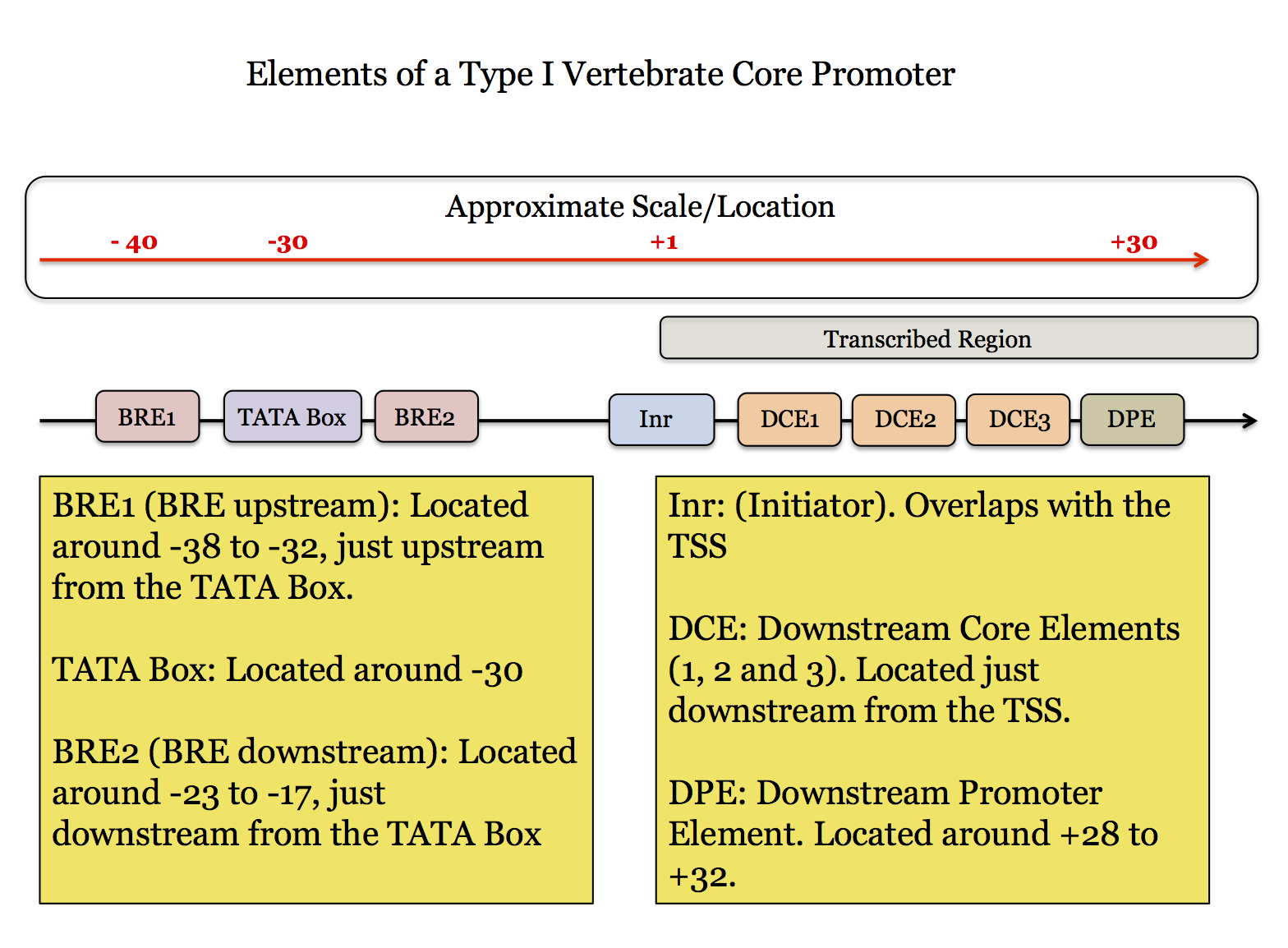
When we talk about the structure of a promoter we are just talking about its DNA sequence. In particular, there are specific sequences that are shared across promoters and which, of course, function similarly in the different promoters. In this section we will look at what the common Core Promoter sequences, or elements, are and how they are arranged - that is, where they are found within the Core Promoter sequence overall. The classic Core Promoter element is the well-known TATA Box, which was the first to be discovered. Over the years several other elements have been characterized and the figure below shows the vertebrate Core Promoter Elements which typically extends from around nucleotide -40 to around nucleotide +40. As discussed above, the Core Promoter is where the Basal Transcription Factors bind to recruit RNA PolII. The basic role of the Core Promoter elements is that they are the binding sites for the BTFs and each element has a consensus sequence (most of which are not given here to avoid information overload). As is typical for protein binding sites, the elements are short sequences, less than 10 nucleotides in length.
|
|
The elements shown in the figure above are found in many Type I promoters (and sometimes in Type II promoters). However, it is important to note that no single promoter will contain all of these elements so the figure does not really show a general Core Promoter structure. The figure is just a summary of the elements that are known and where they are located if they are found in a specific promoter.
Proximal Promoter
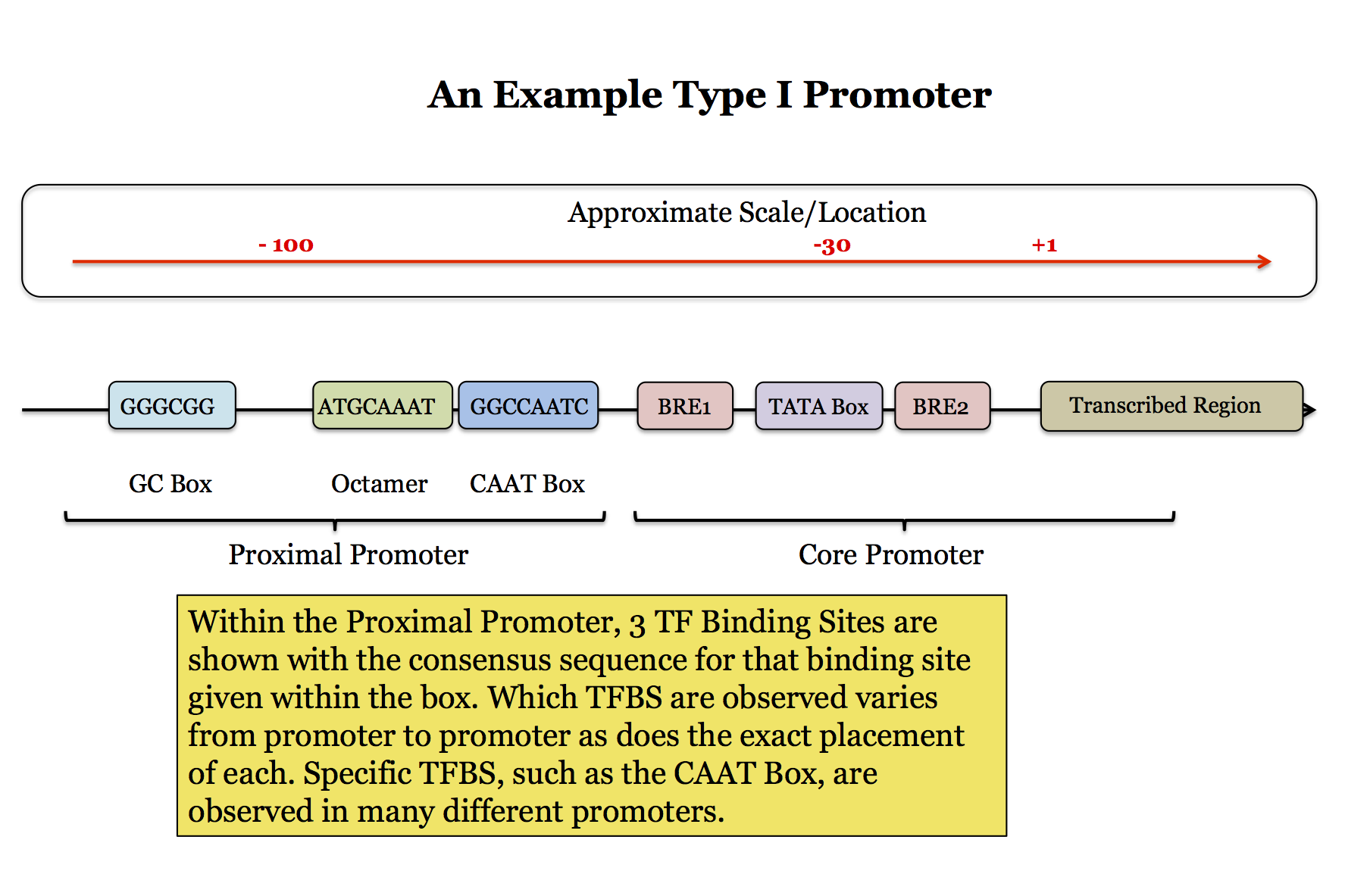
Just upstream from the Core Promoter is a region called the Proximal Promoter. The Proximal Promoter differs quite a bit from gene to gene but in general it contains a set of TFBSs (Transcription Factor Binding Sites). These are sequences bound by specific Transcription Factors and the binding of the TFs plays a role in transcription initiation. This is similar to the binding of Transcription Factors to regulatory elements such as enhancers (see Eukaryotic Gene Regulation) but they are classified differently because they only function if they are in a specific location and orientation, something that is not true for enhancers and silencers. Common TFBSs in Proximal promoters are CAAT Boxes, GC Boxes and the Octamer Box. These are shown in a Figure below.
Putting them together:
Most Type I promoters consist of an arrangement of some of the Core Promoter elements and a set of TFBS in the Proximal Promoter. An example promoter is given here. Note that this is just a hypothetical promoter, but it should give you a general idea of how a promoter might be structured.
|
|
| Eukaryotic Transcription | Table of Contents |