Gene Conversion
| Repair and Recombination | Table of Contents |
Gene conversion is a process in which one allele (say A1) within a cell of a heterozygote "converts" the other allele (A2) to the A1 sequence. If this occurs during a time when the cell has 4 chromosome copies, for example just following chromosome replication, then the cell would have three copies of A1 and one copy of A2. If it occurs at another time the cell would become homozygous for A1. (Although we used the example of A1 "converting" A2, the A2 allele could convert the A1 allele. As we shall see, which allele converts the other is a matter of chance.)
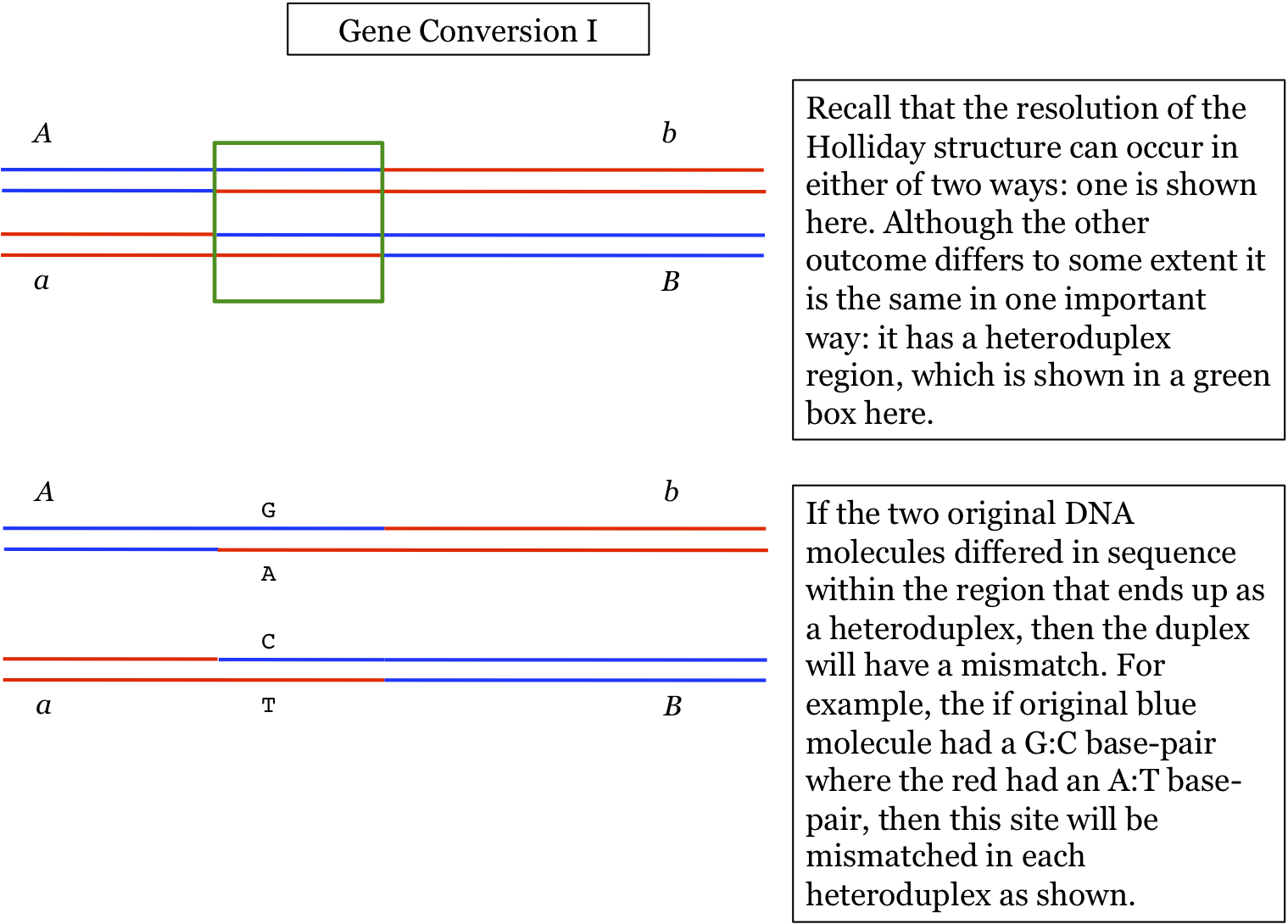
This page will cover how such a conversion occurs. It results from a combination of recombination and DNA repair. Make sure that you understand the process of formation of a Holliday Structure. Two things are critical. First, no matter how the Holliday Structure is resolved, the resulting DNA molecules have a heteroduplex region, which is a region containing one strand from one of the original DNA molecules and another strand from the second parental molecule. Second, recombination occurs between DNA molecules with similar but not necessarily exact sequences. As will be illustrated, this means that at the end of recombination, the heteroduplex region could contain mismatches. It is the repair of these mismatches that can lead to gene conversion. The process is illustrated here:
|
|
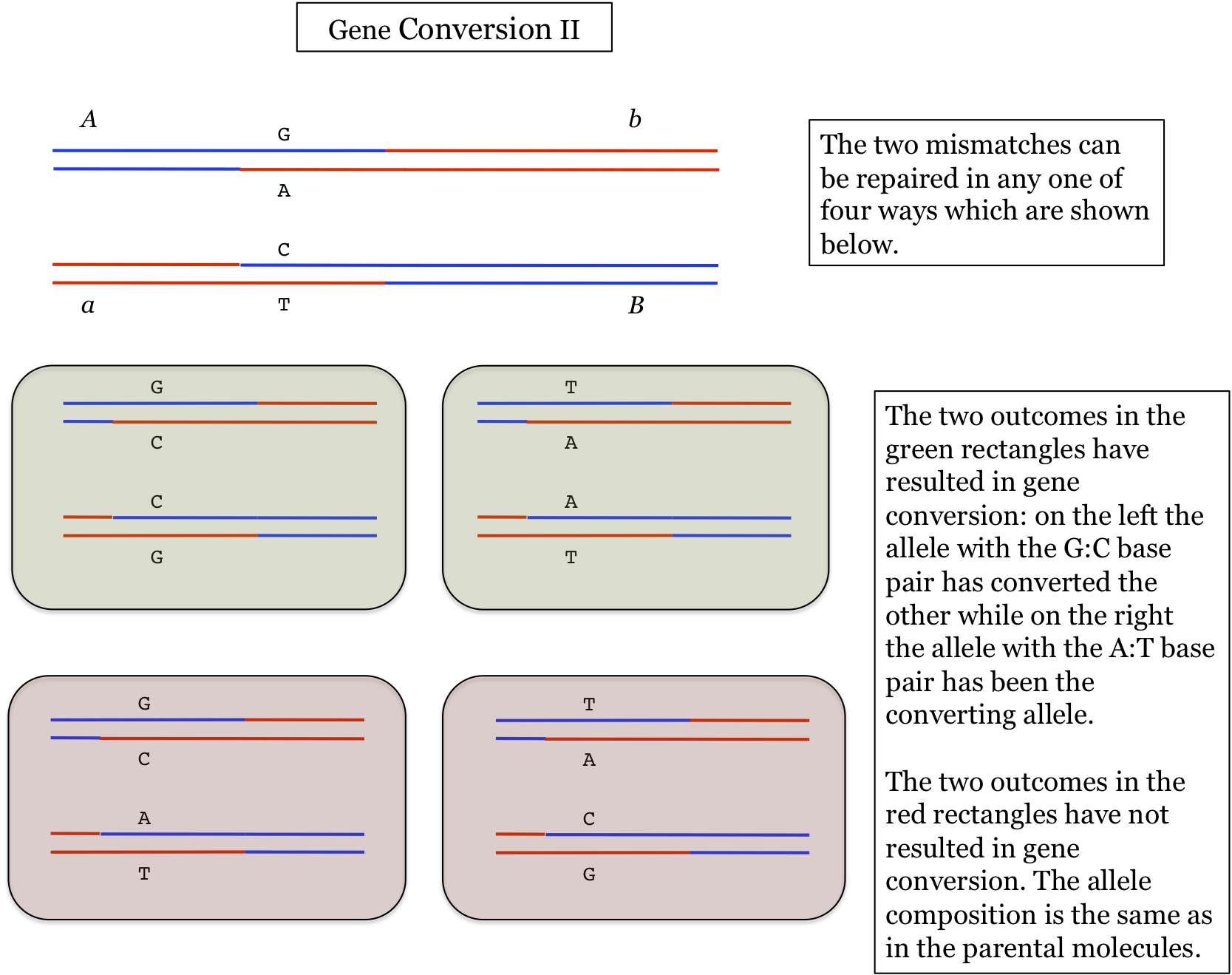
The mismatches will eventually be repaired by the cell. Unlike mismatch repair following replication, when DNA is hemimethylated, the cell cannot distinguish between the two strands in this case. Therefore, it will repair the mismatches randomly; it will do this by excising one strand and then using the second as a template for repair-replication. As a result, there are multiple possible outcomes. As you can see here, some of these will have resulted in conversion of one allele so that the sequences are now matched.
|
|
If there are multiple mismatches across the heteroduplex (as opposed to just one shown here), then each gets repaired and the outcome in terms of gene conversion becomes more complex. Many different alleles can be created by the many possible combinations of repairs - even new sequences that were not present in either original sequence. However, repair combinations that result in gene conversion are still possible.
| Repair and Recombination | Table of Contents |