General Translation
| Table of Contents |
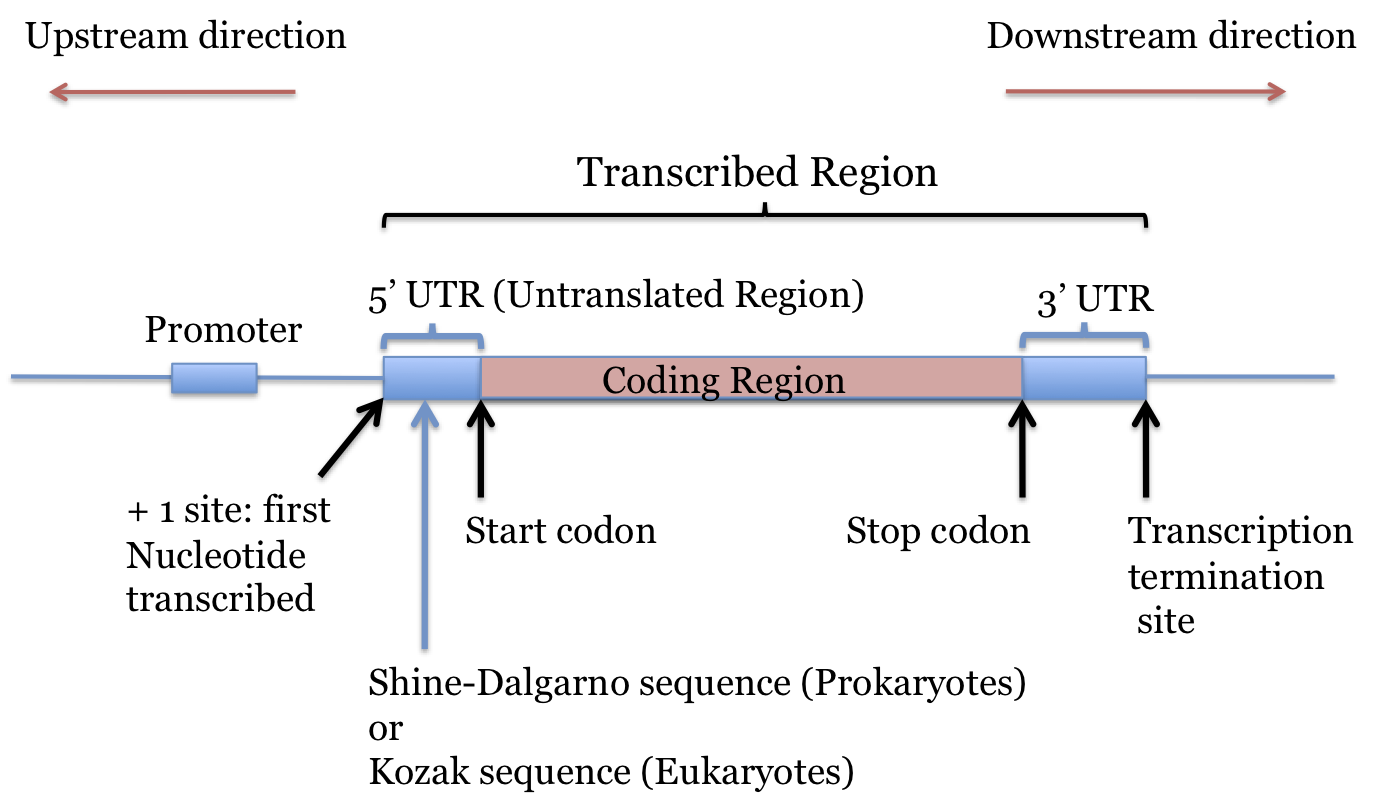
The following figure summarizes some important concepts of translation. Much of this section will cover the mechanisms by which a sequence of nucleotides is translated into a sequence of amino acids. The process involves the translation of non-overlapping triplets (called codons) in the mRNA sequence with each triplet specifying either one of 20 amino acids or translation termination. The relationship between the triplet sequence and the amino acid sequence is the genetic code. Translation is performed by a large protein/RNA complex called the Ribosome which has a large subunit and a small subunit.
|
|
Here we are interested in some general non-mechanistic aspects. As covered under Transcription, the mRNA transcript is generated from the Transcribed Region of the DNA, just downstream from the promoter. Translation initiates at the Start Codon which is a specific codon for each mRNA. Translation continues until a Stop Codon or Termination Codon is reached downstream. (What makes something a start or stop codon is covered elsewhere.) These two codons define what we call the Coding Region. This is not the same as the transcribed region but is the internal part of the transcribed region. The two stretches of nucleotides that are transcribed but not translated are shown in the figure; they are referred to as the 5' and 3' UTRs.
Within the 5' UTR and close to the Start Codon is a sequence which is important for translation initiation. This sequence is the Shine-Dalgarno sequence in Prokaryotes and the Kozak sequence in Eukaryotes (which, unlike the Shine-Dalgarno sequence, actually contains the Start codon within it as you will see). Although they differ structurally, the two perform the same basic function of allowing the ribosome to "find" the Start codon.
| Table of Contents |