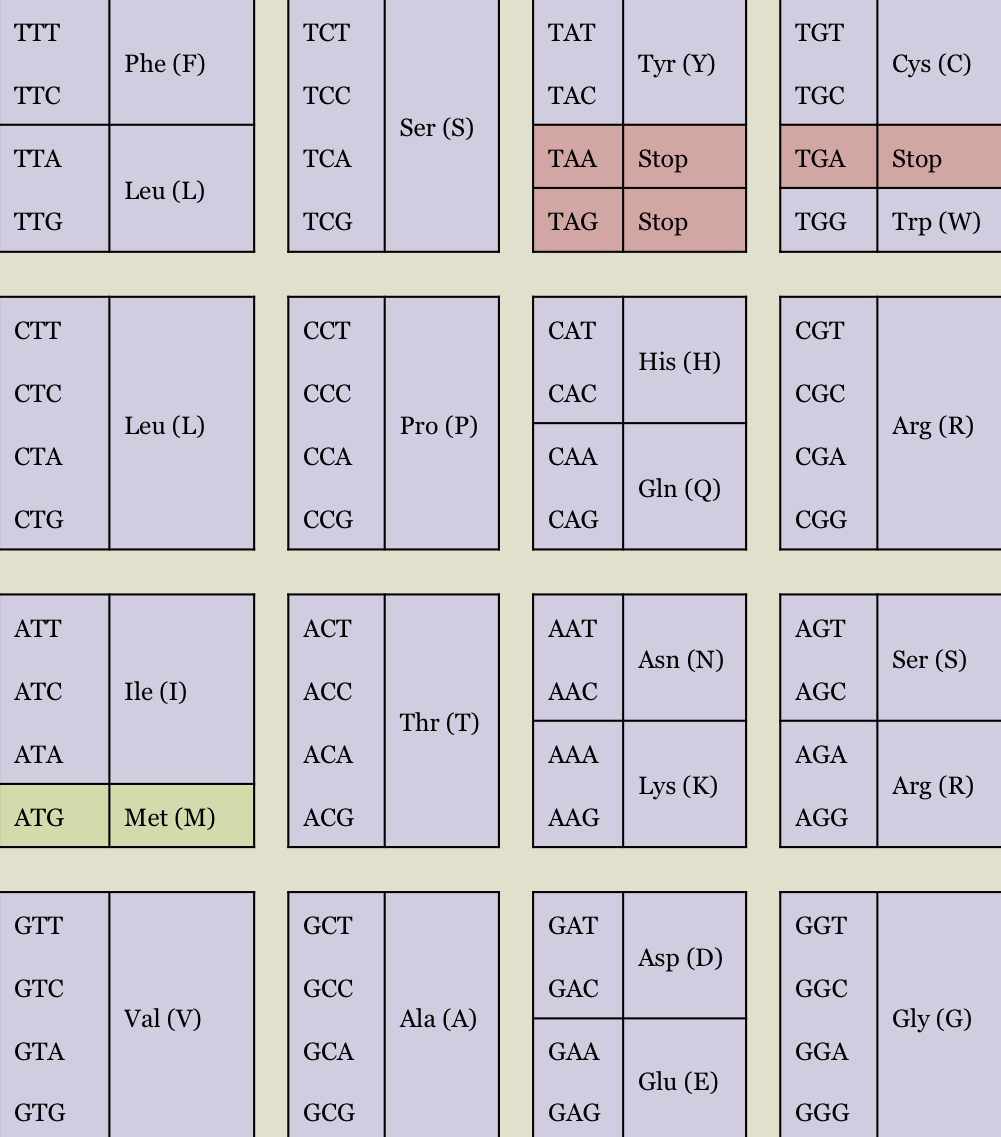
What is shown here is the standard genetic code. This is the codon/amino acid relationship that is found in the majority of organisms that we study. There are, however, other genetic codes that are founding some organisms or in certain organelles (mitochondria and plastids which have their own genomes). These "non-standard" genetic codes are generally quite similar to the standard code, typically differing in what is "coded" by just one or a few codons.
Important points to note:
-
Sense codons: Of the 64 possible triplets (codons), 61 code for an amino acid. These are referred to as Sense codons.
-
Stop codons: Of the 64 possible triplets (codons), 3 are stop or termination codons. These are sometimes referred to as Nonsense codons and once one of the three is reached it triggers and end to the translation process and the release of the new polypeptide.
- Degeneracy: The genetic code is degenerate. This means that more than one codon can code for a single amino acid. There are 20 amino acids that are specified by the 61 sense codons resulting in a fair degree of degeneracy. The 3 amino acids that are coded by 6 codons are called six-fold degenerate, those coded by 4 codons are four-fold degenerate and those coded by 2 are, of course, two-fold degenerate. There is also one three-fold degenerate group. Also, you should note that most of the degeneracy is at the third codon position. This fact plays an important role in a number of areas of genetics.