Imprinting
| Eukaryotic Regulation | Table of Contents |
Imprinting refers to the situation in mammals when the expression of a gene is affected by parental origin. For example, if the maternally inherited copy of a gene is expressed but not the paternally inherited copy, then the gene is said to be imprinted. This is an example of an epigenetic phenomenon. It is accomplished by the methylation of DNA in a CpG island near the transcription start site of the gene, and the imprinting occurs at some point prior to the formation of the zygote in germ line cells of the relevant parent.
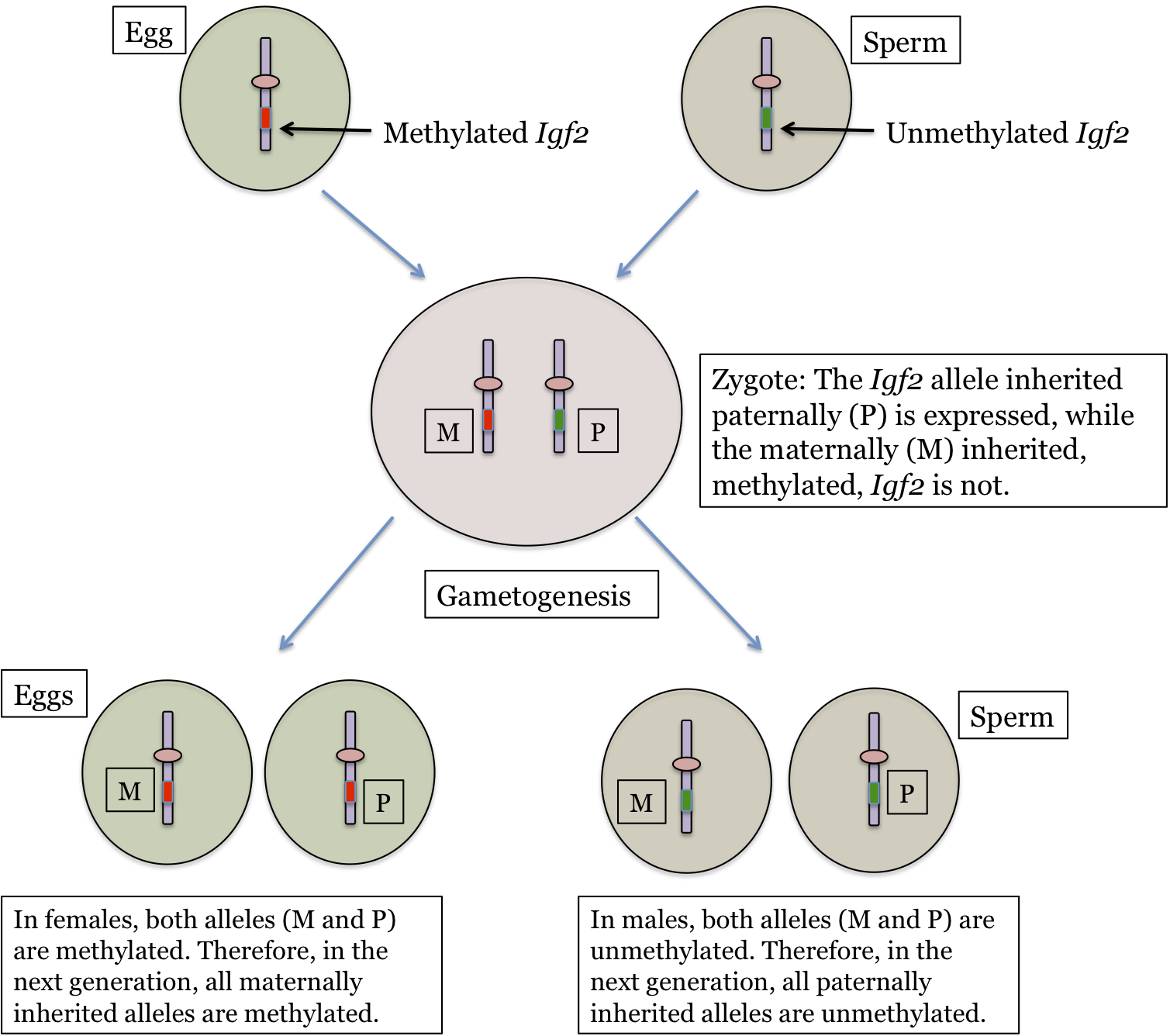
A good example of this is the Insulin-like Growth Factor 2 (Igf2) gene. The CpG island near the transcription start site of the paternally inherited copy is not methylated, while it is methylated in the maternally inherited copy. Therefore, only the paternally inherited is expressed during development. It is important to note that in males both copies are passed on unmethylated - even the maternally inherited copy that was originally methylated. Similarly, in females both copies are passed on methylated - even the paternally inherited copy that was originally unmethylated. Therefore, at some point during gametogenesis, methylation and demethylation must occur in each individual.
|
|
| Eukaryotic Regulation | Table of Contents |