Insulators
| Eukaryotic Regulation |
Remember that in the section on Eukaryotic Chromosome Structure we covered the organization of metazoan chromosomes into Topologically Associating Domains (TADs). Take a moment to review that page. In this section we are going to see how the organization of metazoan chromosomes into TADs is important for gene regulation.
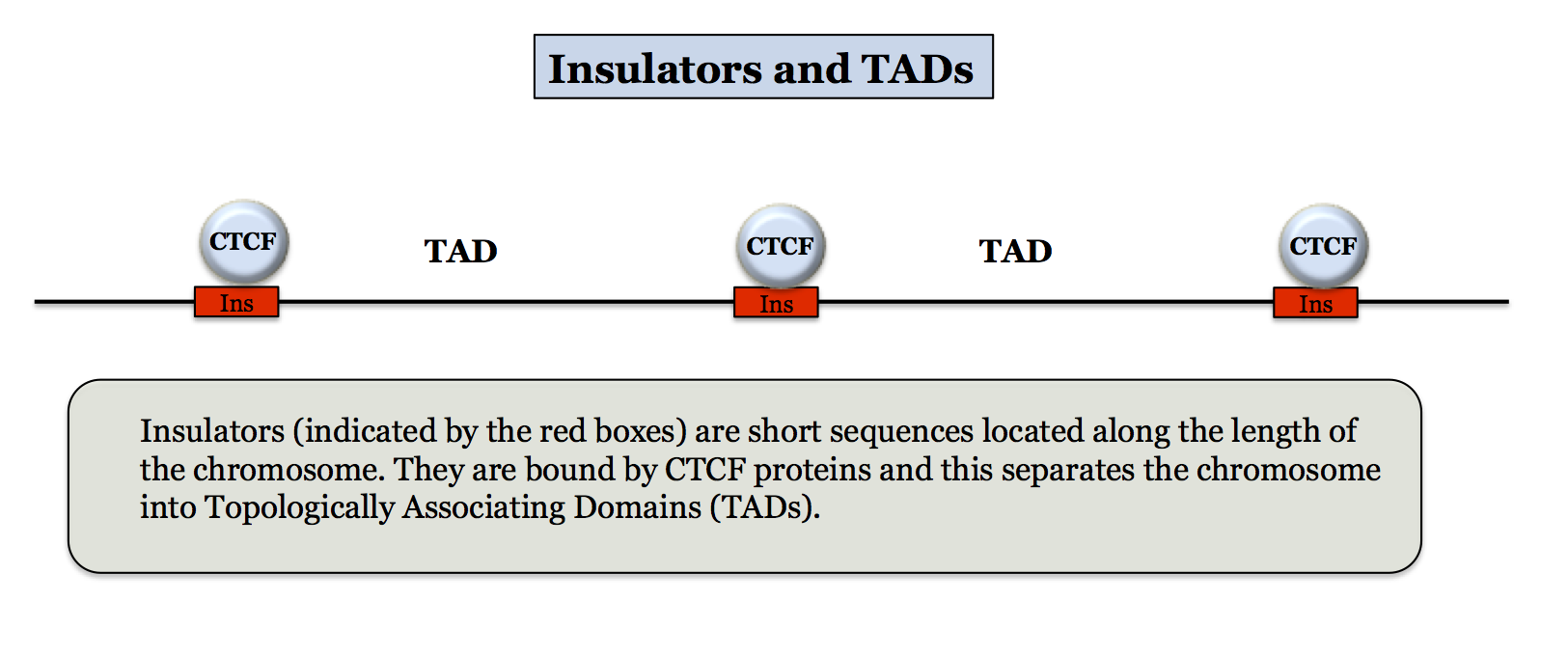
Remember from the other section that Insulators are sites that define the boundaries of TADs. These sites are bound by the CTCF protein and interactions between CTCF proteins at adjacent Insulators causes the intervening chromatin (the TAD) to form a loop structure. Although TADs do form this loop structure it is not important for what we will discuss in this section. Therefore, we will keep it simple by just drawing TADs in a linear fashion and so we can diagram adjacent TADs as:
|
|
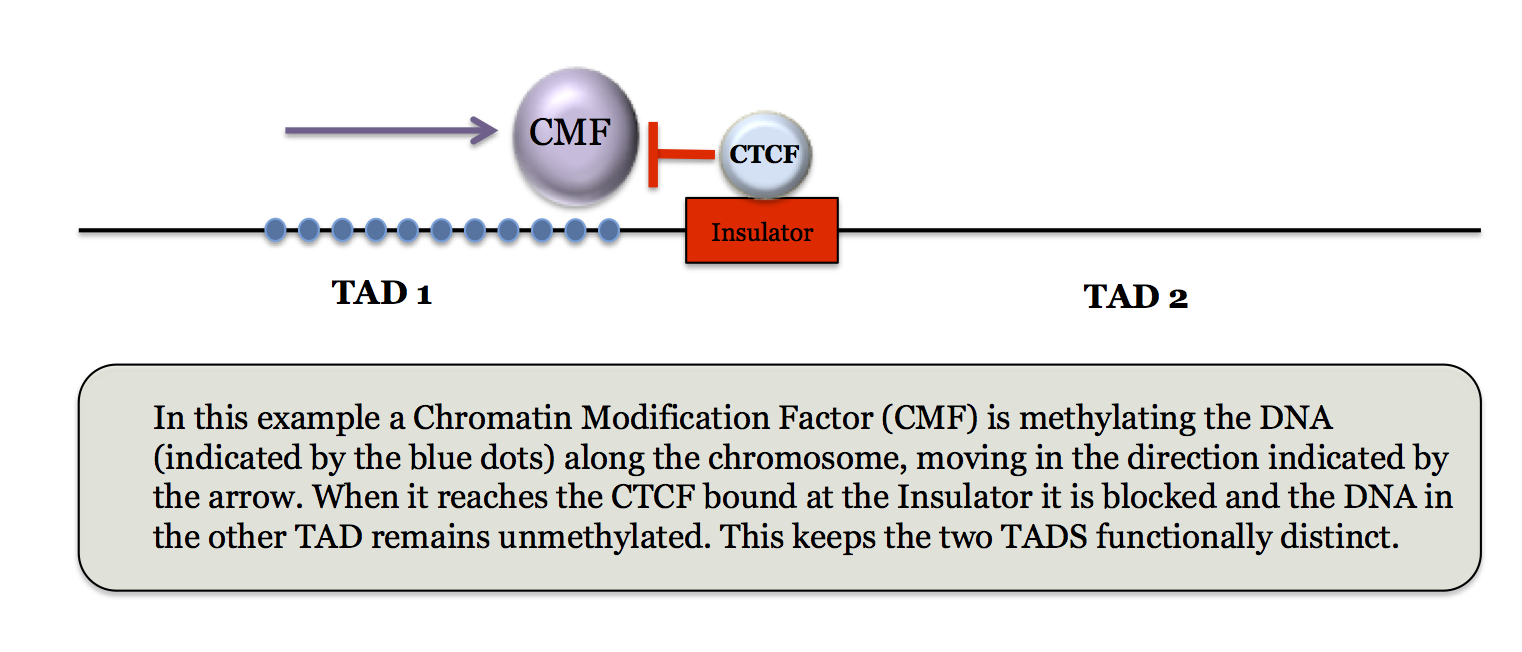
In terms of gene regulation, CTCF proteins bound to Insulators have two main effects. One is that they act to block the spread of epigenetic changes; for example methylation of DNA can start at one location and spread along the chromatin but not past a bound insulator. This keeps epigenetic modifications from spreading from one TAD to another.
|
|
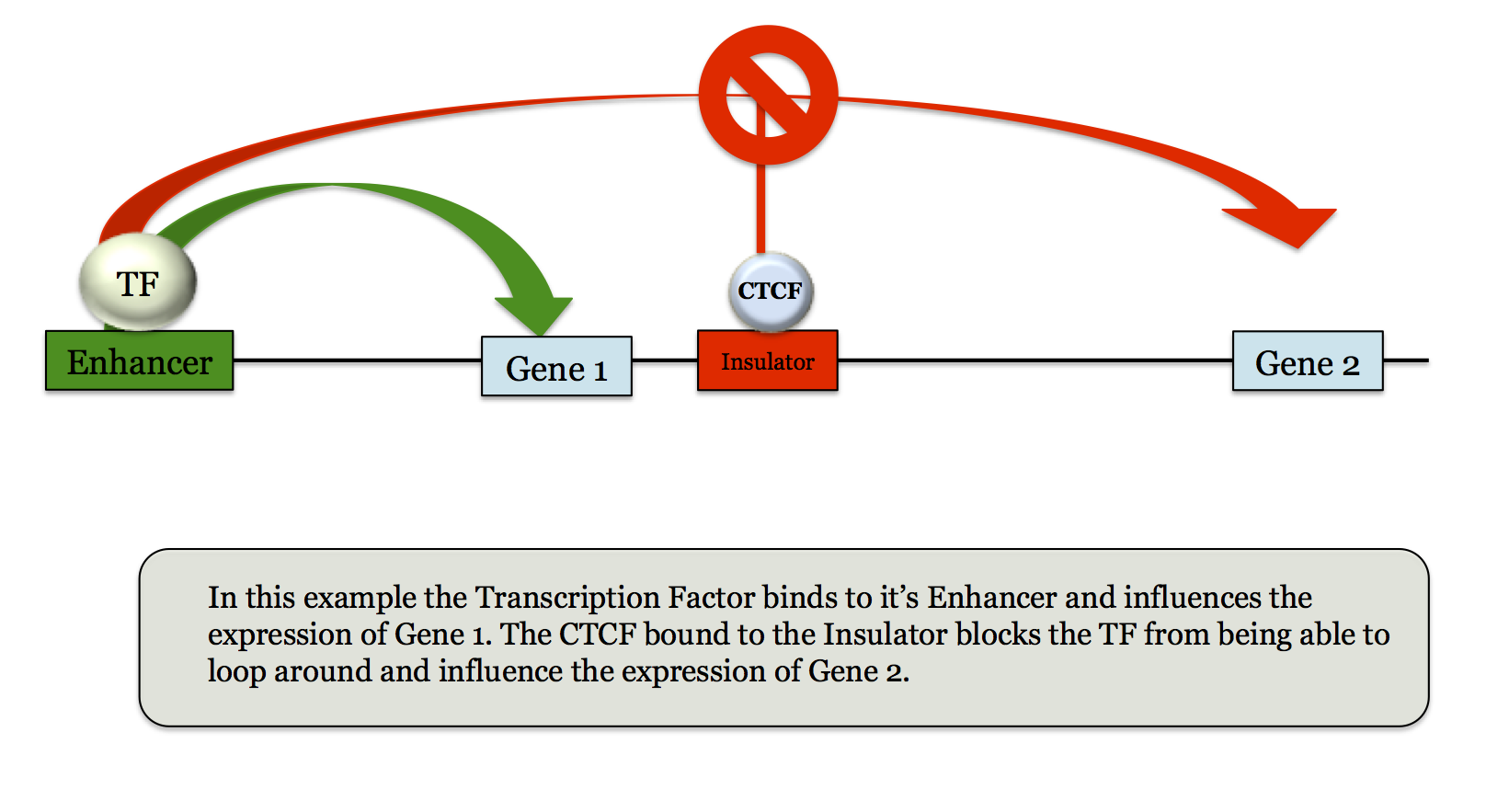
CTCF can also act to block regulatory elements, such as enhancers, from influencing genes separated from the regulatory element by the Insulator.
|
|
The end result is that TADs are isolated from each other with respect to gene regulation. What is happening in one domain is shielded from what is happening in other domains. This is important genetically since it means that the action of a regulatory protein is targeted and does not spill over to genes in neighboring domains.
| Eukaryotic Regulation |