Karyotype
Karyotype is defined as the chromosome content of a typical cell or individual of a species. In humans this consists of two copies each of the 22 autosomes and a pair of sex chromosomes. This can be written in one of these two ways:
46 XX
46 XY
Where the 46 represents the total number of chromosomes and the sex chromosome content is then indicated.
Two terms that you should know:
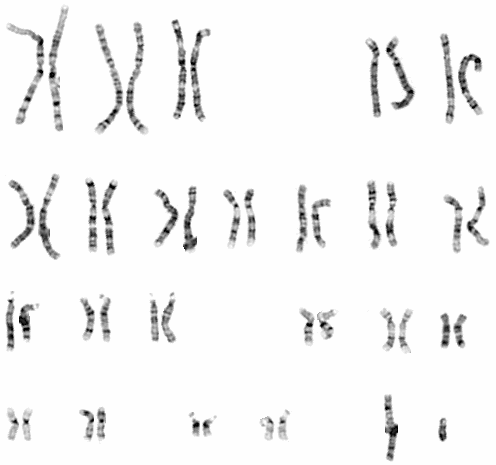
Chromosomes are visualized after a staining process that is performed when the chromosomes are relatively condensed during cell division. A commonly used stain is Giemsa stain, which generates a reproducible set of bands, called the banding pattern, on each chromosome. The way in which the stain actually results in these bands is not fully understood, but the bands themselves are still useful for studying the chromosomes and as references to specific regions.
Stained human chromosomes
|
|
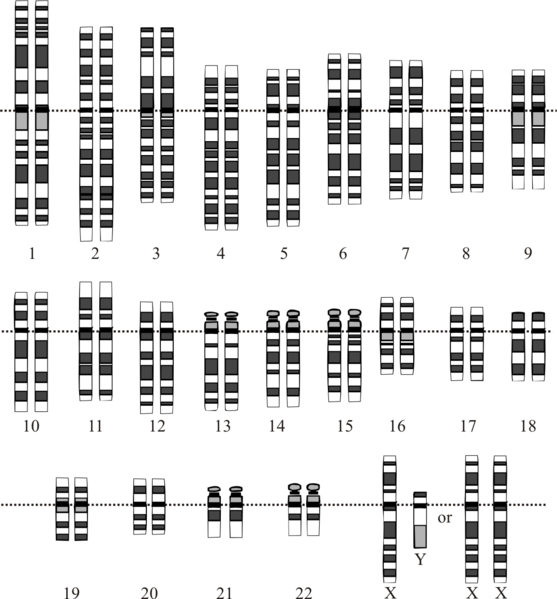
Stained chromosomes are often shown in an idealized form to clarify the banding pattern.
|
|
Karyotype can also refer to the representation of chromosomes, usually arranged by size and centromere placement as shown in the two figures above.
The chromosomes of various species have been numbered, ordered first by size and then by centromere placement. The human chromosome numbers, seen in the figure above, were determined in this manner.
Chromosome number (n): We use n to represent the basic number of chromosomes in a given species This defines the haploid genome and we can then refer to the number of chromosomes in (most) somatic cells of individuals of that species as a multiple of this. Diploids are 2n, tetraploids are 4n and so on. In humans, n = 23 and most cells in our body have 46 chromosomes, although there are some 4n cells.
The Nature Scitable page on cytogenetics.>/p>
Table of Contents