Recombination
| Repair and Recombination | Table of Contents |
In Mendelian genetics, the discussion of recombination really deals with genetic recombination which is the production of non-parental allele combinations. This section deals with the molecular mechanisms by which crossing over occurs, which leads to genetic recombination. Although we differentiate between crossing over (the process) and recombination (the result) in Mendelian Genetics, molecular geneticists usually use the term recombination to cover the process and the result.
The basis of any discussion of the molecular mechanisms of recombination is the Holliday model first put forward in 1964. The model has been revised, and continues to be revised, but it explains many basic observations about recombination. However, there is a lot of evidence that recombination can also occur by other mechanisms which are not discussed here.
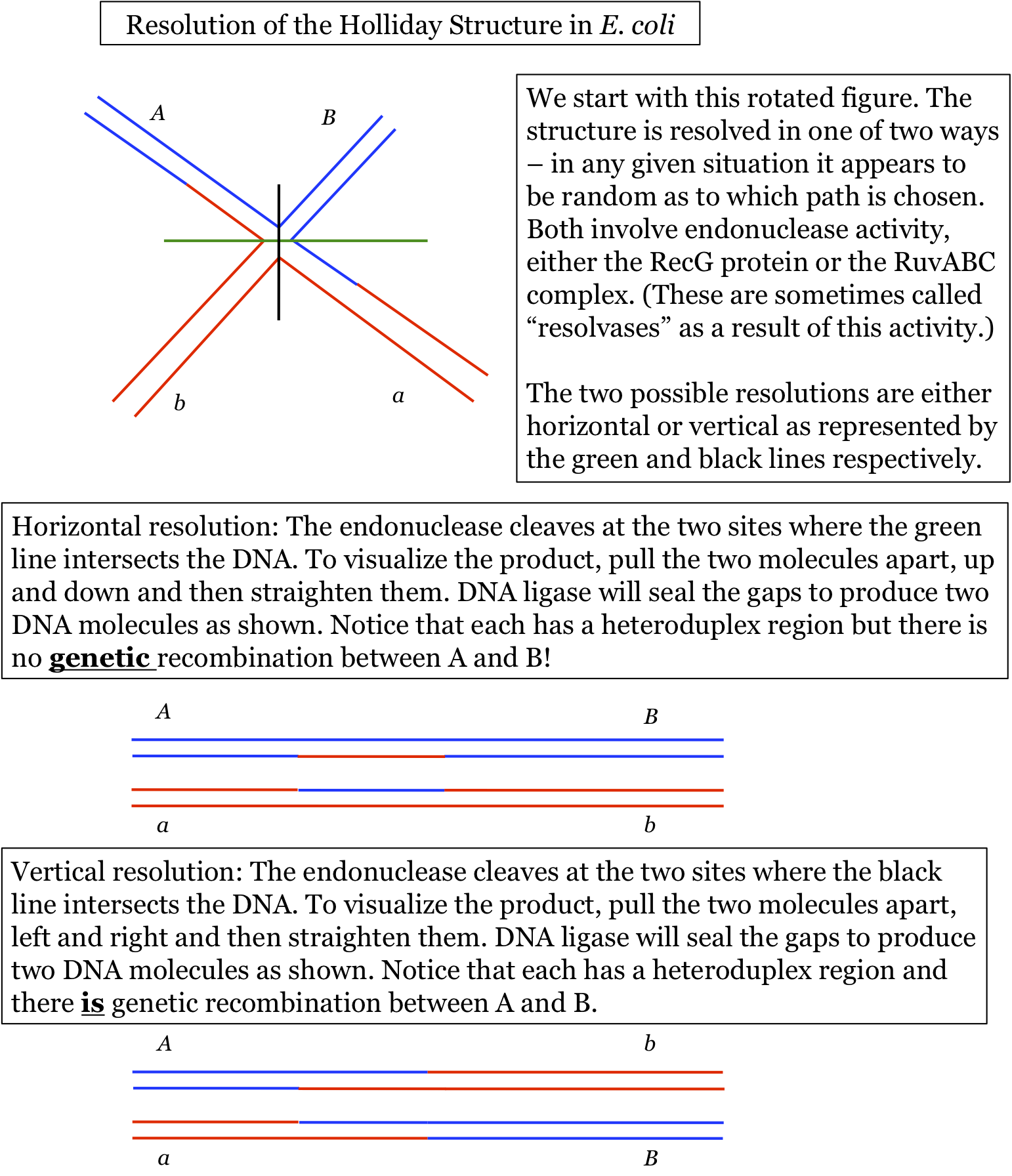
The Holliday model applies to two homologous DNA molecules and involves general steps: (1) the formation of a structure called either a Holliday structure, a Holliday intermediate, a Holliday junction or a chi structure, and (2) the resolution of this structure.
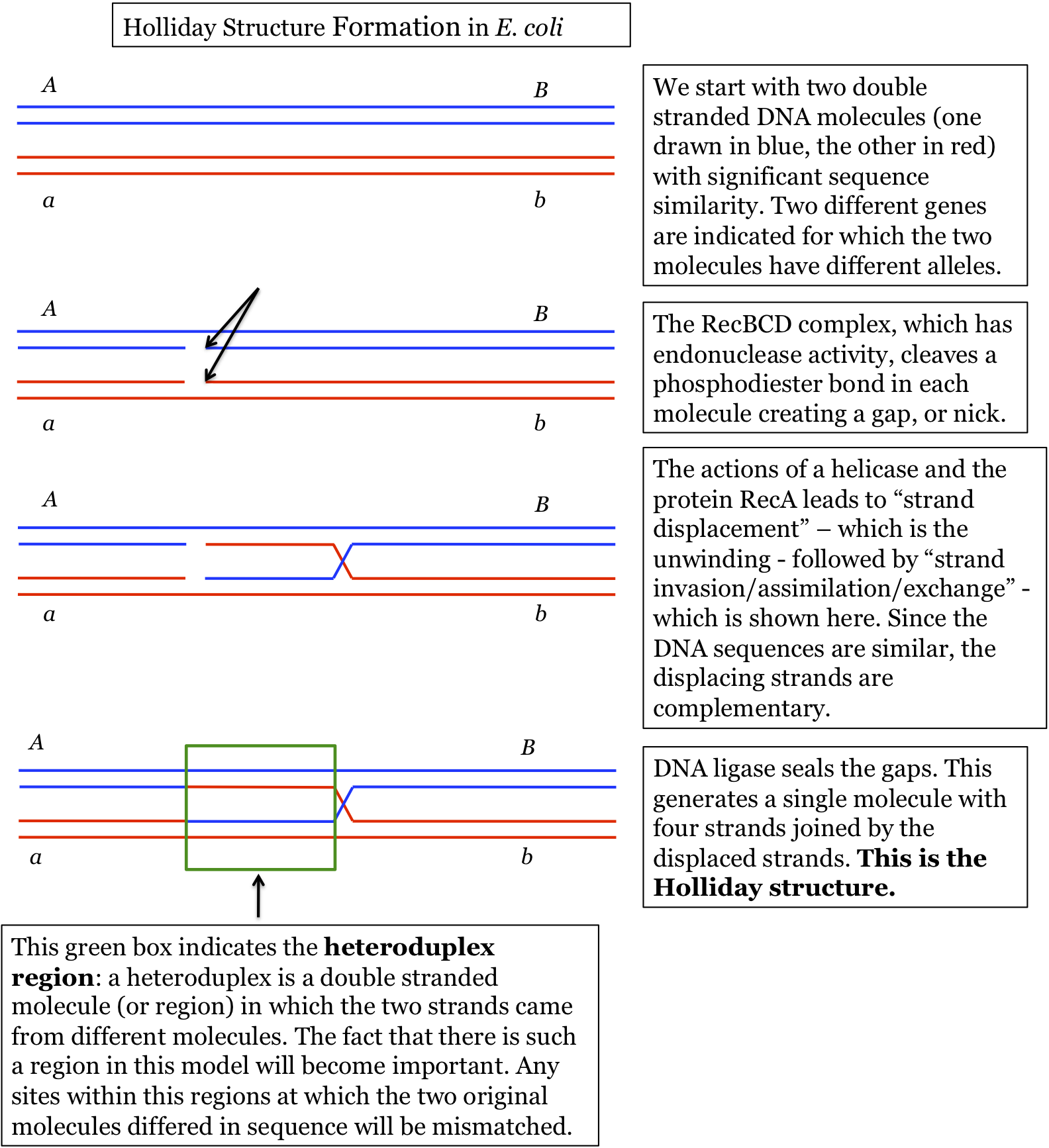
Formation of the Holliday Structure/Junction
This process is diagrammed below. One small point:the model applies to any two DNA molecules that are highly similar in sequence over the stretch where the strand exchange occurs. Often you see these referred to as homologous DNA molecules but this terminology is not strictly accurate. "Homologous" is a term from evolutionary biology which specifically means that the trait (in this case the sequence) is similar in two or more organisms as a result of inheritance from a common ancestor. The model here does apply to such molecules but it really applies to any two DNA molecules with sequence similarity, whether or not this similarity is due to homology. Often in molecular biology you will see the term homologous used when what is really meant is the more general term similarity.
|
|
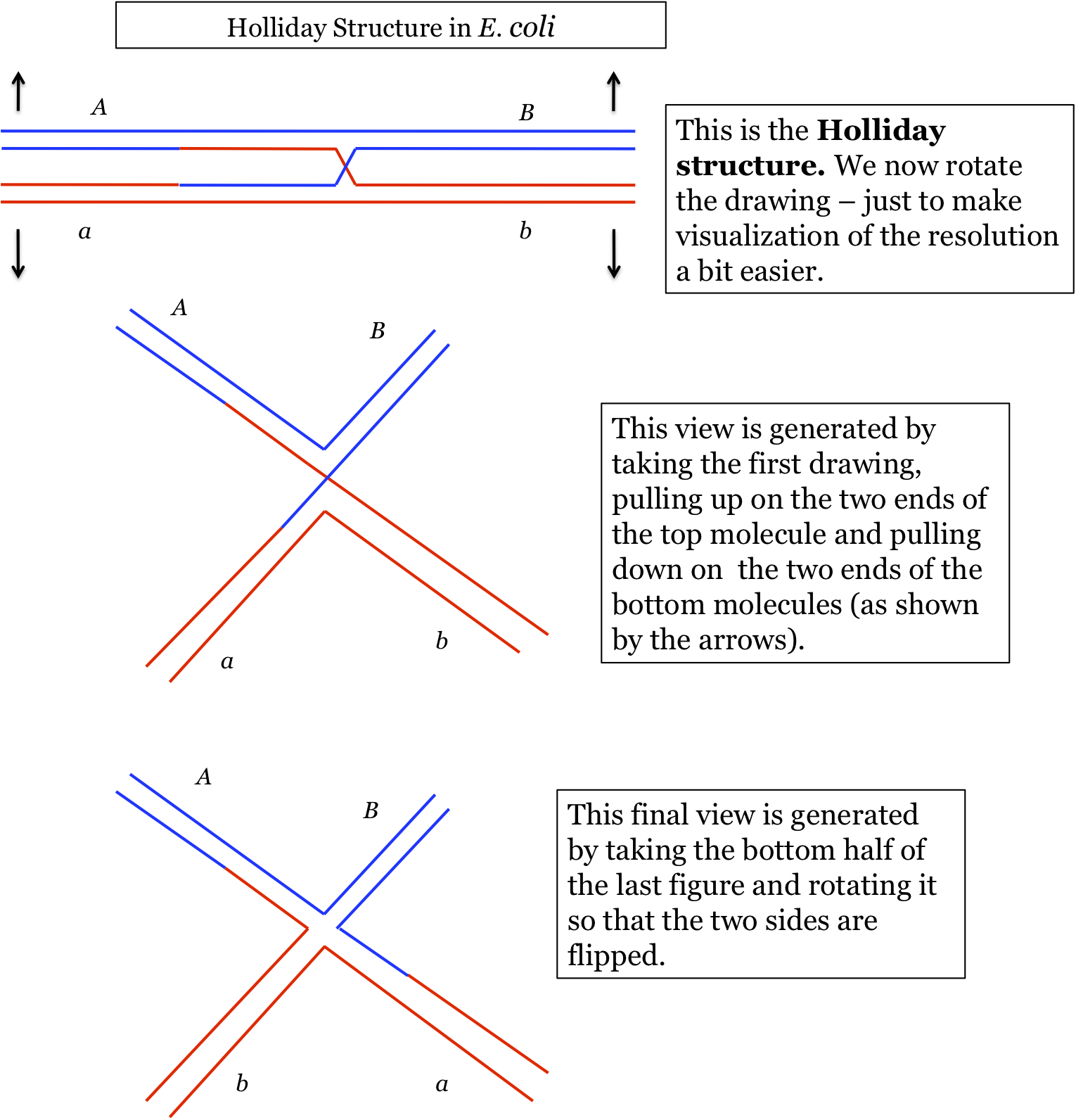
What is shown above is the formation of the structure. However, before we discuss the resolution of the structure back into two separate dsDNA molecules we are going to rotate the drawing. We only do this to make the visualization easier, it is not really something that happens in the cell: the 3-dimensional structure of this is a bit more complex than what is illustrated and this can be seen in the video below.
|
|
Resolution of the Holliday Structure
|
|
A video that covers the formation of a Holliday structure.
| Repair and Recombination | Table of Contents |