Multiple Genes
We will be dealing here with genes that are unlinked which means that they segregate independently. Linked genes are covered elsewhere. When Mendel first performed crosses with plants that differed in multiple traits he found that the traits were inherited independently of one another. Based on this observation he put forward his second law - the Principle of Independent Assortment (or Independent Segregation). This principle stated that the segregation (assortment) of alleles for one gene was not affected by the segregation of alleles of other genes. A good review of this material can be found - particularly in Figure 6 - at The Nature Education Scitable page if you want to brush up on it.
How did Mendel reach the conclusion that the traits assorted independently? Recall the results that he got when examining two traits together. When he interbred the F1 plants he observed the famous 9:3:3:1 ratio of phenotypes. It is the observation of a 9:3:3:1 ratio that led to the proposal of Independence. What we explore next is why this is the case.
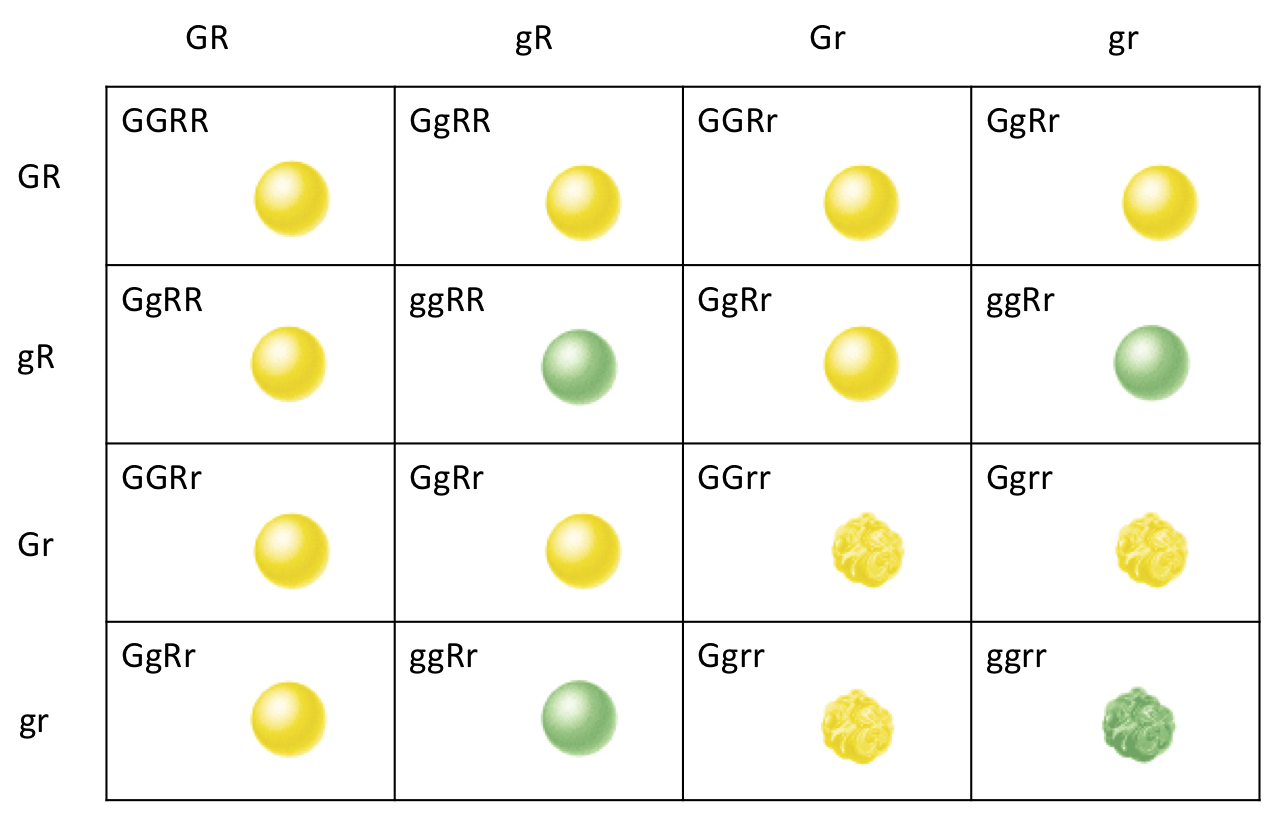
In the Punnett Square below there are two traits, seed color (G = Yellow and g = green) and seed contour (R = Round, r = wrinkled). A parental cross of GGRR x ggrr produced F1 plants with the genotype GgRr and Yellow, Round seeds. When the F1 plants were interbred (or self-fertilized) it was a dihybrid cross, GgRr x GgRr (a dihybrid cross being a cross of two individuals who are both heterozygous for each of two genes).
|
|
In terms of probability, the concept of Independent Assortment is the same as the independence of events. If we have two genes, G and R, each with a dominant and recessive allele then what Mendel was saying was that the probability of a gamete carrying the G AND R alleles = Pr(G) * Pr(R) or, considering the recessive alleles, Pr(g AND r) = Pr(g) * Pr(r).
In the case of a heterozygote (GgRr), segregation of G and g means that Pr(G) = 1/2 and the segregation of R and r means that Pr(R) = 1/2. Therefore, if the genes are independent:
Pr(G and R) = 1/2 * 1/2 = 1/4. In other words, 1/4 of the gametes from an GgRr individual will be [G, R].
(We can apply the AND rule if the two genes are independent and of course this applies to any alleles for those genes).
If gamete frequencies in the Punnett Square above are 1/4 each then the probability of each square (combination of gametes) is 1/16 and so you predict a 9:3:3:1 phenotype ratio from the cross (make sure that you can perform this calculation). Since that is the ratio that Mendel observed, he realized that the gamete frequencies must be 1/4 each meaning that the two genes he was working with must segregate independently.
Note that the probability for each square is 1/4 * 1/4 = 1/16. In general it is Pr(gamete from parent 1 AND gamete from parent 2). These can be multiplied if the probability of the gametes are independent. This is NOT addressed by Mendel's second Principle. It is the segregation that leads to gamete frequencies that is what the Principle is about. We will see when dealing with linked genes that, even when Independent Assortment is violated, the probability of getting a particular gamete from one parent is still independent of getting a particular gamete from the other parent.
When dealing with the inheritance of unlinked genes, the best approach is to deal with each gene separately and then apply the AND rule for the overall combination(s) you are interested in. Since there are limited possibilities for each gene the calculation is quite straightforward:
If you cross AaBbCc x AaBbCc what is the probability of getting a fully recessive progeny?
From Aa x Aa we know that Pr(aa) is 1/4. The same holds for each gene since in each case you are crossing a heterozygote and are interested in the homozygous recessive progeny.
Therefore, Pr(aa AND bb AND cc)
= Pr(aa) * Pr(bb) * Pr(cc)
= 1/4 * 1/4 * 1/4
= 1/64
The best approach to dealing with multiple genes is to:
Just remember that this approach works because they are unlinked (i.e. independent).
If we turn to the standard dihybrid cross with a Punnett Square we can see how this works.
As discussed above, the independence of the genes comes into play during segregation and is what gives us the gamete frequencies of 1/4 each. We get the classic 9:3:3:1 ratio from this cross but rather than draw a square each time we can see how our approach works.
What proportion will be A_B_?
Step 1 is obvious, since the genotype we want is written out.
Next separate the genes and start with A. From Aa x Aa what is the probability of A_? Again, you should know this basic cross (the cross that gives us the 3:1 ratio). The answer is 3/4. The same applies to the B gene.
Finally combine them. 3/4 * 3/4 = 9/16.
This is much easier than a Punnett Square, particularly when you are dealing with more than two genes. For example, try drawing a square to answer the question From the cross AaBbCcDdEeFf x AaBbCcDdEeFf what is the probability of getting a progeny with all dominant phenotypes? Using the probability approach you see that it is (3/4)6.