Gene Action Pathways
In order to more fully comprehend genetic analysis, and gene interaction in particular, we need to start putting genes into a better context. When we study basic Mendelian crosses we simplify things by focusing on the independent action of a gene. A classic example would be a cross between purple-flowered plants and white-flowered plants that Mendel originally performed, and which he explained with the concept of a gene with a dominant and a recessive allele.
What we want to keep in mind is that while the difference between the purple and white flower plants is due to these two alleles, the flower color overall is affected by many genes all of which interact to produce and deposit the complex of pigments that provide the color. What is key is that for all of these genes, the plants Mendel worked with all carried the same set of alleles so that they didn't contribute to the difference in flower color, even though they were important for the determination color.
As a result, we don't really want to say that Mendel was studying the "gene for flower color" but, rather, the gene that was responsible for the specific variation he observed in flower color between two lines of peas.
Although they are an excellent starting point for understanding genetics, situations in which a single gene is responsible for the observed phenotypic difference are relatively rare even in experimental settings. Therefore, we want to start thinking about how multiple genes interact to produce phenotype and how alleles across different genes interact to produce more complex variations in phenotype.
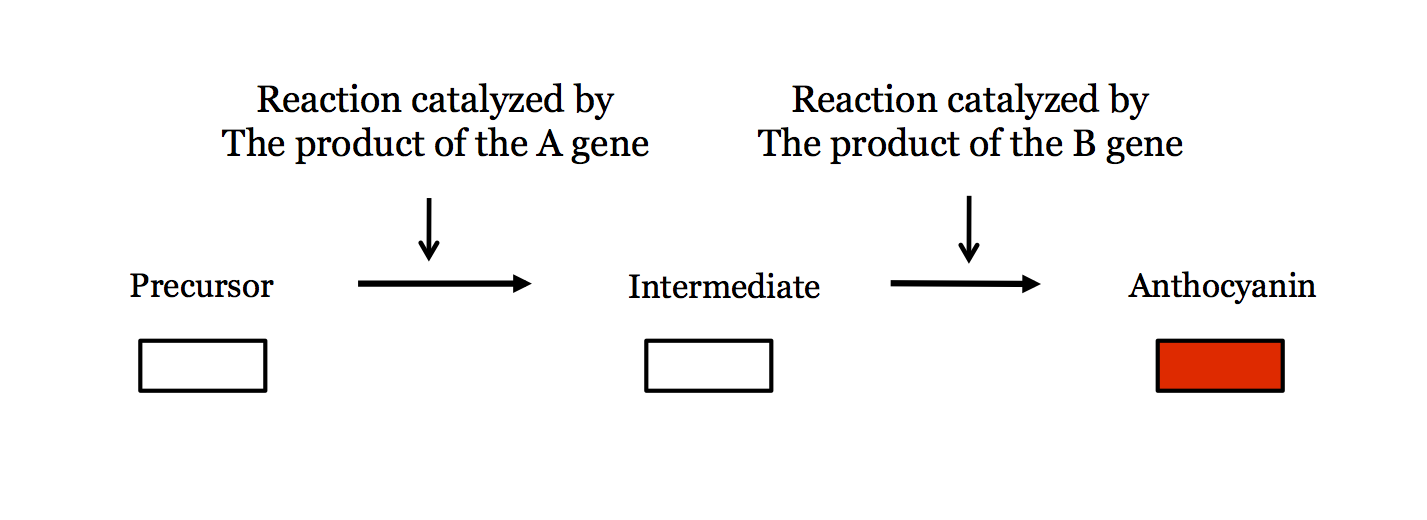
A good way to begin is to consider a simple biochemical pathway such as the one shown below. Although it is essential that you see that genes can interact in many ways besides such pathways - think of things such as proteins binding together in structures or genes that act to regulate the expression of other genes - biochemical pathways are wonderful models for understanding some of the basic concepts of gene interaction.
In the pathway shown there are just two reactions, each catalyzed by an enzyme that is the product of a gene as indicated. The product is a red pigment (anthocyanin) that provides color to the flowers of the plant. We can see that neither the A gene nor the B gene is THE gene for flower color. Instead, both are necessary for red pigment to be synthesized.
|
|
Now let us say that there is an allele - a - of the A gene that is a loss-of-function mutation. This means that the protein it codes for is not active and thus cannot catalyze the reaction.
In a plant with the genotype aa the first reaction is never catalyzed so there is no substrate for the second reaction. The flowers of an aa plant will have white flowers (no pigment) and this will be due to the mutation in the A gene, but we can see that this is not THE gene for flower color, only the gene responsible for the variation observed in this example. As pointed out above, the difference between a red-flowered plant and a white-flowered plant can be due to them having different alleles of the A gene but this is no the only gene that contributes to the flower color phenotype.
Real biological pathways are more complex and the interactions get even more complicated so we will stick with relatively simple pathways in this course. In the section on Gene Interaction we will use this concept of pathways to explore how the coordinated actions of multiple genes produce an organisms phenotype and how geneticists deal with these interactions.