Permutations and Combinations
Permutations and combinations play an important role in probability. They arise whenever we are dealing with a set of outcomes (in this section these are also called objects which is a more general term used when dealing with permutations) that can be arranged in different ways.
To start we will address the question, what are permutations and combinations and how do they differ from one another?
A combination of a set of objects is just an unordered arrangement of a subset of the objects (if we deal with all of the objects then there is only 1 combination). Say you have a thousand songs on your iPod and you want to listen to 3 of these songs while you study. How many 3-song combinations are possible? This is unordered since we didn’t ask about the order in which you play the 3 songs. Therefore, it is a combination.
A permutation of a set of objects is just a specific order in which they are arranged – that is, it is an ordered arrangement. Say you only have three songs on your iPod: Song A, Song B and Song C. There are six different ways in which the 3 songs can be arranged: A:B:C or A:C:B or B:A:C or B:C:A or C:A:B or C:B:A. Of course, the order in which they are arranged does not change which songs appear and that is the important difference between the combination of songs and the permutation of the songs. One combination has multiple permutations.
To extend this idea let’s go back to the iPod with 1000 songs. If you want to listen to 3 of them, how many permutations are possible? Unlike the question about combinations, here we want to differentiate playlists that have the same 3 songs but in a different order. So, while the songs A, B and C count as one combination, this combination can be arranged in 6 ways as we just saw. To answer this you need to first determine how many different combinations are possible and then how many permutations there are for each combination. We will deal with how to do the actual calculation below.
In probability, these ideas are important to consider whenever you have multiple events occurring. Although this could involve any number of types of events we will only consider the most common situation (in genetics), which is multiple occurrences of the same type of event: for example, rolling several 6-sided dice, or tossing a number of coins or having multiple children. We are often interested in the probability of a certain combination of outcomes for these events regardless of the order in which these outcomes occur (the permutation). An example would be tossing a dime and a nickel: these are two events of the same type (a coin being tossed, we just differentiate them as nickel and dime so we can keep track of them). If you want to calculate the probability of the combination that one coin is heads and the other coin lands tails, you need to consider the fact that this combination has two permutations. One is the case in which the dime is heads and the nickel is tails and the second is the case in which the dime is tails and the nickel is heads. Each of these permutations satisfies the combination in which we are interested and each is a different outcome from a probability perspective. In such situations, we need to consider the probability of each permutation when calculating the overall probability of the combination.
In terms of something that is relevant to genetics, say you want to know the probability that a couple has 4 daughters and 2 sons. You have been given a certain combination but the order of birth (the permutation of the children) is not specified. Therefore, you have to consider all possible permutations. Basically, there are different birth orders (different permutations) each of which satisfies the combination of 4 daughters and 2 sons that you are asked about. For example, one specific permutation that satisfies this combination is that they have 2 sons followed by 4 daughters. An alternate permutation is that they have a son, a daughter, another son and then 3 more daughters - and there are other possible permutations. Each permutation must be considered in answering the question about the probability of a combination.
When should you account for permutations?
To answer this you:
The exception in (a) is obvious in the case of the two coins given above. Had you been asked: What is the probability that the dime is heads and the nickel is tails? then you are asked for a specific permutation. Similarly, if you are asked: What is the probability that a couple has a son followed by 3 daughters? then you are being asked about a specific permutation. Therefore, in these cases you would not need to consider different permutations, only the one you are asked about.
The exception in (b) can be illustrated with the two coins. Suppose you were asked: What is the probability that both coins are heads? Notice that in this case the outcome is the same (both are heads). If the dime is heads and the nickel is heads, there is no way to rearrange the outcome of heads between them. Therefore, you only need to consider the one permutations. Similarly, if you are asked: What is the probability that all 6 children are sons? then the combination has only one permutation.
How do you account for permutations?
The best way to actually deal with permutations when you get to solving the problem is to see that it just involves a combination of the AND rule and the OR rule. For each specific permutation you apply the AND rule (what is the probability that the dime is heads AND the nickel is tails). Since, any of the permutations can satisfy the general outcome you apply the OR rule to the permutations: the answer is either permutation 1 OR permutation 2 OR etc., for all possible permutations.
Since the different permutations are just rearrangements of the same outcomes they all have the same probability. In addition, since you are just adding the probabilities together, the way to deal with them is just to apply the following:
(Eq. 1) (No. of permutations) * Pr(permutation)
In the coin example, there were two permutations. Each permutation has the probability of ½*½ (= ¼).
Therefore the answer is 2*(¼) = ½
How do you determine the number of permutations?
Having gone through all of this, the last step is to figure out how many permutations you have to account for – obviously important for (Eq. 1). In some cases it is possible to just count them but often it is a bit more complex. The most common way to count the number of permutations is through an application of the Binomial Coefficient. Let’s go back to the question above about 6 children (6 outcomes) of which 2 are sons. How many permutations are there? The answer is given by:
6 (choose) 2 = 6! / 2! (6-2)! = 6x5/2/1 = 15.
Where x! = x(x-1)(x-2)(x-3). . .(1)
(i.e. the product of all numbers from 1 to x.)
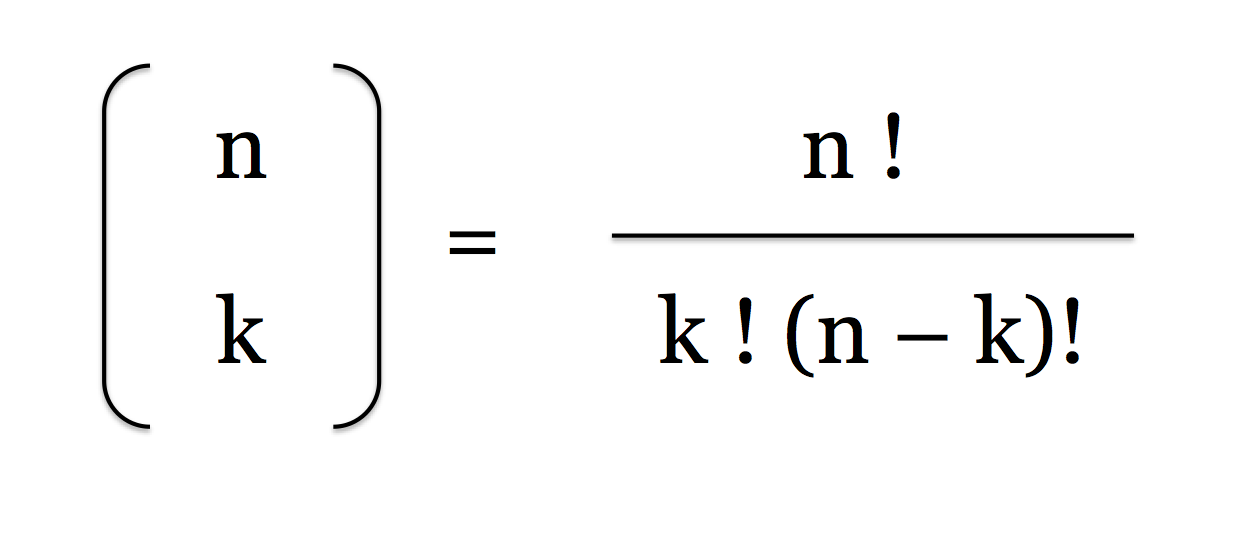
In general, if you have n outcomes and of these k are one type while (n - k) are another type, the number of permutations is given by the Binomial Coefficient:
|
|
Which is read as N (choose) K.
Notice that it doesn’t matter how you assign the two types since
k!(n-k)! will be the same in either case.