Probability and Pedigrees
Along with using pedigrees to assess whether a pattern of inheritance is recessive or dominant autosomal, we can also use them calculate the probability that an individual has – or will have – a particular genotype or phenotype. This uses the basic methodology of Mendelian Inheritance with the additional step of assigning genotypes to all individuals on the pedigree (at least those that are relevant to our question) that we can and then calculating from that point.
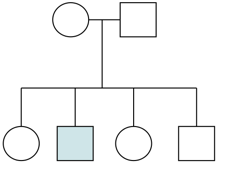
For example, for the trait in the following pedigree, you might want to know the probability that individual II3 is a carrier of the recessive allele.
|
|
To start, we can see that the trait must be
recessive since neither parent is affected while II2 is. We can thus assign the
genotype aa to II2 and Aa to both parents. So, we are
dealing with a cross of heterozygotes and the question becomes: From the cross
Aa x Aa what is the probability that a progeny is a carrier (genotype Aa)? However, we
need to add one component that often arises in pedigree analysis. We know that
II3 has the dominant phenotype and we have to account for this fact. From a
cross Aa x Aa we know that the probability of getting Aa is ¼. However,
this probability is predicted in advance of the progeny being born or observed. Once we know that
the progeny has the dominant phenotype
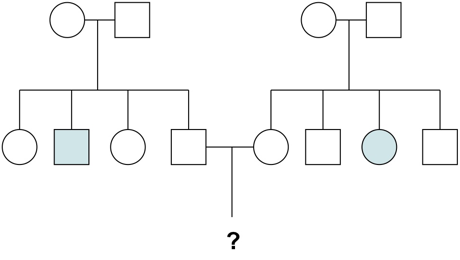
Of course, these types of questions can get increasingly complex but we always deal with them in the same way. The increased complexity usually comes from the fact that we have to deal with uncertainty about the genotypes of parents in the cross that we have to deal with in our question. For example, for the following pedigree we might be asked: What is the probability that II4 and II5 have an affected child?
|
|
Notice that this is essentially the same as the previous pedigree and involves a recessive trait. The complexity here comes from the fact that we do not know with certainty what the genotype of II4 is. As we just calculated there is a 2/3 chance he is Aa and, therefore, a 1/3 chance that he is AA. The way to deal with this uncertainty is to perform a calculation for EACH possible genotype and take into account the probability of the individual being that genotype. This is easiest to do in a table as shown below, but the table is not necessary, it is simply a useful tool to make sure you account for all possibilities and can more easily see where you might have made a mistake.
|
Possible Mating |
Pr(Mating) |
P(aa child) |
Overall |
|
M x F |
|
|
|
|
Aa x aa |
2/3 |
1/2 |
1/3 |
|
AA x aa |
1/3 |
0 |
0 |
This approach is also covered here.
The Pr(Mating) column is calculated using the AND rule. It is really the probability that the two parental genotypes, given in the first column, both occur. Since we know that II5 is aa, this reduces to the probability of the II4 genotype (e.g. 2/3 x 1 in the first row).
The “Overall” column is calculated from the AND rule: it is the probability that the mating in that row occurred AND the progeny had the required genotype (aa in this case).
The final answer is 1/3 + 0 = 1/3. This comes from an application of the OR rule. It is the probability that either the mating in the first row occurred OR the mating in the second row occurred.
This approach can be applied across numerous generations if necessary. Start at the top and work your way down to calculate the genotype probabilities for any necessary individuals in the first generation. Then apply these to do the same thing for individuals in the second generation. These can then be applied to calculations for the third generation and so forth, as far down the pedigree as necessary. If you utilize a table of the format given above the calculations are relatively straightforward.
Table of Contents