Recombination Frequency
We can deal with recombination in genetics if it occurs with a regular frequency; if we know how often it tends to occur between two genes then we can account for it when predicting possible progeny genotypes.
Luckily, recombination between any pair genes does tend to occur at a fairly regular frequency. This is because crossing over tends to occur randomly along the chromosome and so the probability of a cross-over occurring between two specific genes is roughly (but not exactly) the same every time meiosis occurs. As we will see, and as you probably know, this is correlated with how far apart the two specified genes are along the chromosome.
If we could observe every meiosis that occurred, detect every crossover, and figure out if it was between two genes we are studying, then we would have a good estimate of the frequency with which crossing over occurs between those genes. This is not really feasible, of course. What we can do, though, is observe how often a recombinant allele combination is inherited. Since this will occur only when there was a crossover between the two genes during meiosis, the frequency at which recombinant allele combinations are inherited is a measure of the frequency of crossing over between the genes.
Measuring Recombination Frequency (RF)
To begin, we will define Recombination Frequency (RF). RF is defined as the proportion of progeny from a test cross (this is important - you must use a test cross!) that inherit a recombinant allele frequency from the heterozygote parent. An important reason for measuring RF is that it can be used as an estimate of the distance between two genes on the chromosome. This is because the frequency at which recombinant gametes are formed by the heterozygote which will depend on how often crossing over occurs between the two genes which in turn is related to how far apart the genes are.
We measure Recombination Frequency using a Test Cross which is a cross between a heterozygote and a fully homozygous recessive individual: Aa Bb x aa bb. We cannot measure recombination frequency from a dihybrid cross!
1. We need to know the parental combination in the heterozygote: either cis or trans.
2. Once you know this, diagram it. Let us assume we are dealing with cis for our example. (Notice that allele arrangement is not important for the homozygote - no matter what it only produces [a, b] gametes.)
A B/a b x aabb
Four progeny genotypes are possible:
| Genotype | Progeny Phenotypes |
| AaBb | A and B phenotypes |
| aabb | a and b phenotypes |
| Aabb | A and b phenotypes |
| aaBb | a and B phenotypes |
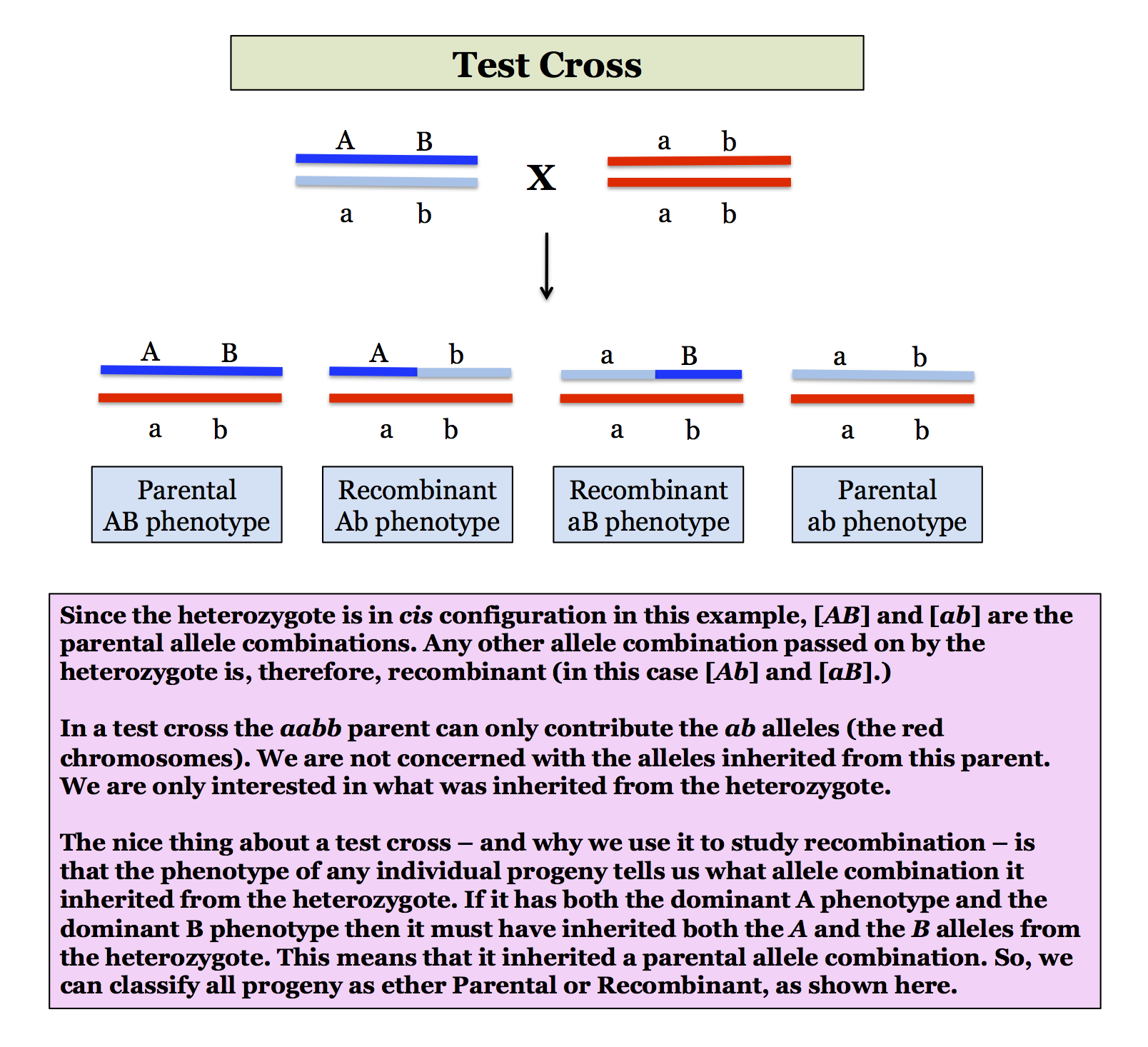
The first two can only arise if a parental chromosome (allele arrangement) is inherited from the heterozygote (by definition, one that did not cross over).
The other two are only possible if a recombinant chromosome is inherited. These arise when a crossover occurs between the two genes in the heterozygote.
That is the idea of a test cross. Since the aabb parent can only pass on [a, b] gametes, the phenotype of a given progeny tells you whether it inherited a parental or a recombinant gamete from the heterozygote. (If you did a dihybrid cross, a recombinant gamete could be inherited from either parent and it would become messy.)
3. Classify every progeny as parental or recombinant and count them.
4. Calculate:
Recombination Frequency (%) = # Recombinant progeny/#total progeny
The units are: 1% RF = 1 Map Unit (m.u.) = 1 centiMorgan (cM)
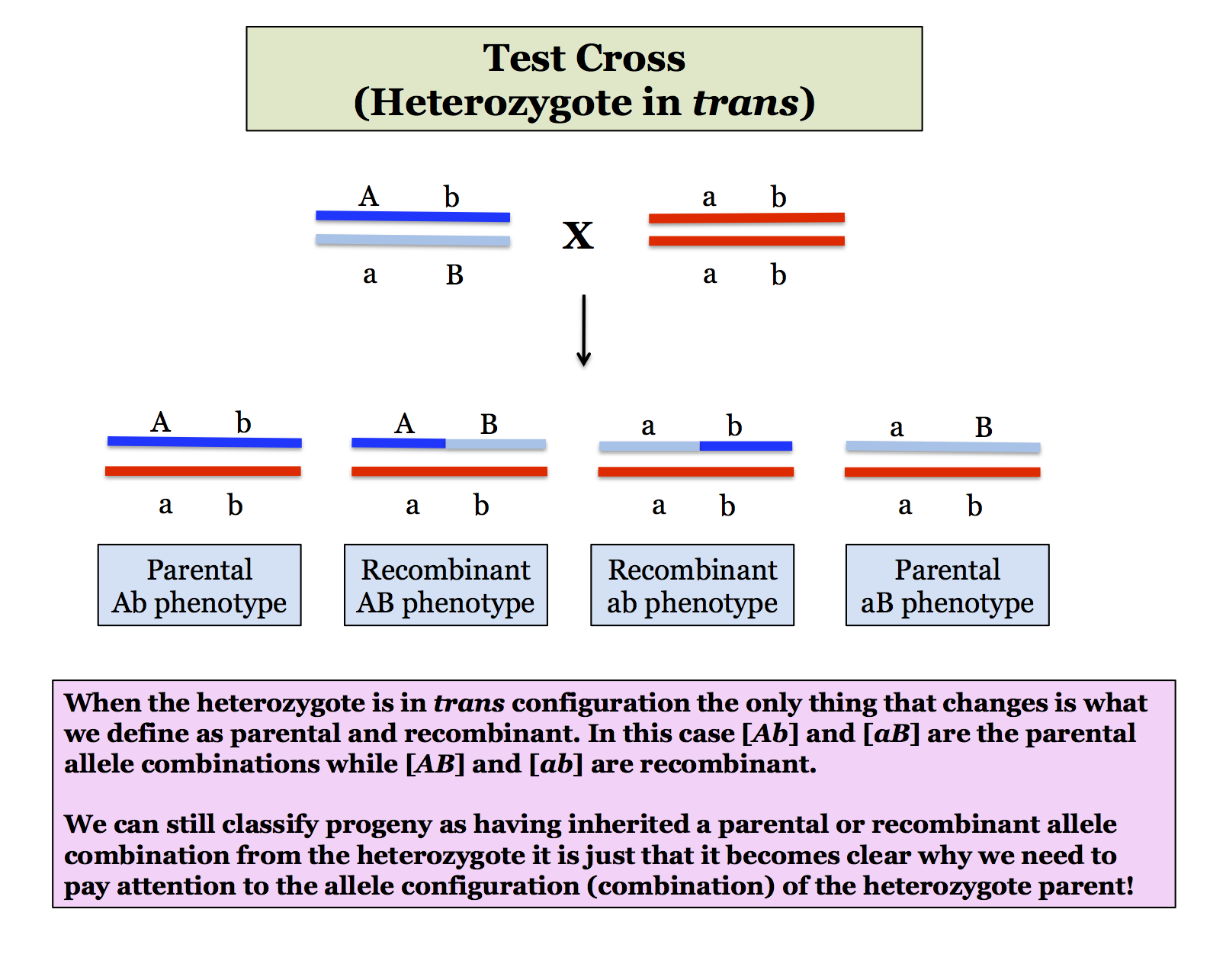
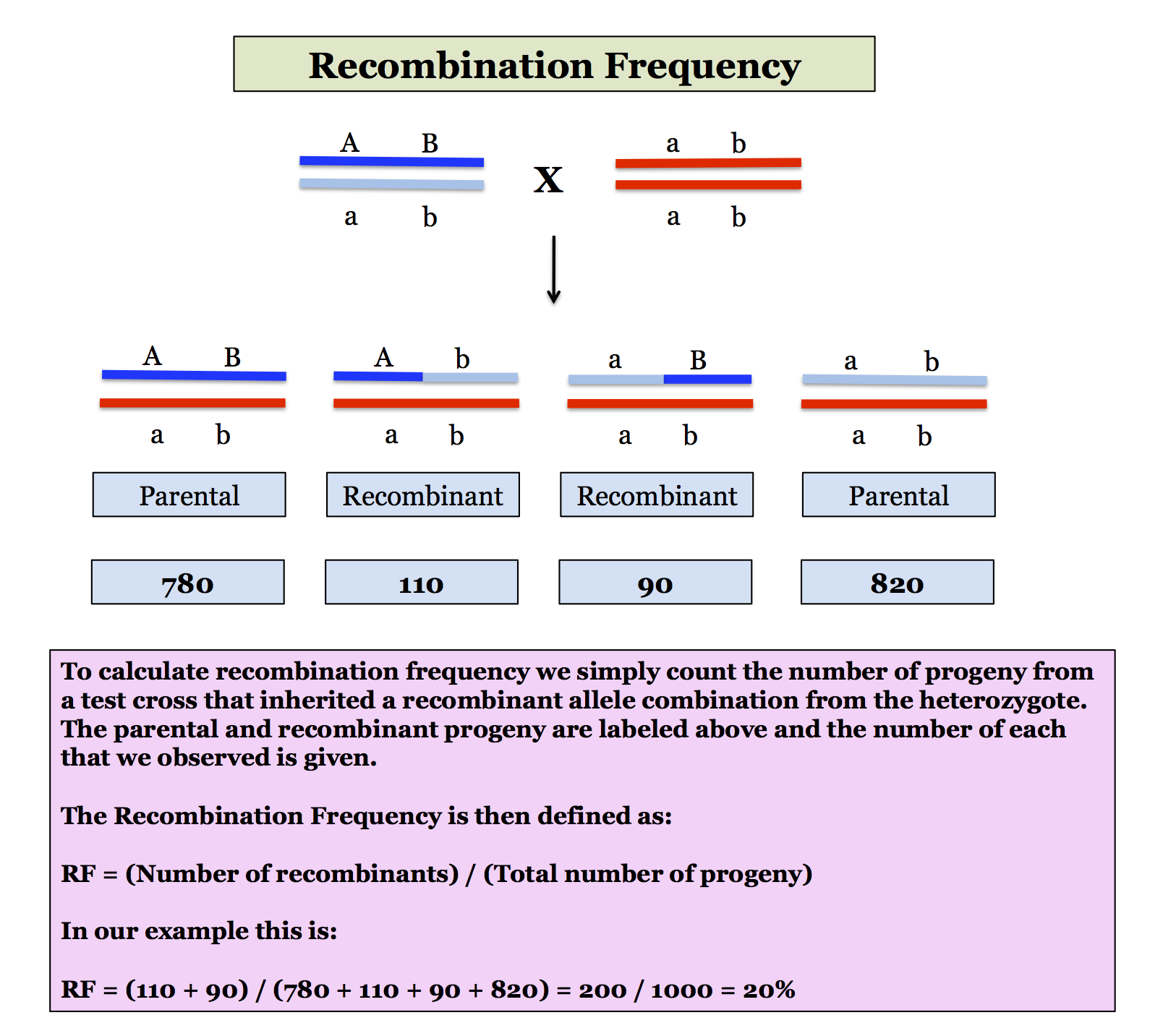
This material is shown in the following figures.
|
|
|
|
Genetic Distance (vs. Physical Distance)
The number of centiMorgans is our measure of the genetic distance between the two genes. Since RF will be related to how far apart the two genes are this is an estimate of distance. However, it is NOT a measure of physical distance. Physical distance is the number of nucleotides (length of DNA) between the two genes. Therefore, genetic distance, as measured by RF, and physical distance are different concepts. They are generally correlated, and will be as long as crossing over is random along the length of the chromosome, but we have to keep in mind that the two measures are based on different concepts.
Example
You perform a test cross, AaBb x aabb of an individual is cis configuration and observe the following:
We will use this example to illustrate an important point. Even without being told that the individual was in cis configuration it is obvious from the progeny numbers. Among the progeny the parental pair (those that inherited parental allele combinations) is always greater in number than the recombinant pair . For unlinked genes you expect parentals and recombinants to be in equal frequency: if you diagram this out you should see that you expect a 1:1:1:1 progeny ratio if the genes are unlinked. So, the maximum recombination frequency you can get is 50%. If you ever get a higher RF value you have mixed up the parental allele combinations!
Steps (1) and (2) should be obvious so we can proceed to Step (3) and classify the [A and B] and [a and b] phenotypes as parental and the other two as recombinant.
There are 350 total progeny and so for Step (4) we have:
RF = (53 + 56) / 350
= 31.1%
Therefore, the genes are 31.1 cM or 31.1 mu apart.
Another example is given in the figure below for two genes that are 20cM apart.
|
|