Regulatory Elements
| Eukaryotic Regulation | General Trx Factors |
Regulatory elements, also known as cis-regulatory elements, are regions bound by Transcription Factors and which play a key role in eukaryotic gene regulation as a result of this interaction. These regulatory elements are DNA regions that contain one or more Transcription Factor Binding Sites (TFBSs) which are short DNA sequence, typically about 6-12 nucleotides in length, that are recognized and bound in a sequence-dependent manner by a specific Transcription Factor.
One thing you may notice is that people sometimes refer to a regulatory element as a response element. This is just because the binding of Transcription Factors (and therefore the change in gene expression) usually happens when a cell is responding to a particular environment or signal. Because of this, the regulatory element involved in that process is thought of as a response element. So if you see the term response element, just think regulatory element.
|
|
On this page we will look at some of the general properties of regulatory elements and TFBSs and how they are involved in gene regulation. I should point out that in each of the figures here the regulatory elements are drawn upstream from the promoter. I do this just to keep the diagrams simple. In actual fact, regulatory elements are sometimes found downstream from the promoter, even within introns of the gene. Make sure that you have read the general overview before studying this material.
Defining Characteristics
The regulatory elements discussed here have two characteristics that differentiate them from the sequences located at the promoter, particularly the proximal promoter. These are:
These points apply to the entire set of TFBSs in a regulatory element as a group. The sites within an element function as a unit and the relative locations and orientations of the TFBSs within the regulatory element are important. The regulatory element itself can be moved around or inverted and still function, but not the individual TFBSs within the element.
It should also be stressed that these regulatory elements must be in cis-configuration with the gene (on the same DNA molecule) to function, and that they cannot be moved just anywhere on the chromosome and still function; it is only that regulation is not strictly dependent on them being in a specific location. How far away can they be? That actually differs between organisms. In single-cell eukaryotes like yeast we find regulatory elements very close to the promoter, usually within a couple hundred nucleotides. In more complex eukaryotes like Drosophila we often find them a bit further away. In complex eukaryotes like vertebrates we often find them quite distal from the promoter, sometimes tens of thousands of nucleotides away! Not only do they tend to be further away but we find many more of them per gene in vertebrates.
Enhancers and Silencers
There are two main types of regulatory elements, enhancers and silencers.
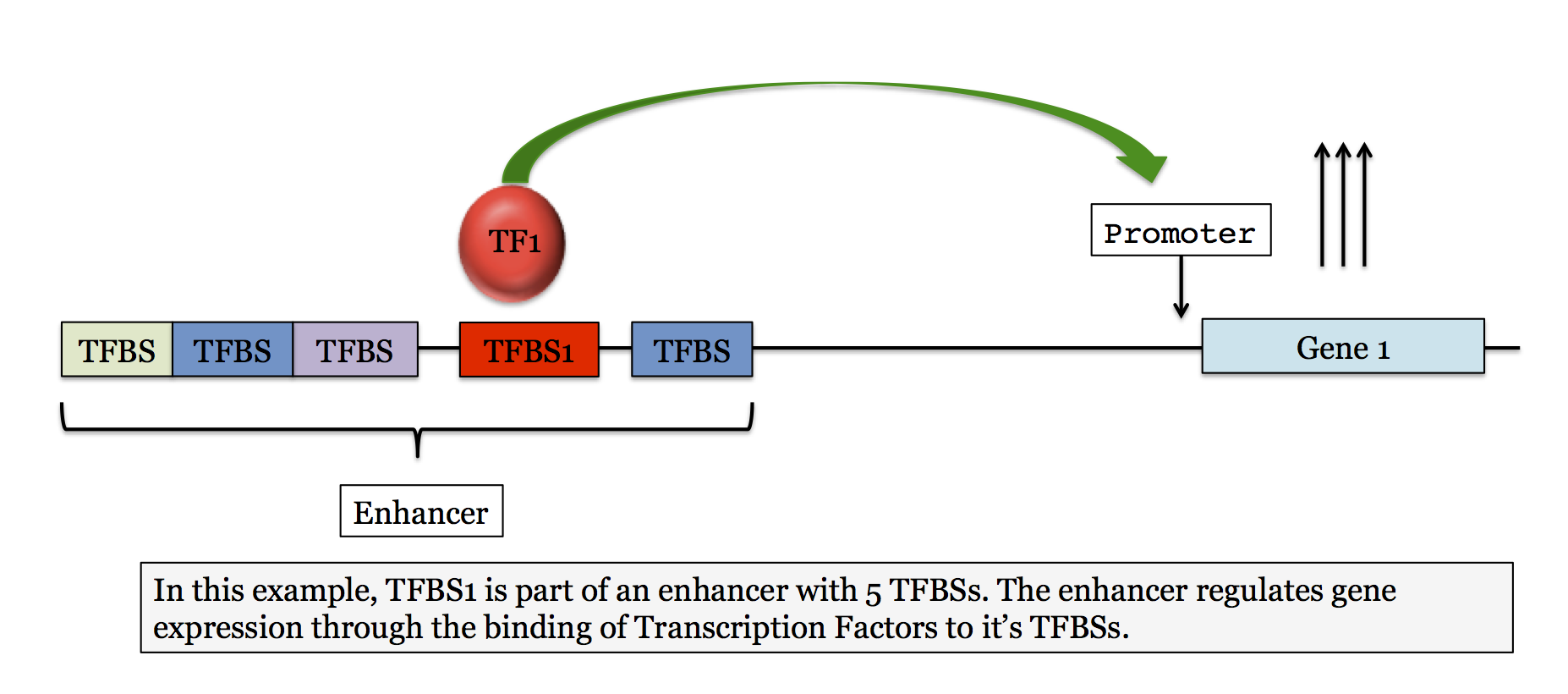
Enhancer: If gene expression increases when the regulatory element is bound by a Transcription Factor (or multiple Factors) then that element is called an enhancer. The degree to which expression is activated can vary depending on which of the TFBSs within the enhancer are bound.
Silencer: If gene expression increases when a regulatory element is bound by a Transcription Factor then the element is called a silencer. Unlike enhancers, silencers discovered so far are typically just a single TFBS but they are still called a regulatory element.
Enhancers appear to be far more common and have certainly been far more thoroughly studied by geneticists. Therefore, in the following examples we will study the action of enhancers. The same basic points hold true for silencers with the difference being a decrease, instead of increase, in expression of the regulated gene.
Binding by Transcription Factors
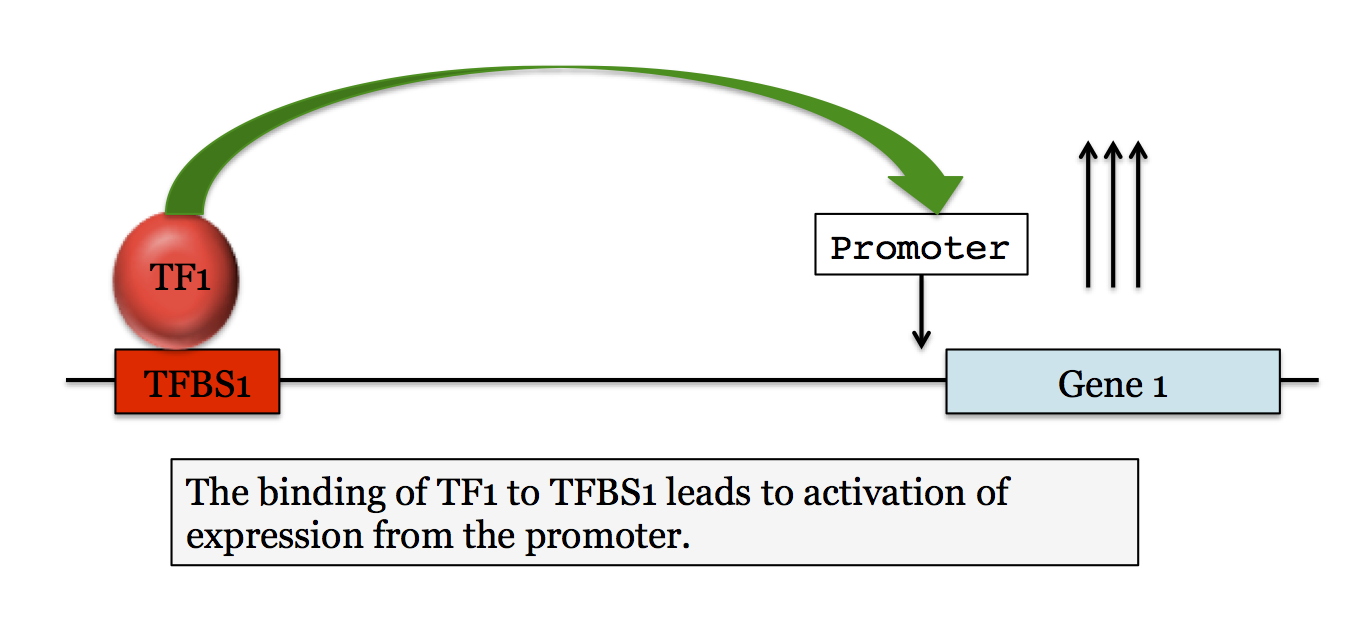
Let's make up a hypothetical TFBS and call it TFBS1. Since it is a TFBS it is recognized by a specific Transcription Factor: we will call this protein TF1. When TF1 is activated it binds to TFBS1 and then influences transcription initiation at the promoter. This is the basic idea of how TFBSs work.
|
|
If we now think about this function at the level of the enhancer, we can see that the binding of TF1 to TFBS1 is the same thing as the binding of TF1 to the enhancer that contains TFBS1. So we can say that it is the enhancer that is regulating expression.
|
|
TFB Sites in Enhancers Function as a Unit
A couple of times I have said something about the TFBSs in an enhancer acting as a unit. What does this mean? What I have presented here is a bit of a simplification of how the binding of TFs leads to gene activation. What geneticists actually observe is that activation by an enhancer requires that a particular set of the TFBSs in that enhancer be bound by TFs. What the enhancer seems to be doing is akin to reading (in a metaphorical sense!) the information in the set of TFs bound to it and activating gene expression in specific situations. How this is accomplished is still being investigated but what it indicates is that the enhancer is really a unit, not a set of independent TFBSs. We will continue to keep our model simple, however.
|
|
|
|
There are multiple copies of each TFBS in a genome
The next important point is that it is not the case that there is just one copy of TFBS1 (or any TFBS) in the genome. There might be multiple copies within a single enhancer and there can also be copies in different enhancers, not just near one gene but near many different genes. When TF1 is activated it binds to all of these TFBS1 sites, meaning that it binds to all of the enhancers that contain a TFBS1. As a result, any promoter that is near an enhancer that has a TFBS1 site is regulated by TF1.
|
|
Activation of Transcription Factors
Transcription Factors bind to TFBSs but only when active. This is how changes in environmental or cellular conditions lead to changes in gene expression.
|
|
The upshot of this is that whatever conditions lead to the activation of TF1 will lead to an activation of any gene that has a TFBS1 in a regulatory element.
General Features of Enhancer Function
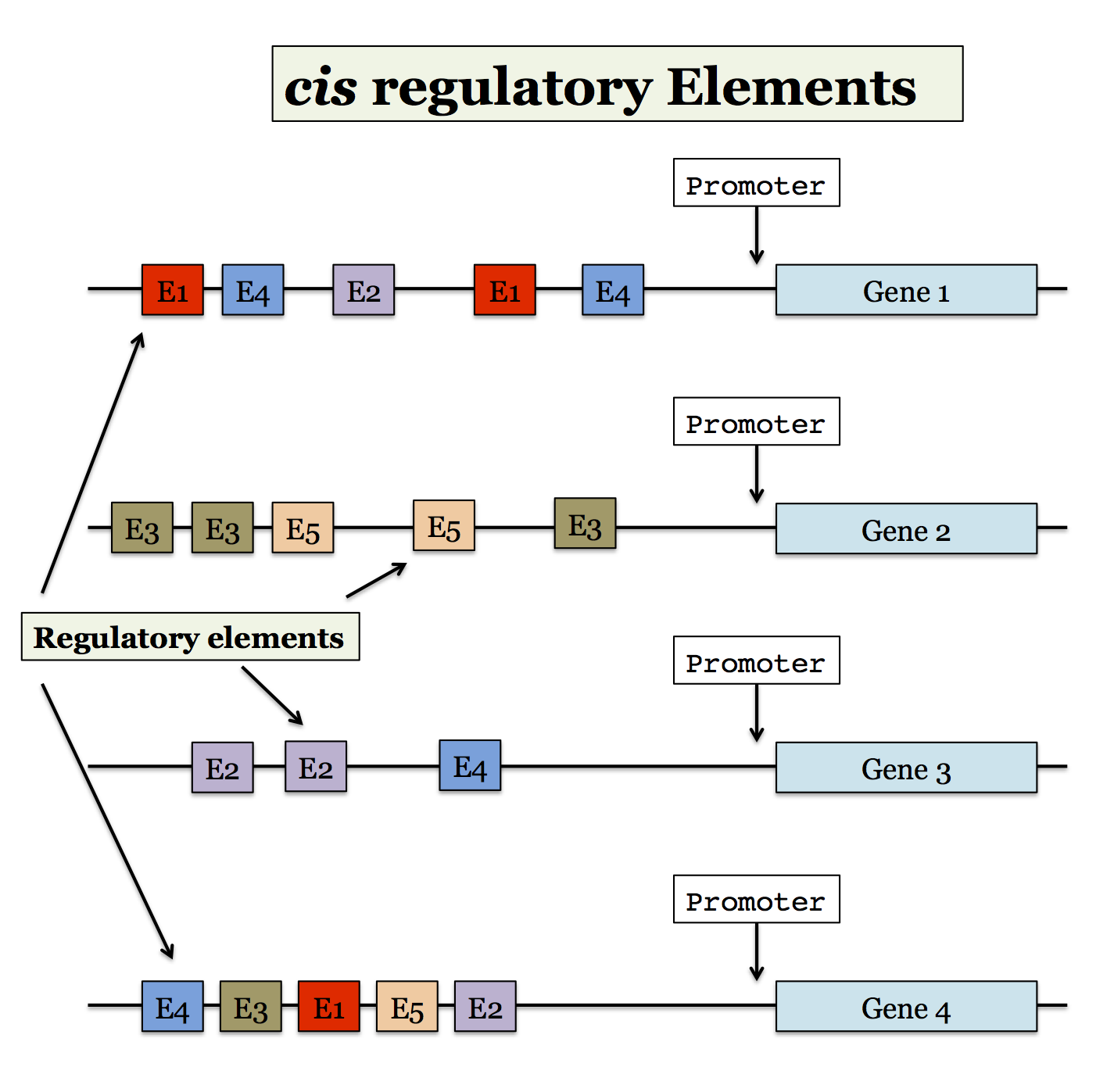
To expand on the idea that there are multiple copies of any given TFBS in the genome we can examine a hypothetical set of enhancers near a set of genes as illustrated in the diagram below. This will allow us to study some important general features of enhancers. In the next diagram, E(X) represents an enhancer that has a TFBS for Transcription Factor X. (For example, any element labeled E2 has a TFBS2 in it.) This means that a gene with E(X) nearby is regulated by Transcription Factor X. It should be stressed that this terminology is NOT meant to indicate that this is the only TFBS in the enhancer, nor does it mean that all enhancers labelled E2 (for example) are the same; what it does mean is that all E2 enhancers have a copy of TFBS2, along with other TFBSs that we are not taking into consideration here. Also, rather than draw in all of the TFBSs for each enhancer we will now simplify it a bit and show an enhancer element as a unit, ignoring the individual TFBSs within, and Transcription Factors binding to the unit.
|
|
This figure illustrates some specific points observed in real regulatory elements:
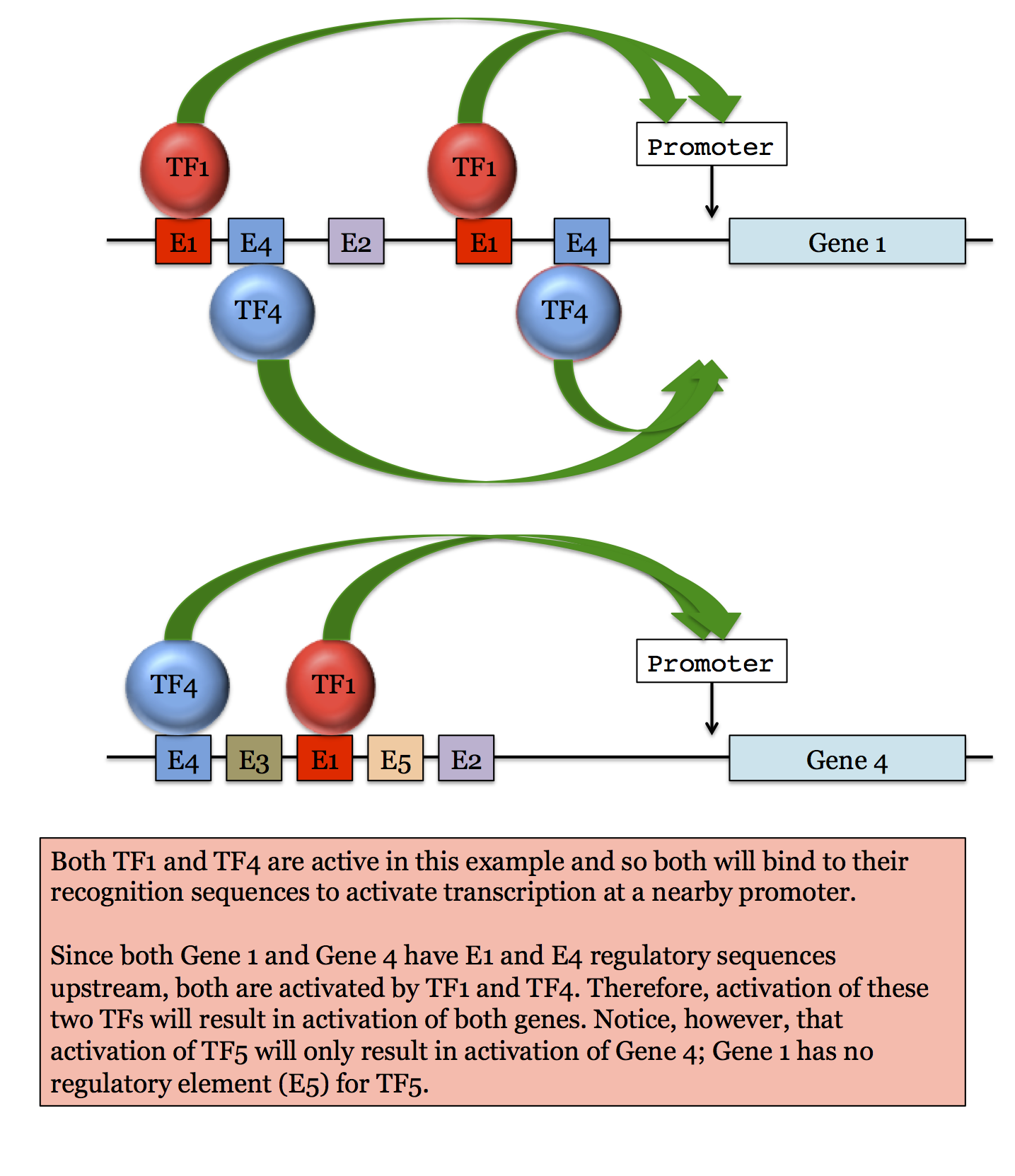
For example, in the following diagram both TFBS1 and TFBS4 are present in enhancers that regulate Gene 1. This gene will be regulated by both TF1 and TF4.
|
|
In the next example, since both Gene 1 and Gene 4 have E1 and E4 sequences upstream, each gene will be regulated by TF1 and TF4 as shown here.
|
|
| Eukaryotic Regulation | General Trx Factors |