RNA interference
| Eukaryotic Regulation | Table of Contents |
This section discusses post-transcriptional RNA-induced gene regulation, or RNA interference (RNAi), which refers to an inhibition of RNA stability and/or translation as the result of an interaction between an interfering RNA (either an siRNA - for small interfering RNA or short interfering RNA - or a miRNA - for microRNA) and a target mRNA.
The general mechanisms involving the two types of interfering RNA (siRNA and miRNA) are quite similar. However, the type of target RNA regulation (cleavage vs. translational repression and destabilization) is affected by whether the small RNA is an siRNA or miRNA, and the degree of complementarity between the small RNA and its target.
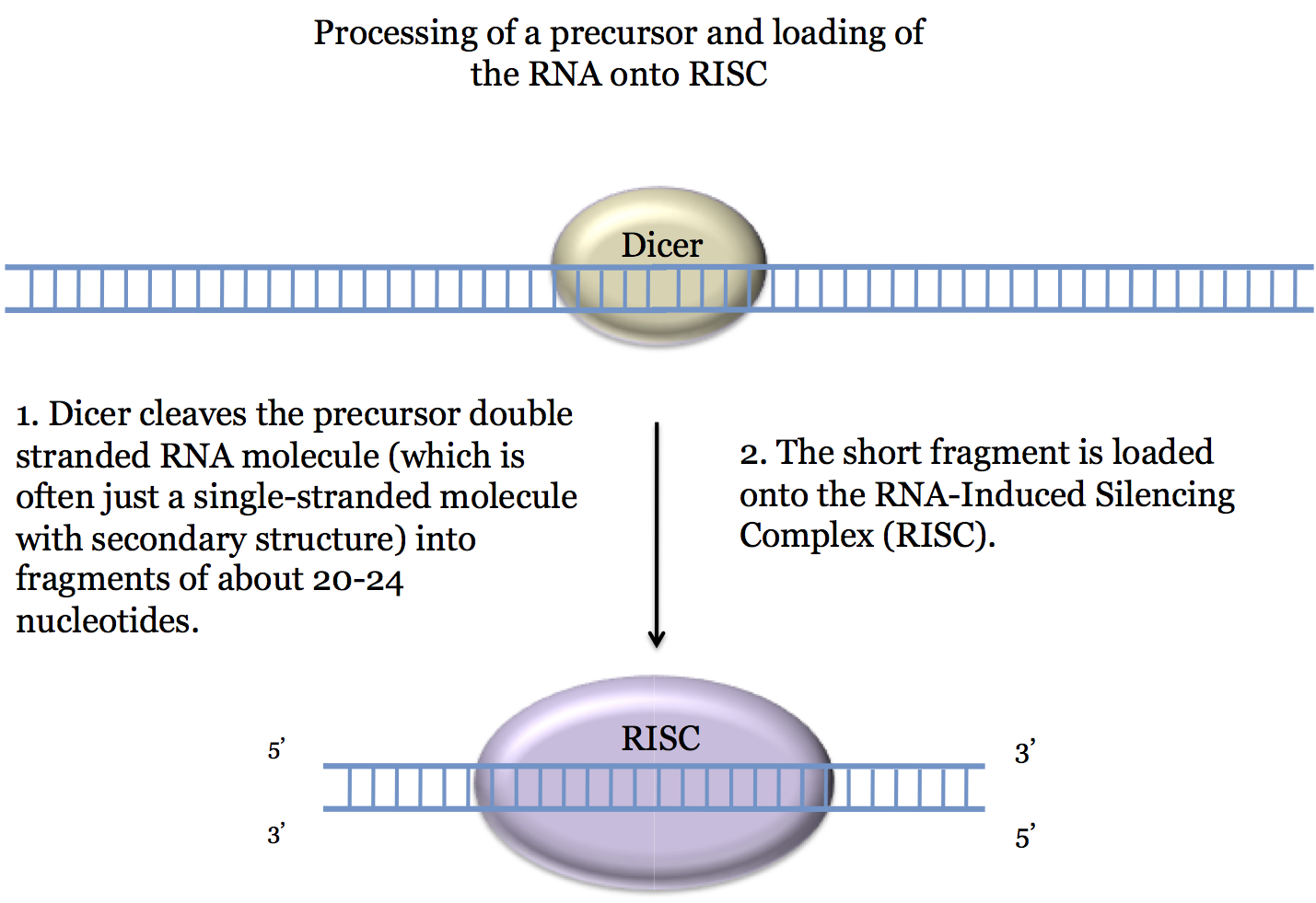
The initial stages of RNAi are similar for both siRNA and miRNA. Both are processed from a longer double-stranded RNA molecule that is the precursor. However, the source of the double stranded precursor varies. In the case of siRNA this is usually exogenous, that is it originates outside the cell (e.g. viral RNA), although endogenous siRNAs (encoded within the cell’s genome) have also been described. In the case of miRNA the precursor is endogenous and is expressed from a miR gene in the cell’s genome. The product of a miR gene is single-stranded but folds up into a secondary structure that contains a stem-loop. This transcript is processed to form a short, double stranded RNA through a pathway involving a protein called Drosha that cleaves this stem-loop so that it is essentially a double-stranded RNA.
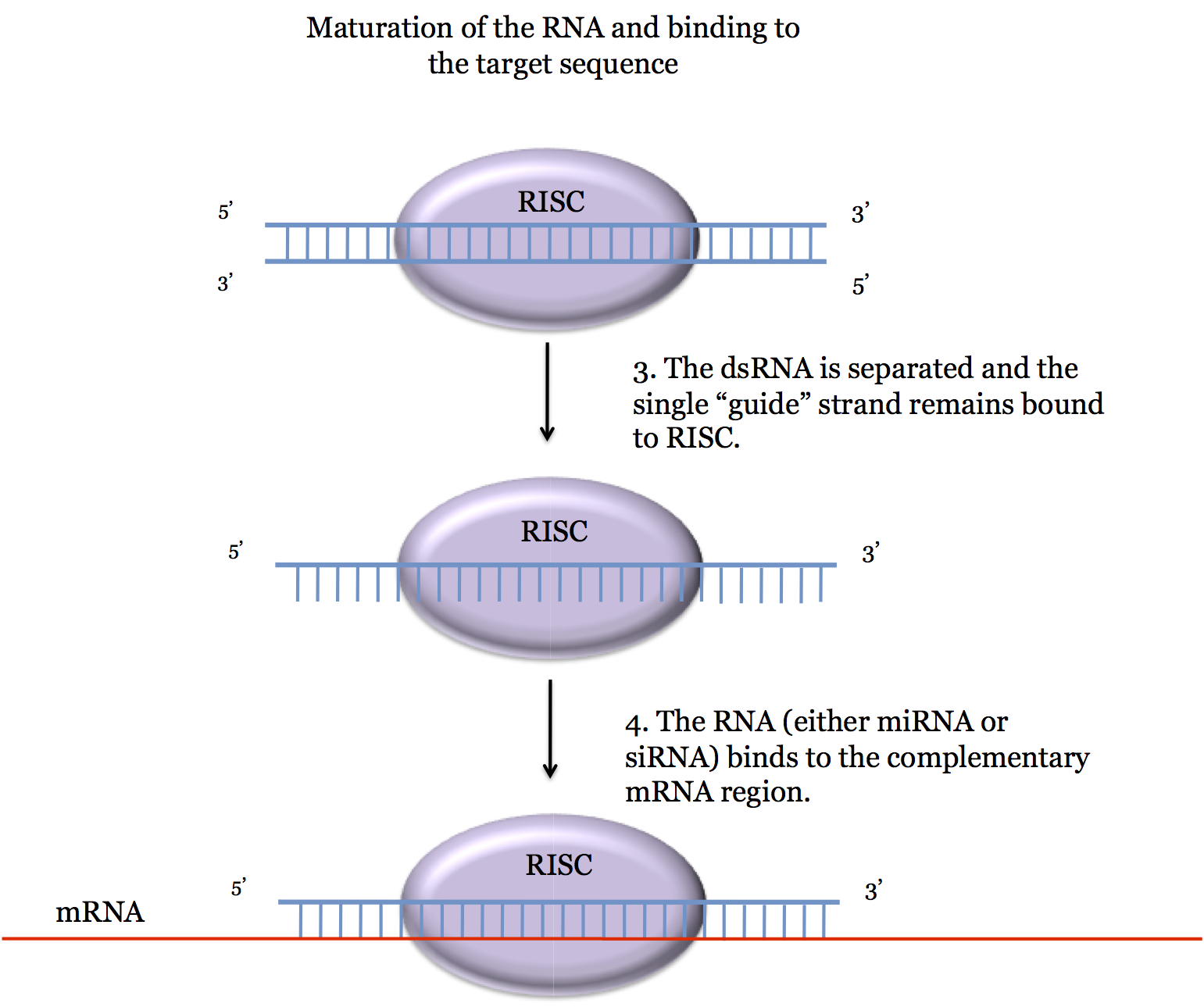
For both siRNAs and miRNAs, the larger dsRNA molecule is then cleaved by a protein called Dicer into shorter fragments of about 22-24 nucleotides in length. One strand from these fragments is then loaded onto RISC (RNA-Induced Silencing Complex).
RISC always contains a single-stranded small RNA (siRNA or miRNA) and a protein from the Argonaute family, although the exact protein composition can vary. The small RNA guides binding of RISC to target RNAs via sequence-complementarity. This always results in downregulation of target RNA translation, although the mechanism varies. Targets of siRNA-containing RISC are cleaved and rapidly degraded. In animals, mRNA targets of miRNA-RISC usually do not bind with 100% complementarity and are subject to translational repression and decreased mRNA stability.
|
|
|
|
|
|
The process can be viewed in these videos:
| Eukaryotic Regulation | Table of Contents |