Secondary Structure
| DNA Structure | Table of Contents |
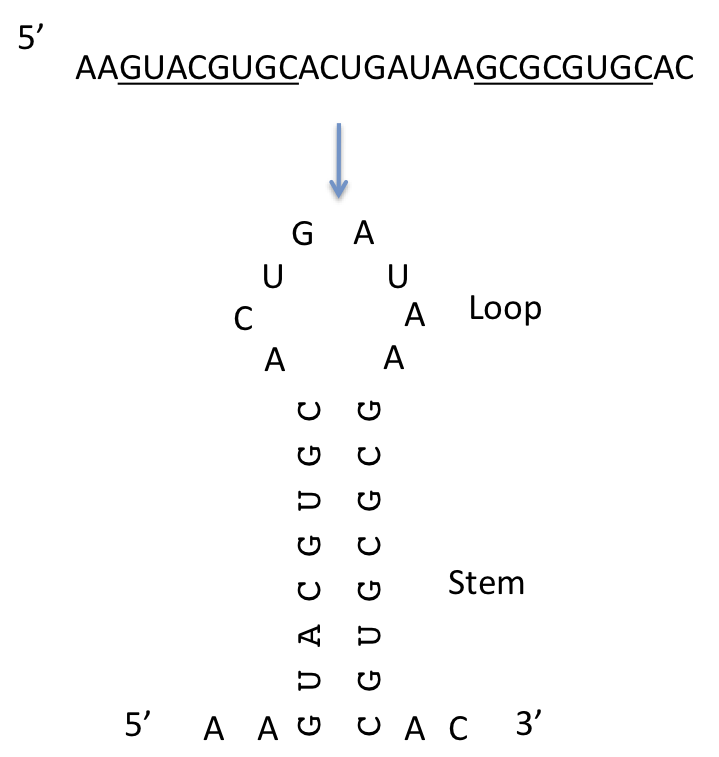
We often discuss the role of hydrogen bonding in the formation of a double-stranded nucleic acid from two complementary single-stranded molecules. What also plays an important role in biology is the ability of a single-stranded molecule to form secondary structure. This is a structure formed by hydrogen bonding between nucleotides in different regions of the same strand. As long as two regions are complementary to one another in anti-parallel then they can form such a structure.
If there is such complementarity in a single-stranded molecule then you will get the formation of something called a Stem-Loop structure, sometimes called a Hairpin-Loop as shown here.
|
|
These structures are usually quite small and not particularly stable. As covered in the section on melting temperature, the stability will be affected by the number of GC (as opposed to AT or AU) pairs within the stem, the length and the proportion of mismatches. Since these structures are not usually very stable they tend to form only briefly. A single-stranded molecule will fold into and out of this structure quite readily, with the amount of time spent with this structure formed being dependent on the stability.
Since RNA is commonly in single-stranded form, secondary structure in RNA is quite important. However, secondary structure formed by DNA molecules that are (perhaps just temporarily due to strand separation) single-stranded can also be important. Secondary structures in RNA can play a role in a number of processes such as Transcription and Regulation.
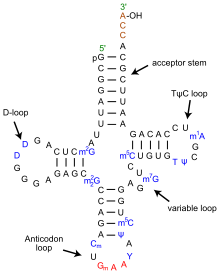
Secondary structure can also be more complex and be an integral part of the structure of molecules such as rRNA and in the familiar clover-leaf structure of tRNA:
|
|
| DNA Structure | Table of Contents |