Supercoiling
| DNA Structure | Table of Contents |
One problem that confronts cells as a result of the helical structure of DNA is supercoiling - a phenomenon that is not just an issue for DNA but for many physical structures. Supercoiling in DNA is the over-winding or under-winding of the two stands in a double-stranded molecule. In a typical B-DNA molecule the two strands are wound around each other once every 10 base-pairs. Under-winding is when they are wound once around one another over a longer stretch (more than 10 base-pairs) while over-winding would mean they cross over each other in less than 10 base-pairs.
You can think of a DNA molecule that is 100 base-pairs long. The two strands should be wound around one another 10 times in this molecule. If they cross one another 20 times, for example, then it is overwound while if they cross one another just 5 times then it is under-wound.
Under- or over-winding is a problem because it is not energetically favored and this introduces tension into the molecule. The tension results in knotting of the overall structure (the knotting relieves the tension) and you can think of this knotting as the problem of supercoiling. As with any substance, only so much tension can be introduced, after which the substance is stressed to the point of breaking. In the case of DNA it also means that as tension increases it takes more and more energy to introduce any more winding.
Linear DNA: Ignoring for now how it might happen biologically, imagine taking a DNA molecule and fixing one of the ends so it cannot rotate. Then, twist the molecule in either direction; one will under-wind and the other will over-wind (it would be obvious which is which if you were holding the molecule). The diagram below shows this twisting - with the left end fixed but the right end free to rotate - and the resulting knots that occur. Don't worry about the Writhe number but notice the twist is either positive or negative, we use these two terms to differentiate whether you have over-or under-wound. In DNA, under-winding is referred to as negative supercoiling while over-winding is referred to as positive supercoiling. What you should notice is that the knotting occurs in opposite directions for negative and positive supercoiling although the general effect of knotting is the same.
The diagram is simplified so that the initial molecule is not really a helix but it should get the idea across.
|
|
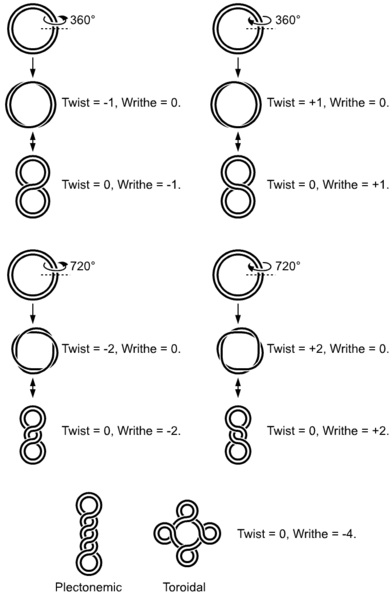
Circular DNA:The same phenomenon occurs in circular DNA molecules. There are no free ends so you can over-wind it quite easily b pulling apart the two strands in one location. Since the molecule is circular, if you do this you don't change how many times the two strands are wrapped around one another but you do force the wraps into a smaller area - this area will be over-wound as a result. Unlike the case of a linear molecule above, where we left one end free to rotate, under-winding a circular DNA molecule would require that you cut one of the two strands.
Supercoiling of a circular molecule is shown here although rather than showing under- or over-winding it just shows the molecule being twisted. Regardless, the end result is the same; tension is introduced and the molecule knots up. Again, positive and negative supercoiling result in knotting in opposite directions.
|
|
Supercoiling in cells: We can now turn our attention to how under- and over-winding occurs in cells. The major source of supercoiling inside a cell is over-winding as a result of processes that separate the two strands; processes such as replication and transcription. In each case, the two DNA strands need to be separated so that one or both of them can be used as a template. If there is no free end to rotate then this will force the wraps into a smaller area of the molecule and, as a result, this area will be positively supercoiled. This is particularly a problem for replication as the separation just keeps growing in length along the entire molecule.
You should keep in mind that this is even an issue for linear molecules. Usually, although chromosome ends exist, replication forsook or transcription bubbles are approaching one another. This forces the wraps into smaller and smaller areas. The general message is: positive supercoiling is constantly being introduced into DNA. If this is not relieved the cell will eventually snap the DNA or it will become energetically unfeasible to separate strands any further. Neither is a very nice option for the cell.
Relieving supercoiling: Cells have a number of enzymes that function to relieve supercoiling. Some of these will also generate negative supercoiling so that most chromosomes are in a negatively supercoiled state much of the time. These enzymes are referred to topoisomerases as a class and there are two general types:
| DNA Structure | Table of Contents |