Topologically Associating Domains
| Chromosome Structure |
A popular picture of a chromosome is a set of genes arranged on a long DNA molecule. This is a partially accurate representation but what it misses is the fact that metazoan chromosomes actually have a spatial organization. To get the general idea of this organization think of a long city street like Broadway in NYC. It stretches from the one end of Manhattan island to the other (and north of that) without interruption. However, if you travel the length of Broadway you find that it is divided into blocks.
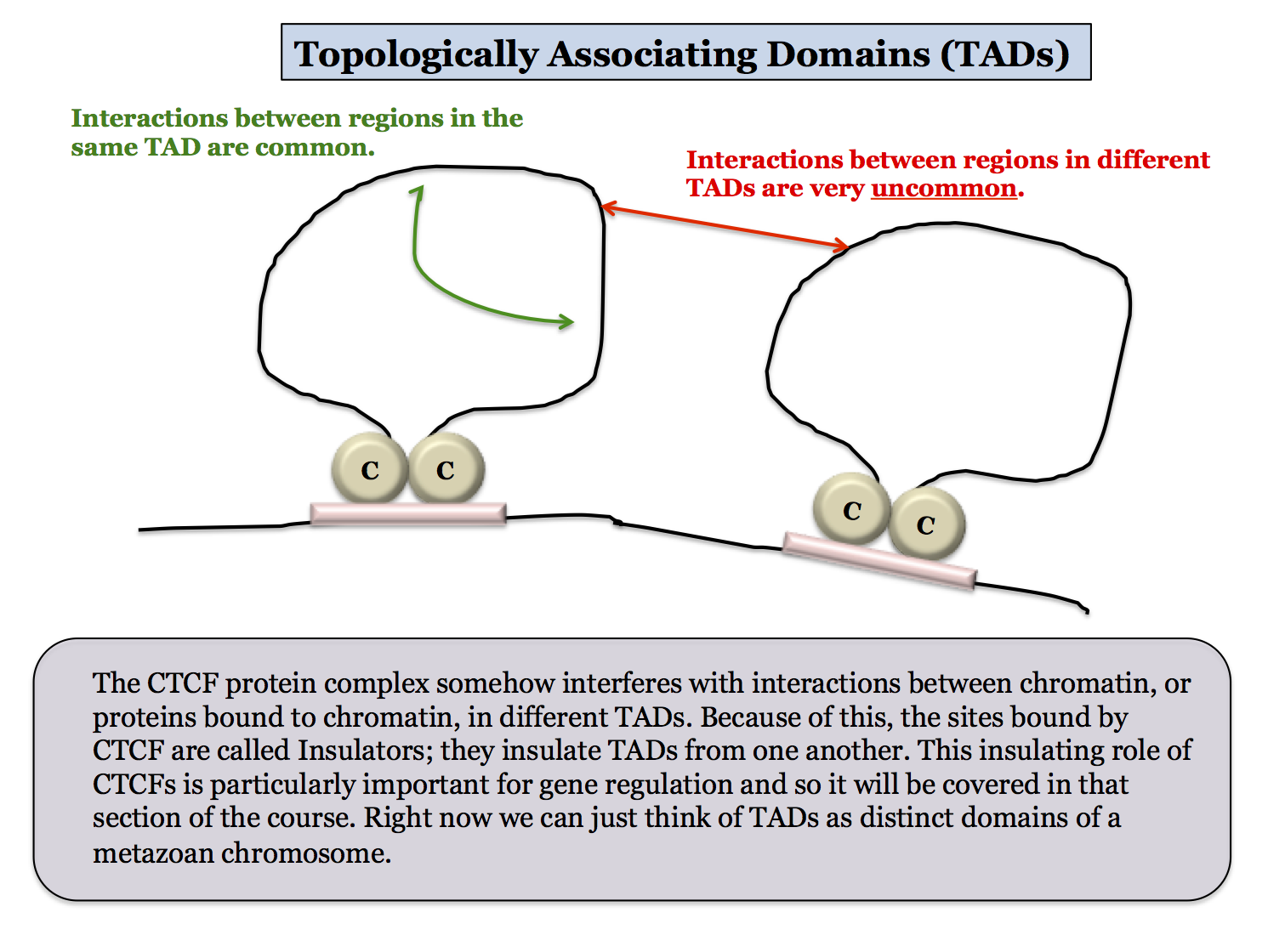
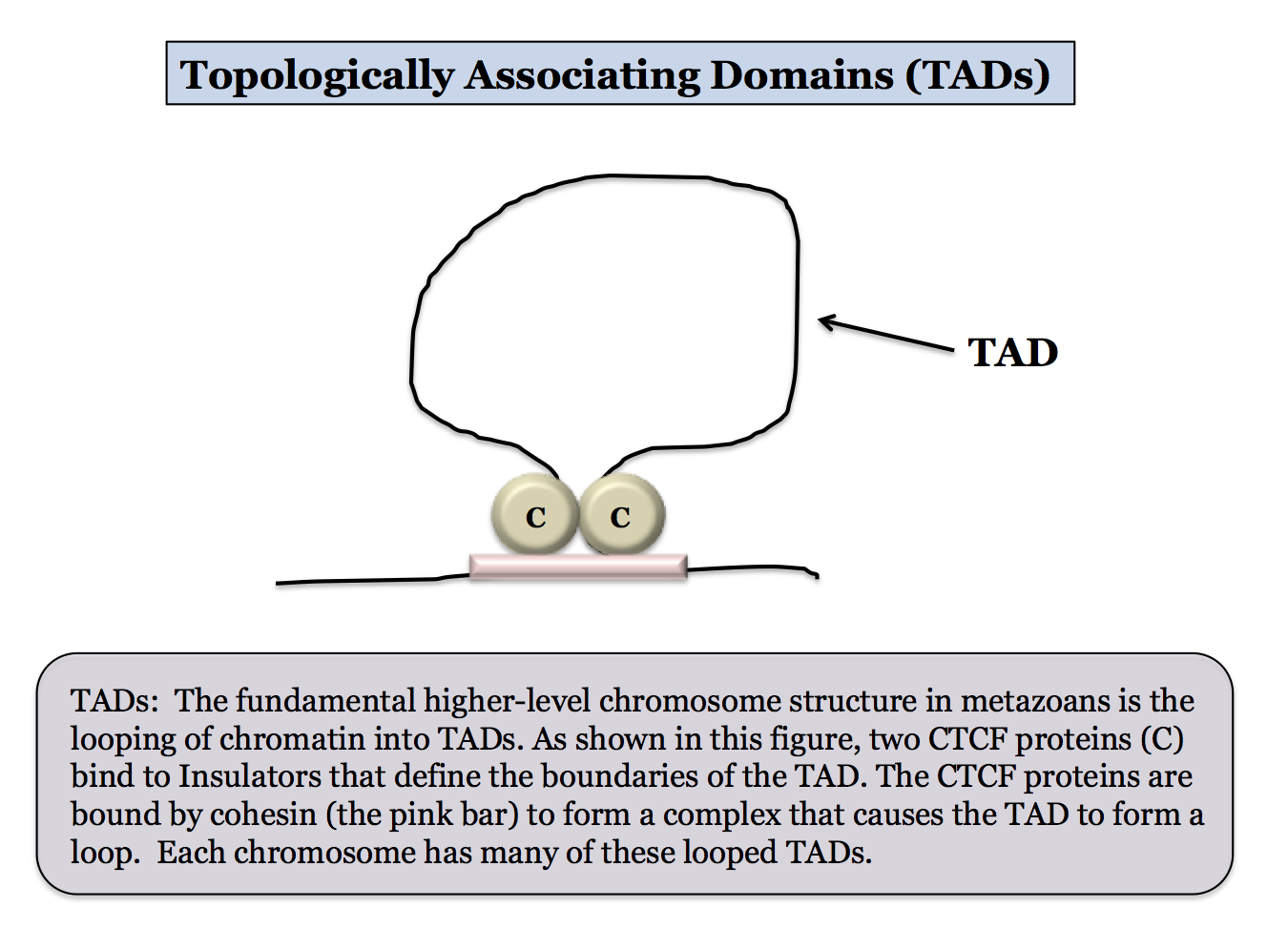
Similarly, eukaryotic chromosomes are divided into sections which are called Topologically Associating Domains or TADs. The TADS are side by side along the length of the chromosome. Of course, there aren't any side streets to divide the chromosome. Instead, TADS are separated by proteins that are bound to the DNA at sites called Insulators. The proteins can then interact to loop out the DNA between them as shown here.
|
|
We don't want to take the city block metaphor too far. TADs are more isolated from one another than blocks are. As we will see in the section on gene regulation, certain reactions and chromatin modifications are limited to one domain so that different domains end up with different regulatory properties. This makes sure that what is happening to a gene in one domain does not have an influence on genes in nearby domains. It wouldn't be misleading to think of Insulators (or, really, the proteins bound to Insulators) as acting like walls that separate - insulate - TADs from each other.
|
|
Overall, a metazoan chromosome is divided into a set of loops, or TADS, that are functionally separated from each other. To give you a rough idea of the size of these domains, experiments have indicated that they average somewhere between 200,000 and one million bases in length in the human genome.
Although it is not a great page overall you can find a nice diagram of TADs in the section on Loops of Chromatin here.
| Chromosome Structure |