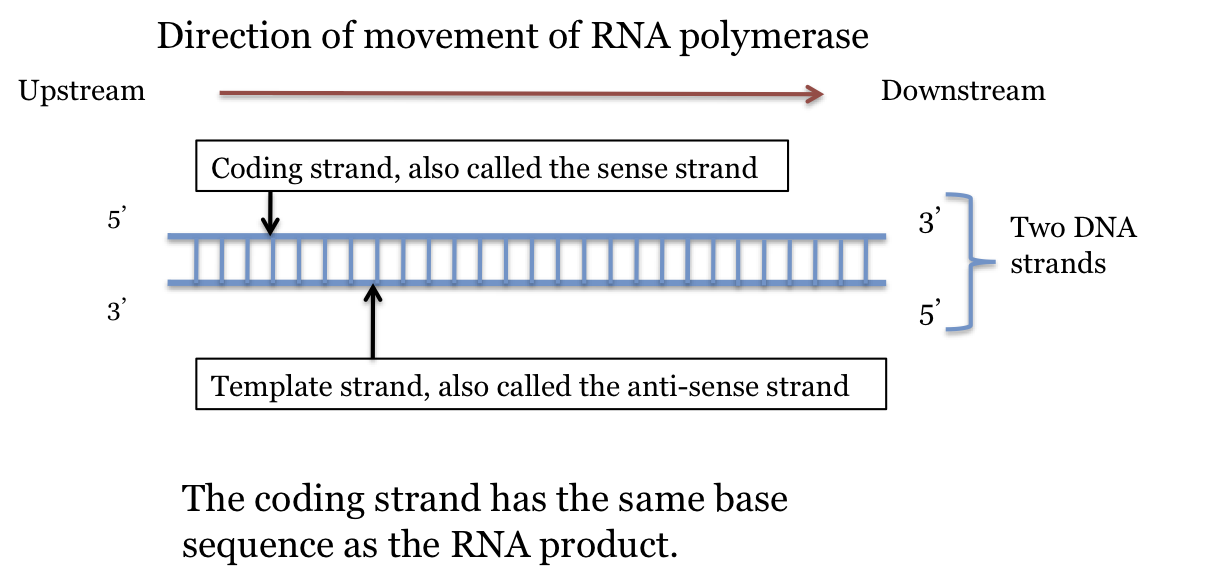
During transcription, one strand of a double-stranded DNA molecule is used as a template to generate a single-stranded RNA molecule by polymerization. The reaction is carried out by an RNA polymerase which catalyzes the formation of a phosphodiester bond between two NTP molecules. The important features summarized in the first figure are:
- The strand of DNA that contains the same sequence of nucleotides as the RNA transcript (accounting for the use of Uracil in RNA instead of Thymine) is the coding strand, also referred to as the sense strand.
- The other strand of DNA is the template strand, also referred to as the anti-sense strand.
- Like DNA polymerase, RNA polymerase synthesizes in the 5' to 3' direction. Unlike DNA polymerase it does not need a primer but can synthesize de novo.
- Using the coding strand as the reference strand, anything that lies in the 3' direction is referred to as upstream (which is used in a relative sense, so something is upstream from a specific point along the coding strand). The other direction is downstream. Therefore, the RNA polymerase moves in the downstream direction.
|
|
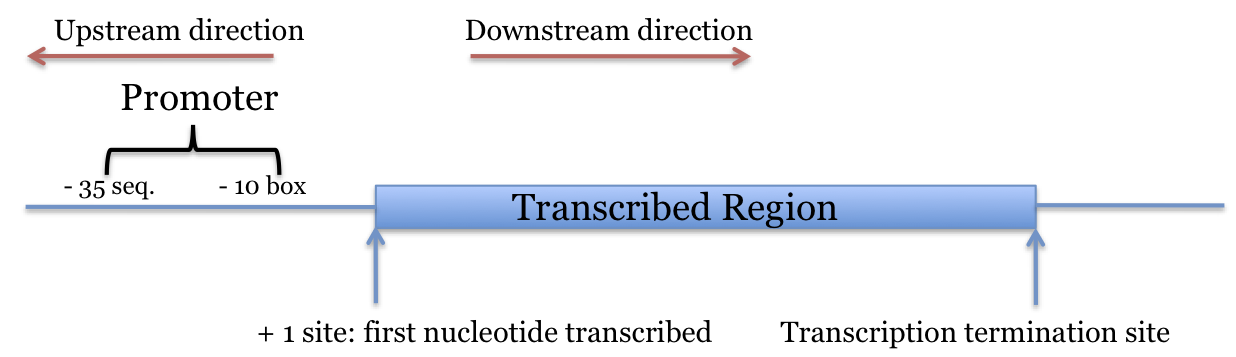
Having discussed these general terms we can now look at a specific region of DNA that is transcribed. The major points summarized in the next figure are listed here. They are expanded upon in the pages covering Prokaryotic and Eukaryotic Transcription.
- The entry point for RNA polymerase is called the promoter. A promoter is simply a specific DNA sequence which is different in different organisms and for different RNA polymerases within an organism. A specific RNA polymerase (or associated proteins) recognizes its promoter sequence and binds to the DNA molecule at this point. The promoter indicated in the diagram below is from E. coli. It consists of two short sequences nearby one another; the -35 sequence and the -10 box. These will be discussed further under transcription initiation. Eukaryotic promoters have a different structure.
- Once RNA polymerase is bound it can initiate transcription. The nucleotide at which transcription initiates is called the Transcription Start Site (TSS). For some promoters the TSS is the same every time transcription occurs but for other promoters (particularly in eukaryotes) transcription initiates at any one of a number of different sites.
- By definition the TSS is numbered as the +1 nucleotide. The nucleotide that is immediately upstream from the +1 is the -1 nucleotide; there is no 0 nucleotide. Every site is numbered in the + and the - direction away from these two sites. This is where the -35 and -10 sequences get their names; the numbers indicate the approximate position relative to the +1 site.
- RNA polymerase transcribes until it reaches a transcription termination site. The region transcribed is called the Transcribed Region.
- Notice that it is the promoter that orients everything. We defined the coding strand as well as upstream and downstream based on the polarity of a DNA molecule. Since RNA polymerase binds to the promoter sequence, it is the direction that this sequence exists that defines the direction that RN polymerase will move and, therefore, which strand is coding. If you were to "flip" the promoter in a DNA molecule, then the RNA polymerase would move in the opposite direction using the other strand as the coding strand (which would be 5' to 3' in this direction!).
|
|