Uncertainty about Parental Genotypes
A common problem in genetics is the need to calculate the probability of progeny genotypes or phenotypes when you are not certain about the genotype of one or both parents. It is very important to learn how to deal with this sort of situation and so it is a separate topic here. It is also one of the more difficult parts of solving basic genetics problems and so the more you practice it the better.
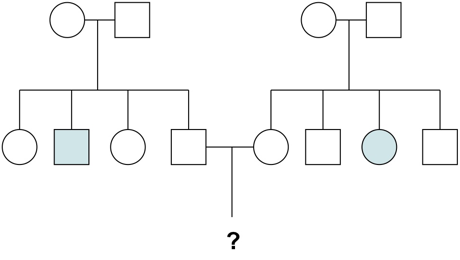
An example is shown in the pedigree below. The trait is obviously recessive (can you see why?). What if you are interested in knowing the probability that II4 and II5 have child with this trait. Given their family history we can see that it is possible that they are both carriers. How do we answer this question when we are uncertain about their genotypes?
|
|
We will start with a simpler example. Consider the situation when you have performed the cross Aa x Aa and taken one of the progeny that has a dominant phenotype. You then test cross this - that is, cross it to an aa individual - and get one progeny. What is the probability that this progeny is aa?
The difficulty in answering this is that you don't know whether you chose an AA progeny or an Aa individual and, of course, the genotype of this individual is will affect the answer. Despite this, you can still answer the question.
You can do this by applying two things that you do know:
1 - You know the probability that the one you chose is AA, and the probability that it is Aa.
2 - You know what you would get in each case. If you chose an AA individual then you will get 100% Aa from the cross. On the other hand, if you chose Aa then you would get 50% Aa and 50% aa (and, thus one half recessive phenotype).
What we describe in (2) are the Conditional Probabilities of progeny genotypes (for example, the probability of Aa IF the parents are Aa and aa). You could leave everything as Conditional probabilities, but it is possible to combine the two items listed above to come up with overall progeny genotype probabilities that account for parental uncertainty AND conditional probabilities. This will then be your predictions for progeny genotypes. (Also, your professor might not accept just Conditional probabilities!)
The way to combine these two points is to take into account every POSSIBLE cross. You can easily calculate the probability of each cross and the probability of each progeny if that were indeed the cross. The overall progeny probabilities are then calculated by applying the OR rule to the crosses. This sounds a bit difficult and it is much easier to see if you lay them all out in a Table as follows:
|
Possible Mating |
Pr(Mating) |
Pr(aa progeny) |
Overall |
|
M x F |
|
|
|
|
Aa x aa |
2/3 |
1/2 |
1/3 |
|
AA x aa |
1/3 |
0 |
0 |
The Pr(Mating) column is calculated using the AND rule. It is really the probability that the two parental genotypes, given in the first column, both occur. Since we know that the Female is aa (P = 1), this reduces to the probability of the Male genotype (e.g. 2/3 x 1 in the first row).
Why is the probability of the Male genotype 2/3 for Aa and 1/3 for AA? If you are uncertain about this you should review the material on Adjusting Genotype Probability.The Pr(aa progeny) column is the conditional probability of the outcome that you are asked about (aa in this case). If you were asked about the probability of an Aa progeny then you would fill in that probability for each row. It is really a Pr(Outcome asked about) column.
The Overall column is calculated from the AND rule: it is the probability that the mating in that row occurred AND the progeny had the required genotype (aa in this case).
The final answer is 1/3 + 0 = 1/3. This comes from an application of the OR rule. It is the probability that either the mating in the first row occurred OR the mating in the second row occurred. This is the answer to the question above about the probability of a progeny being aa. Of course, if you get one aa progeny then you would answer future questions differently. Once this happens you are no longer uncertain about the parents - you know that the cross is so from that point on the answer to the question is 1/2.
Independence of progeny: An important thing to notice is that different progeny from the same cross must have the same parents. Therefore, the probabilities of each progeny genotype are not fully independent. If you consider the cross Aa x aa then the progeny probabilities are independent and can be multiplied. So, the probability of getting two aa progeny from this cross is 1/2 x 1/2.
However, when parental genotype is uncertain, the Overall probability of a progeny being aa that you calculate from the table above is NOT independent of the overall probability that a second progeny is aa. This is because the progeny MUST have the same parents but the overall probability you calculate for a single progeny incorporates the probability of parental genotypes (the P(Cross)). Therefore, when you multiply them together you are multiplying the probability of the parental genotypes twice. This is like saying The probability that the parents are Aa x aa and the first child is aa and the parents are Aa x aa and the second child is aa. But if the cross is Aa x aa for the first child it cannot be AA x aa for the second!
Because of this non-independence of, essentially, parental genotypes, you cannot multiply the overall probabilities together. If you are asked for the above table about the probability of getting 2 aa the answer is not 1/3 x 1/3. Instead, the way to deal with this type of question is to consider the two progeny togetheras the outcome:
|
Possible Mating |
Pr(Mating) |
Pr(2 aa) |
Overall |
|
M x F |
|
|
|
|
Aa x aa |
2/3 |
1/2 x 1/2 |
1/6 |
|
AA x aa |
1/3 |
0 x 0 |
0 |
|
Possible Mating |
Pr(Mating) |
Pr(aa) |
Overall |
|
M x F |
|
|
|
|
AA x AA |
1/3 x 1/3 |
0 |
0 |
|
AA x Aa |
1/3 x 2/3 |
0 |
0 |
|
Aa x AA |
2/3 x 1/3 |
0 |
0 |
|
Aa x Aa |
2/3 x 2/3 |
1/4 |
1/9 |