cis elements and trans-acting Factors
| Prokaryotic Regulation | Table of Contents |
Two terms that you see quite often are "cis element" (or "cis regulatory element") and "trans-acting factor" (or just "trans Factor) so it is important to understand them.
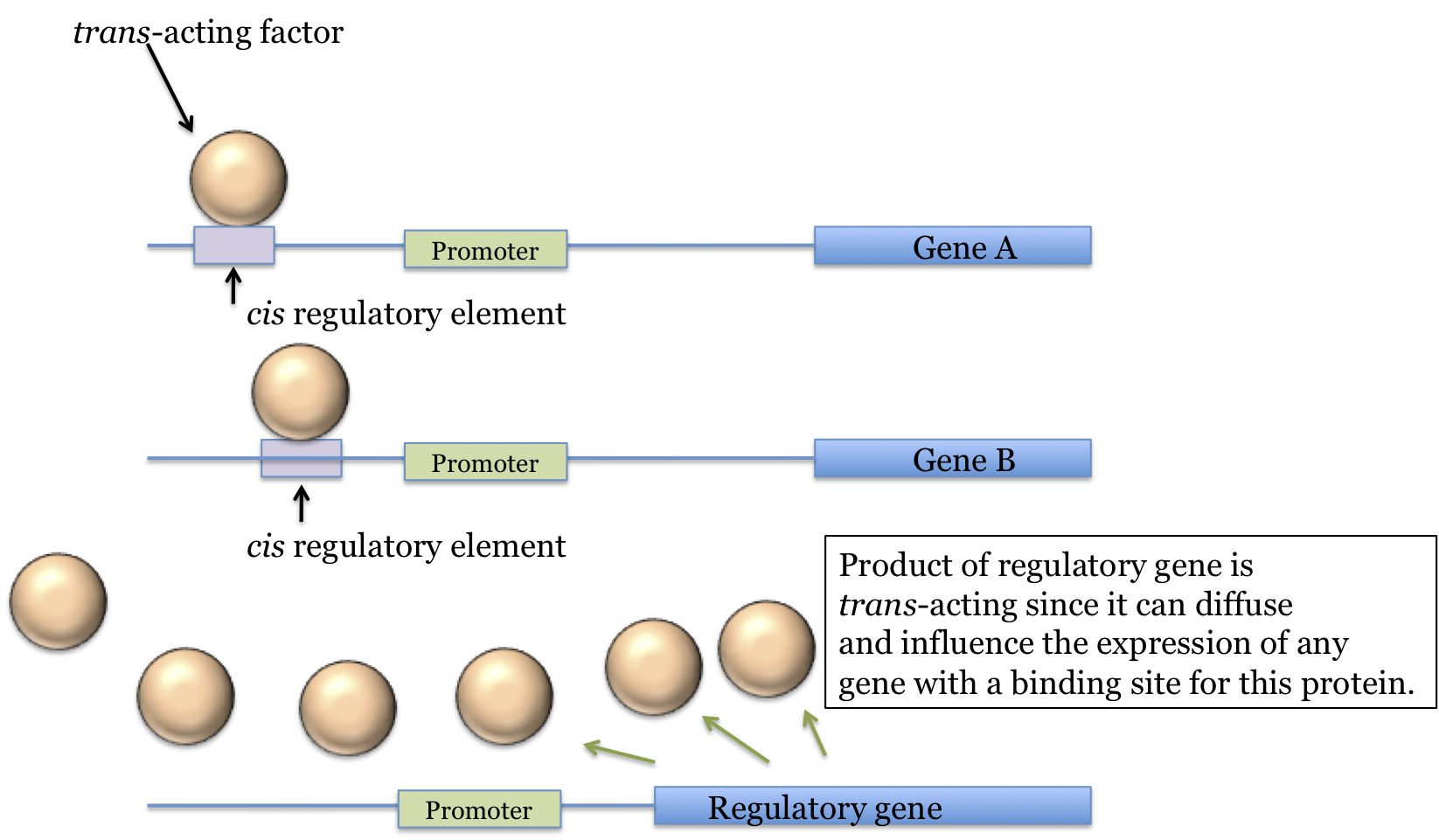
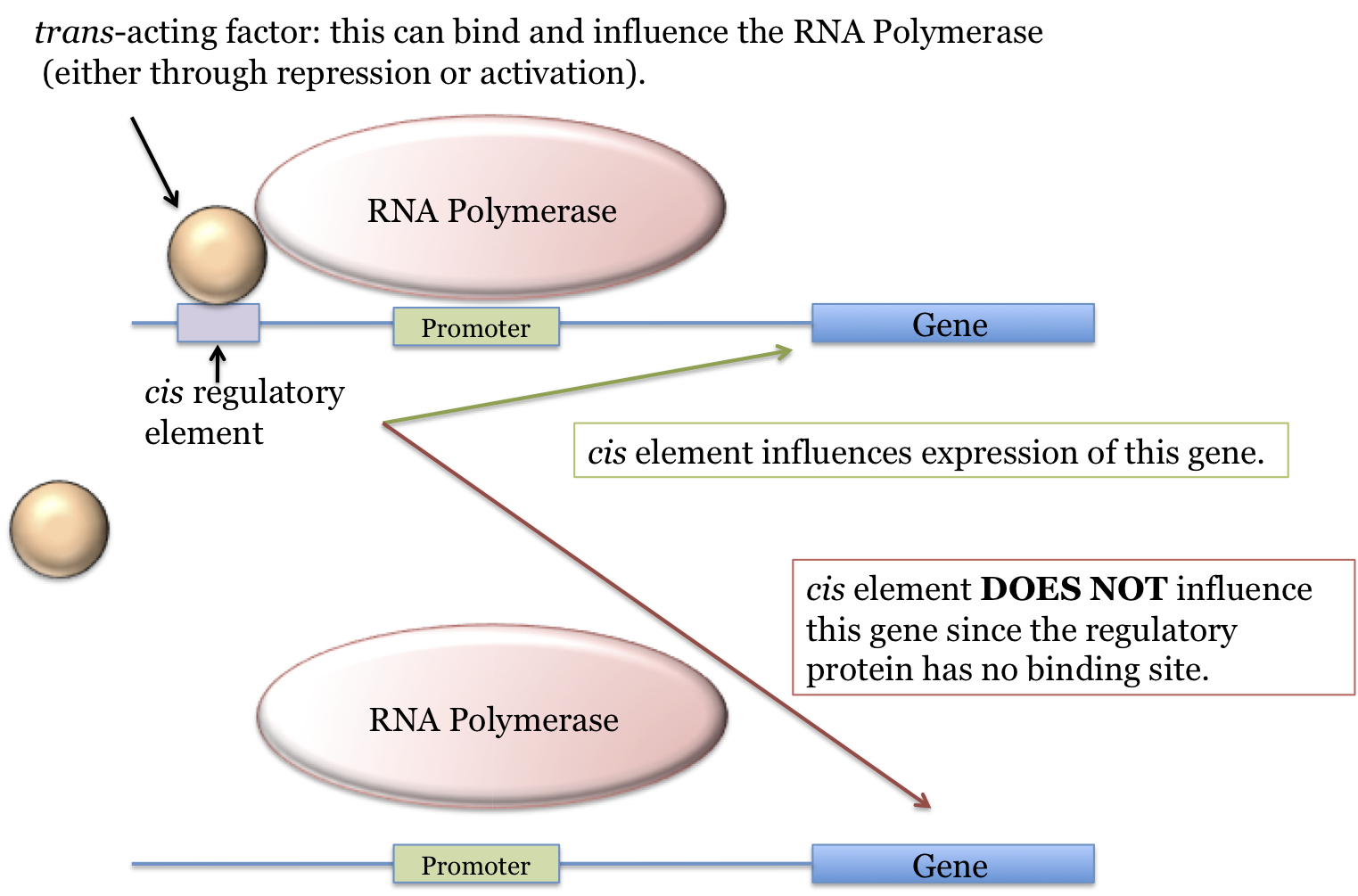
A cis element is simply a regulatory element that must be located on the same DNA molecule as the gene under regulation in order to have an effect. That is, it must be in cis configuration with the gene. These are essentially just DNA sequences which are binding sites for proteins that themselves influence gene expression when bound. Good examples of cis elements are Promoters and Operators; if there is no promoter sequence near a gene then RNA Polymerase cannot bind and the gene will not be transcribed. Having a promoter sequence on another DNA molecule (in trans-configuration) will not solve this.
|
|
A trans factor is a regulatory element/factor that can be located on any DNA molecule (including the same molecule as the regulated gene) and still influence the expression of the gene under regulation - that is, it can act even when in trans configuration. These are essentially proteins; the gene coding for the regulatory protein - the trans factor - can be located on any DNA molecule in the cell and the protein product can diffuse through the cell to bind to it's recognition sequence. Of course, to have an effect, there must be a cis element for the trans factor to bind - it is really the potential to act on genes on any DNA molecule that defines a trans factor.
|
|
| Prokaryotic Regulation | Table of Contents |