General Regulatory Control
| Prokaryotic Regulation | Table of Contents |
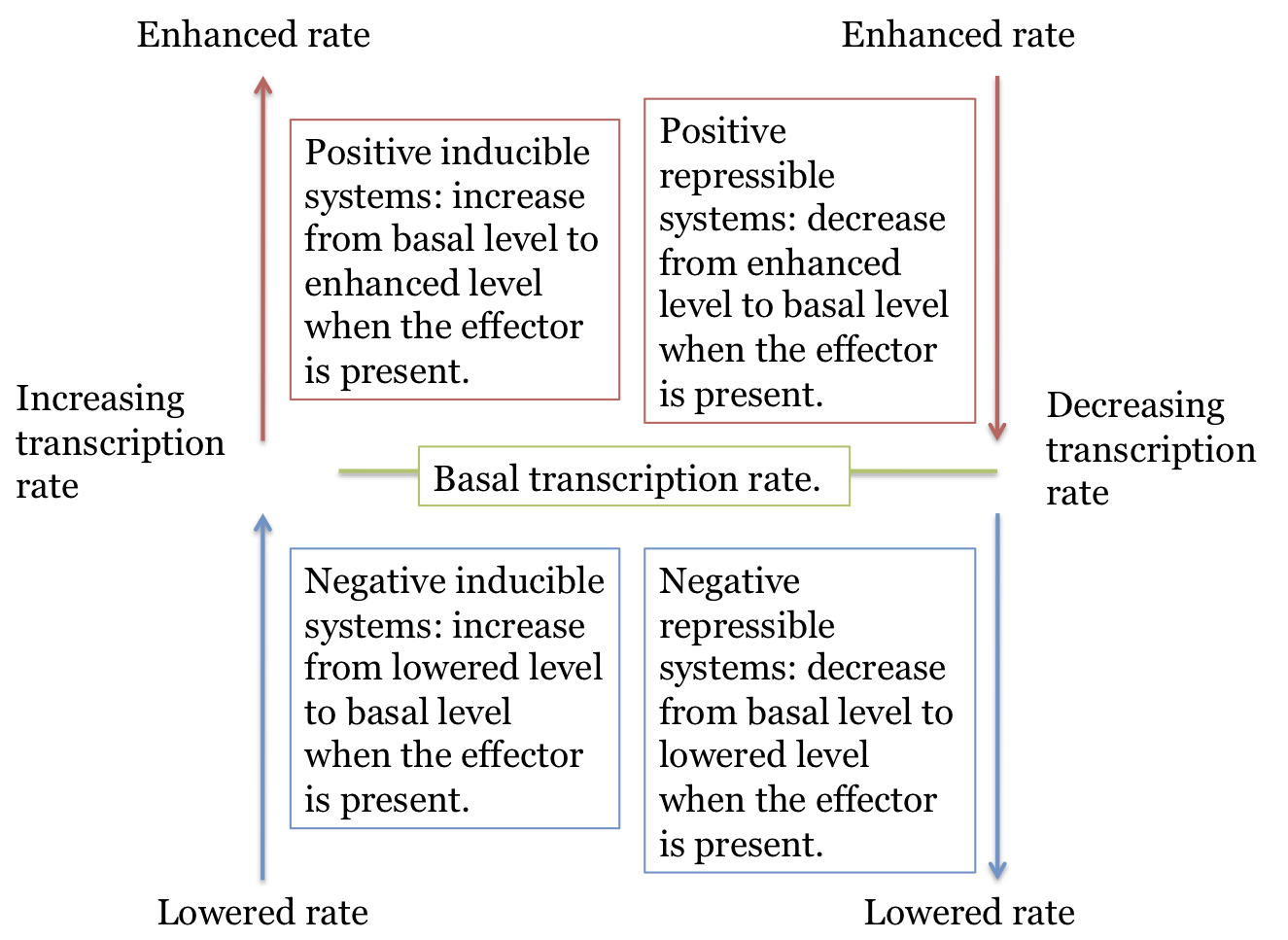
Before we get into specific mechanisms by which regulation of transcription initiation occurs we should start with some general concepts. The main concepts we deal with are 1) the difference between a positive regulatory system and a negative regulatory systems, and 2) the difference between a repressible regulatory system and an inducible regulatory system. We then combine them into the four possible general systems (positive repressible, negative repressible, positive inducible and negative inducible).
Before starting, an important point to understand is the idea of a basal transcription rate. We are going to be discussing how a cell uses various components to alter the rate of transcription of a gene. Therefore, the basal rate is a good point for comparison: it is the rate at which transcription initiation occurs without any factors other than the RNA Polymerase acting. (A major factor affecting the difference in basal transcription rate amongst genes is the promoter sequence itself. Generally, the more different it is from the consensus sequence, the lower the basal rate - although this is a loose rule of thumb!)
A second important point to understand is the concept of an effector, which is often a small molecule. The effector is what the system is responding to - the reason for the change in transcription rate. For example, as we will see in the case of the Lac operon, a modified lactose, called allolactose, is the effector. It is changes in the concentration of this molecule that the cell is responding to, since it the changes are indicative of the availability of lactose. The effector molecule is essentially the signal to the cell about whether or not a gene product is needed and, if it is needed, how much is needed.
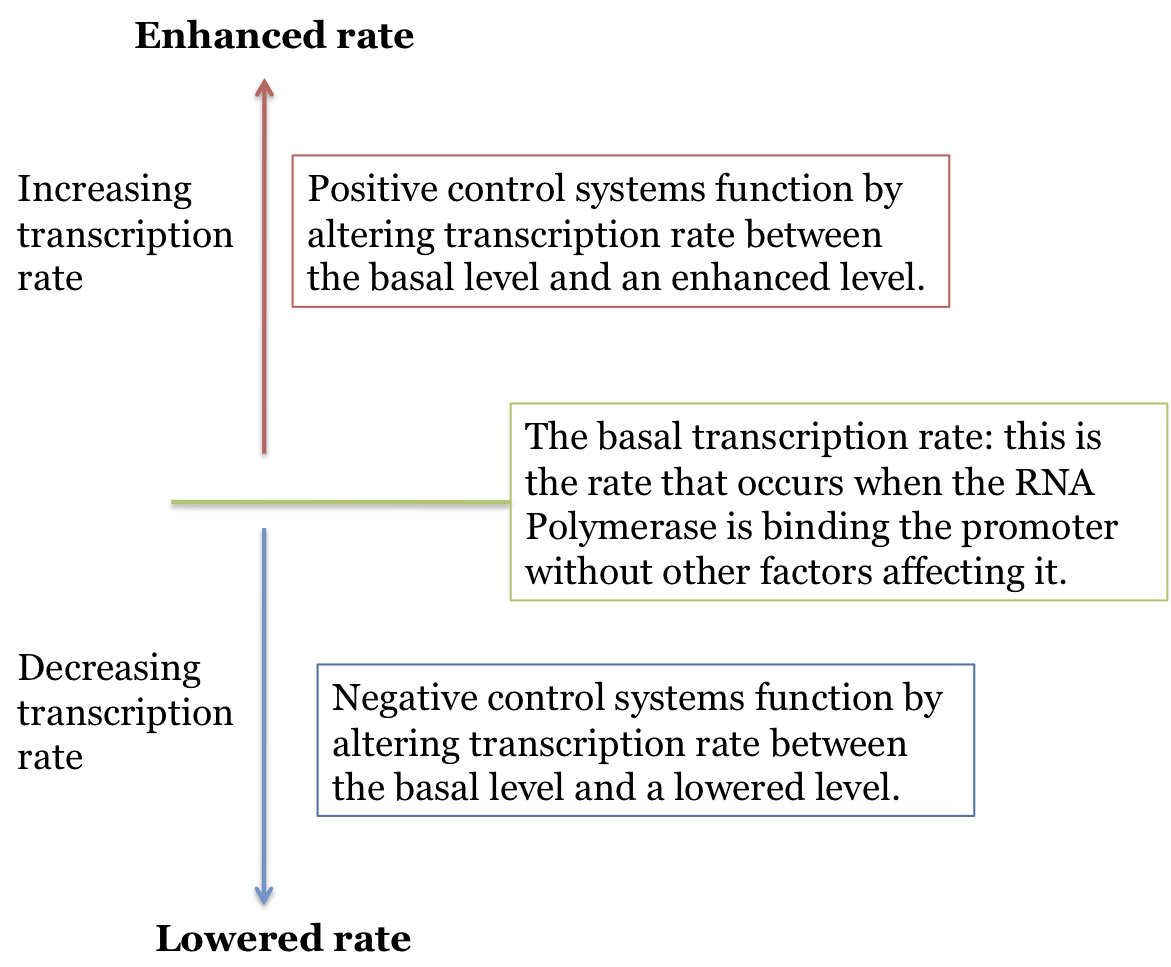
The first general division is between positive and negative systems. Regulatory systems can be generally divided into those in which changes in expression level (in response to changes in the concentration of the effector) occur below the basal level (negative control) or above the basal level (positive control). This is illustrated here:
|
|
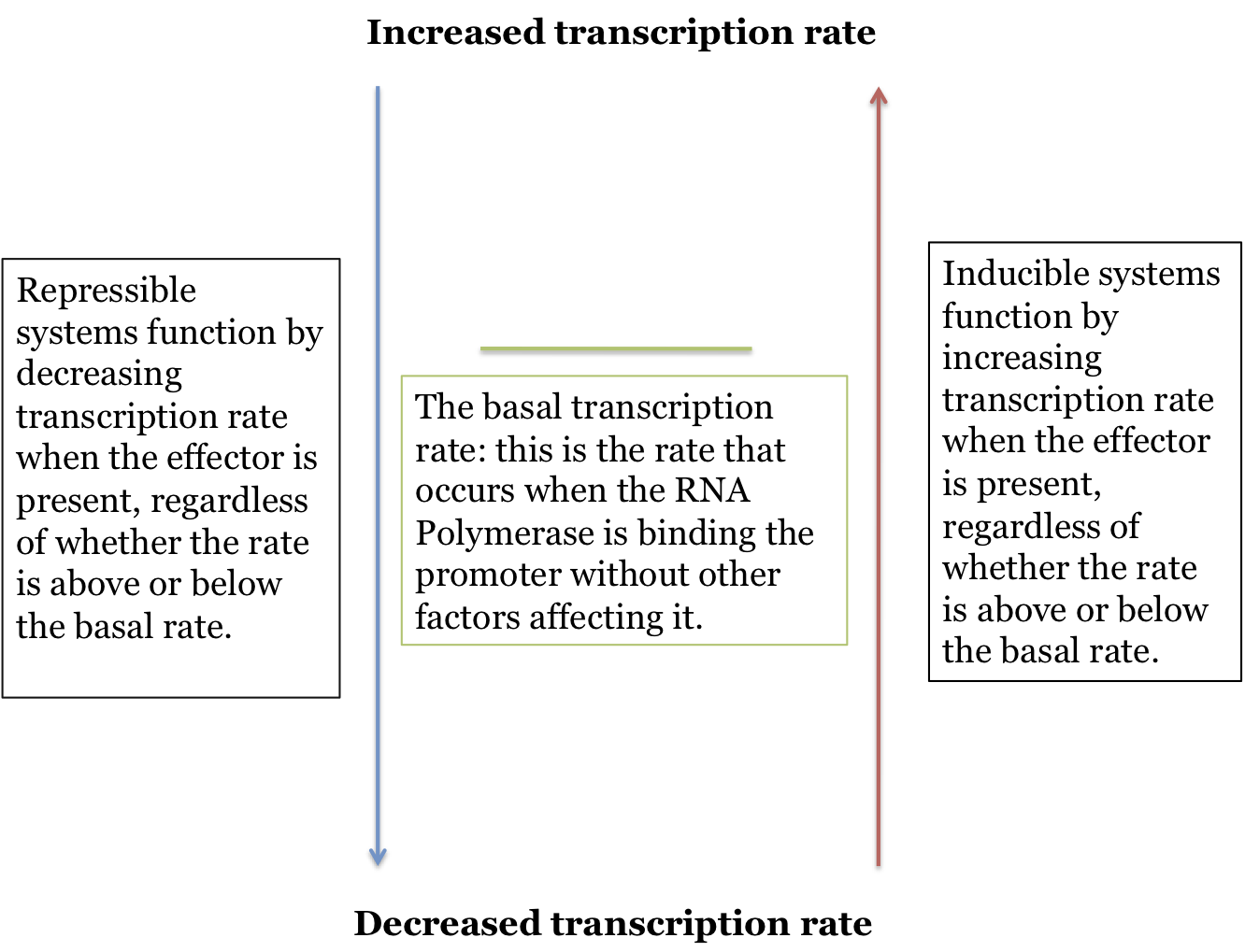
The second general division is between repressible and inducible systems. Regulatory systems can be generally divided into those that respond to the presence of the effecter by lowering the transcription rate (repressible control) or by increasing the expression rate (inducible control). This increase or decrease is not dependent on the relation between expression level and the basal level as illustrated here:
|
|
We can now combine the two concepts as illustrated here:
|
|
| Prokaryotic Regulation | Table of Contents |