Genetic Linkage
Genetic linkage is defined as a relationship between genes on the same chromosome. Because it is really chromosomes that segregate during cell division, and not genes themselves, linked genes tend to get inherited as a unit instead of assorting independently. This is because, in the absence of crossing over - which can result in recombination - all genes on a chromosome will segregate together and, thus, will be inherited as a unit. Here we will cover the concept of linked genes segregating as a unit and other pages will then cover crossing over and recombination.
The important difference between linked and unlinked genes is that when genes are unlinked they segregate independently; this is because different chromosomes segregate independently. When genes are linked they do not segregate independently. When Mendel originally proposed his Law of Independent Assortment he happened to be dealing with unlinked genes. Subsequent work by others, particularly Thomas Hunt Morgan, uncovered violations of this Law, or Principle, which were eventually discovered to be a result of the linked inheritance of genes on the same chromosome. Morgan developed a number of the concepts we use to study linkage and we need to learn how linkage affects inheritance patterns of traits and how to deal with this aspect of genetics.
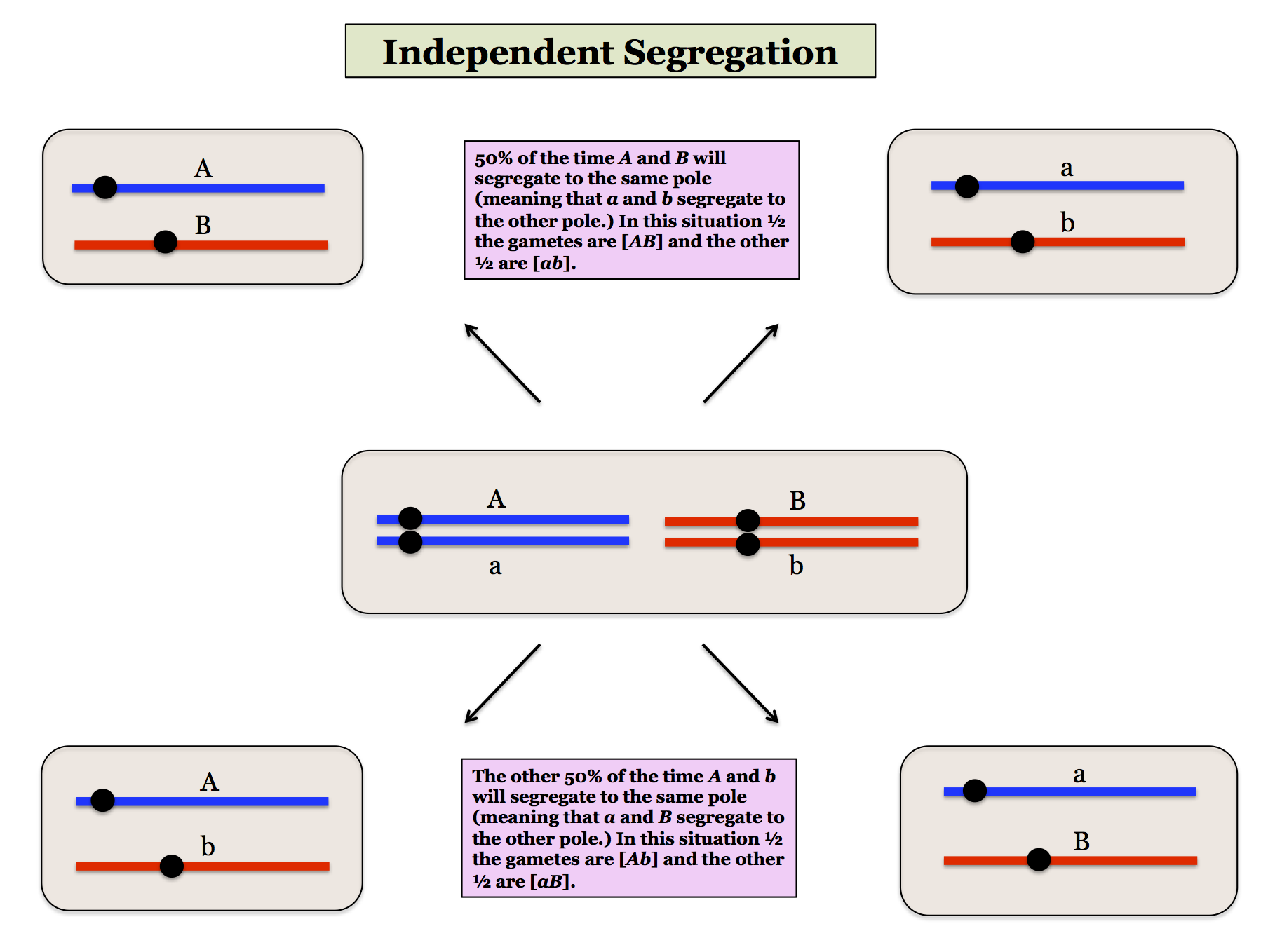
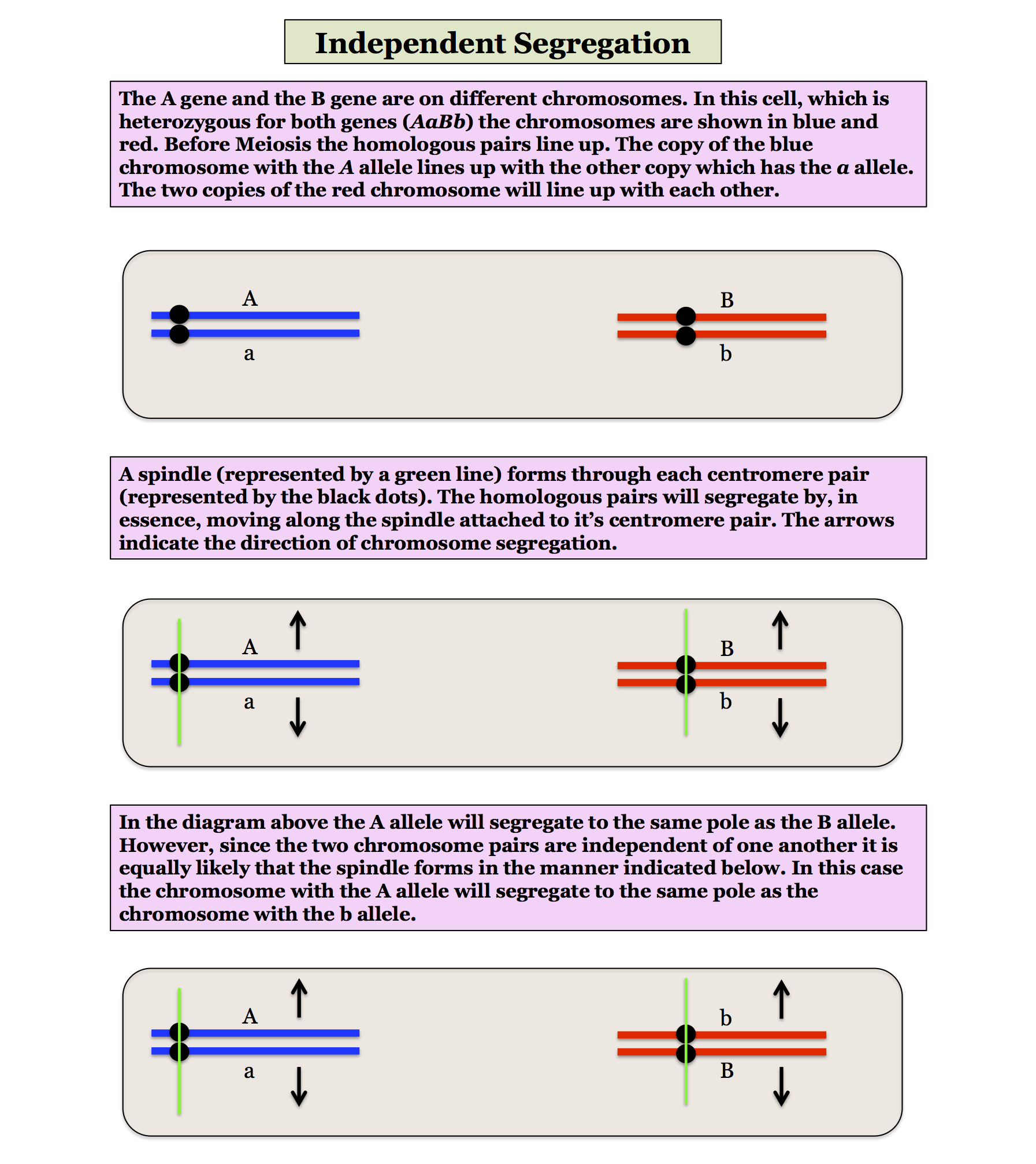
First we will consider how Independent Segregation is a result of genes being located on different chromosomes.
|
|
The consequences for segregation are:
|
|
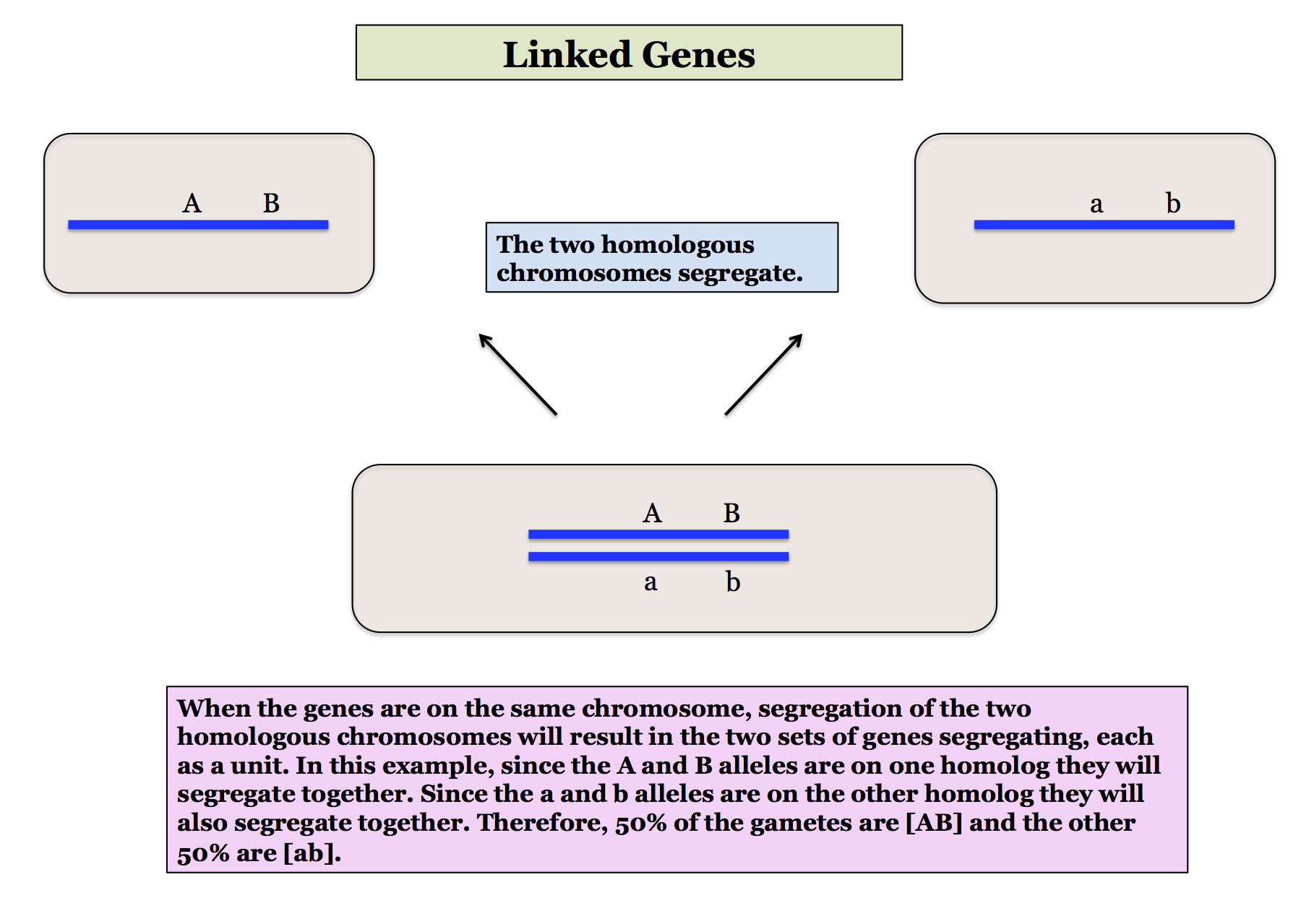
Now we can consider linked genes.
|
|
|
|
The consequences of linkage.
The major effect of linkage for what we are learning is that it affects gamete proportions. This is the main point you should take away from this page. When genes are unlinked an organism that is heterozygous for two genes (AaBb) will produce the four gametes [AB], [Ab], [aB], and [ab] at equal frequencies (1/4 each, or a 1:1:1:1 ratio). This is the basis for the calculations of a dihybrid cross which you can review here.
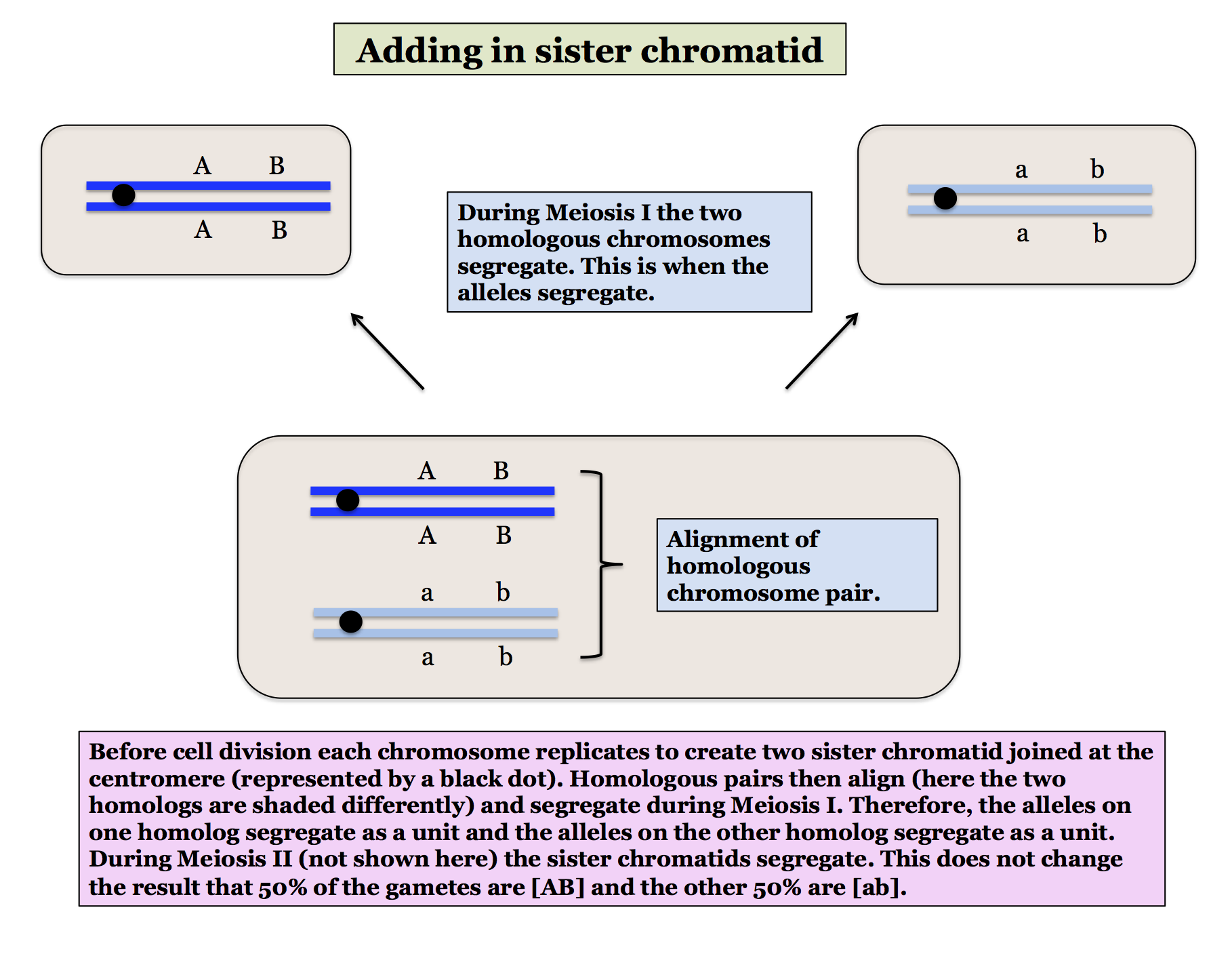
However, when genes are linked they produce these 4 gametes at different frequencies (which, of course, still add up to 100%.) Exactly what the gamete frequencies are will differ for each gene pair - it depends on how far apart they are on the chromosome, as covered elsewhere. For now we just want to make sure that you understand that linkage leads to gamete frequencies that are NOT 1:1:1:1. If you look at the figures above you can see that, since the alleles on one chromosome segregate as a unit, only two of the four possible gametes are actually generated. These two will each be 50% of the gametes. When we cover crossing over this will change but we can start with this basic result of linkage.
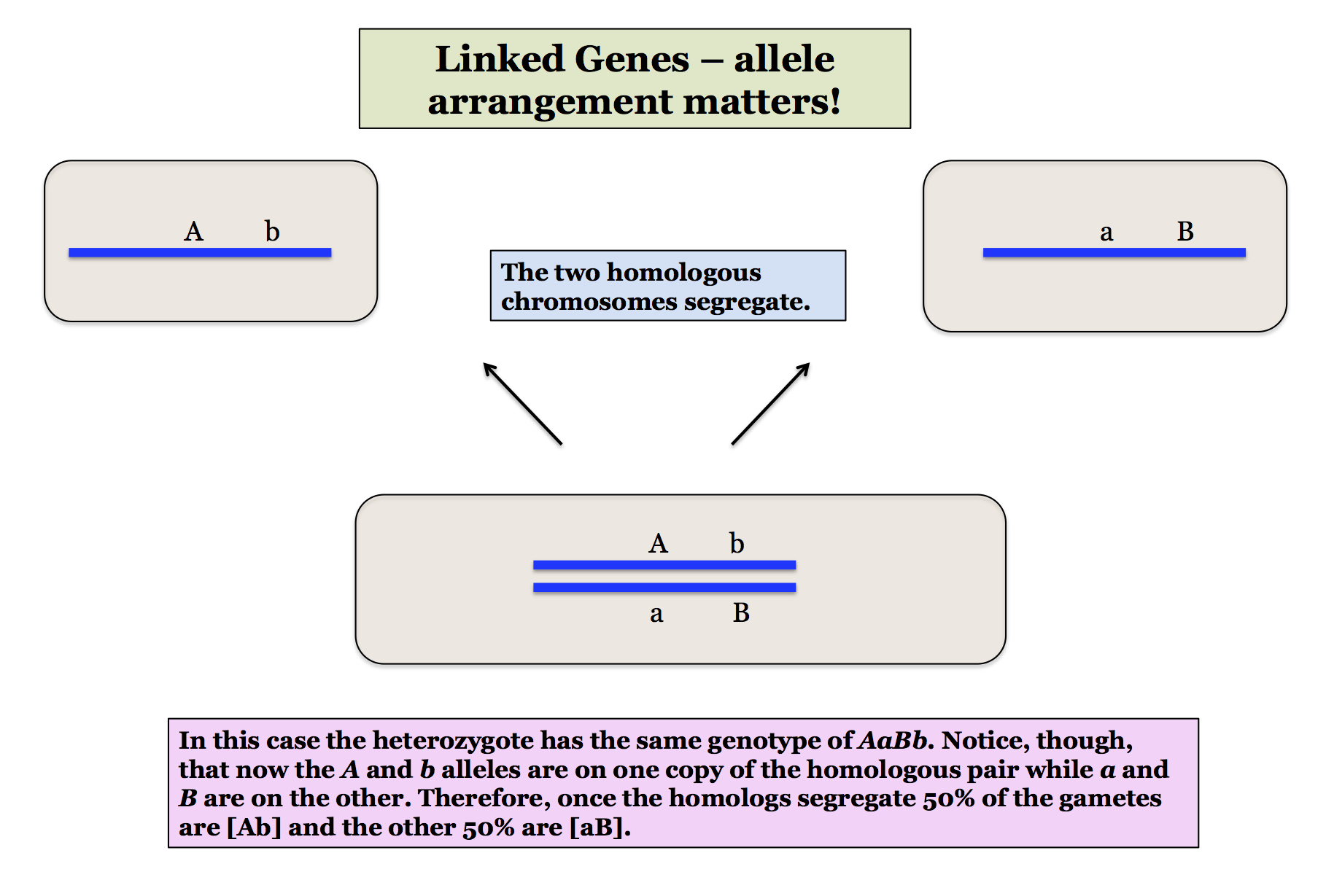
Another important point arises from the fact that alleles on a chromosome segregate as a unit. Which allele segregate will, of course, depend on how they are arranged. In the AaBb individual in the diagram above we had A and B on the same copy which is why they segregated together. But it is also possible for A and b to be on the same copy in which case they will segregate together as shown here.
|
|
Which allele configuration exists depends on the chromosomes inherited by the AaBb individual from its parents. This concept is covered in more detail on another page. Just keep it in mind for now. It becomes very important how alleles are configured since this determines what set segregates as a unit. When genes are unlinked we can just worry about what alleles an individual has. Here we will start to think about how they are arranged - that is, what copies of a homolog has which alleles!
Non-independent segregation and probability.
Another way to consider the effect of linkage is from the perspective of probability. Consider the case when two genes are unlinked and you are asked the following question: In a dihybrid cross (AaBb x AaBb), what is the probability of getting a progeny with the aabb genotype?
Since the genes are unlinked (independent) we would calculate Pr(aa AND bb) = Pr(aa) * Pr(bb) = 1/4 * 1/4 = 1/16.
However, this does not apply for linked genes. It is still true that from a dihybrid cross that Pr(aa) = 1/4 and Pr(bb) = 1/4. In other words, we will still see 1/4 of the progeny showing the aa phenotype and 1/4 showing the bb phenotype. This is because linkage does not affect the inheritance of a single gene: Aa x Aa will still give 1/4 aa.
What linkage means is that since the A and B genes do not segregate independently they are not independent entities and we cannot apply the AND rule. So the probability of aa and bb occurring together is not found by multiplication: it is NOT Pr(aa AND bb) = Pr(aa) * Pr(bb). Instead of applying the AND rule you have to apply methods that involve Recombination Frequency as covered on another page.
You can also watch this video.
You can also read the Nature Scitable page on linkage.