Termination of Replication
| Prokaryotic Replication | Table of Contents |
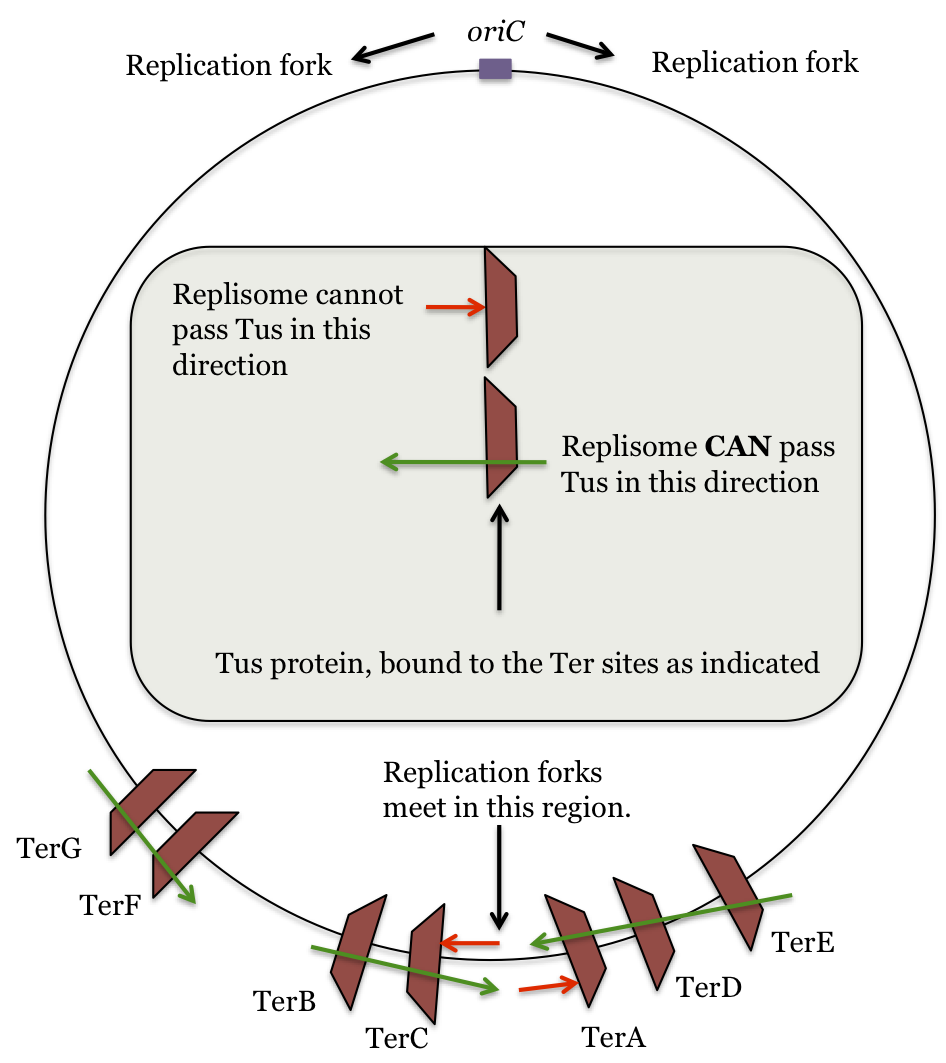
The process of replication termination is not fully understood. One thing that has been established is that termination in E. coli always occurs at a specific location on the chromosome which is just opposite oriC on the circular DNA molecule. E. coli has a mechanism to ensure that the forks meet at this point so that termination always occurs at that location. This mechanism involves a group of proteins called Tus proteins. Tus proteins bind to specific sites along the chromosome called Ter sites and they bind these sites in a specific orientation. When a Tus protein is encountered by a growing fork, the fork can only pass if the protein is in the correct orientation - it is thought that when Tus is in the incorrect orientation it inhibits helicase activity which would halt the fork.
The Ter sites are found in opposite orientations on each side of the termination location, which results in the Tus proteins being bound in opposite orientations on each side. This arrangement functions to ensure that the two forks meet at the termination locus each time replication occurs. Once one fork reaches this point it cannot move further since it then encounters Tus proteins bound in the incorrect orientation. Therefore, even if the forks move at very different speeds they are forced to meet within a localized section of the chromosome.
|
|
| Prokaryotic Replication | Table of Contents |