Linkage Maps
A linkage map is a representation of the arrangement of genes along a chromosome in which the distance between those genes is the genetic distance based on Recombination Frequency (RF).
Once we have calculated RF for pairs of genes we can generate a linkage map with relative ease as shown in the three-point test cross page.
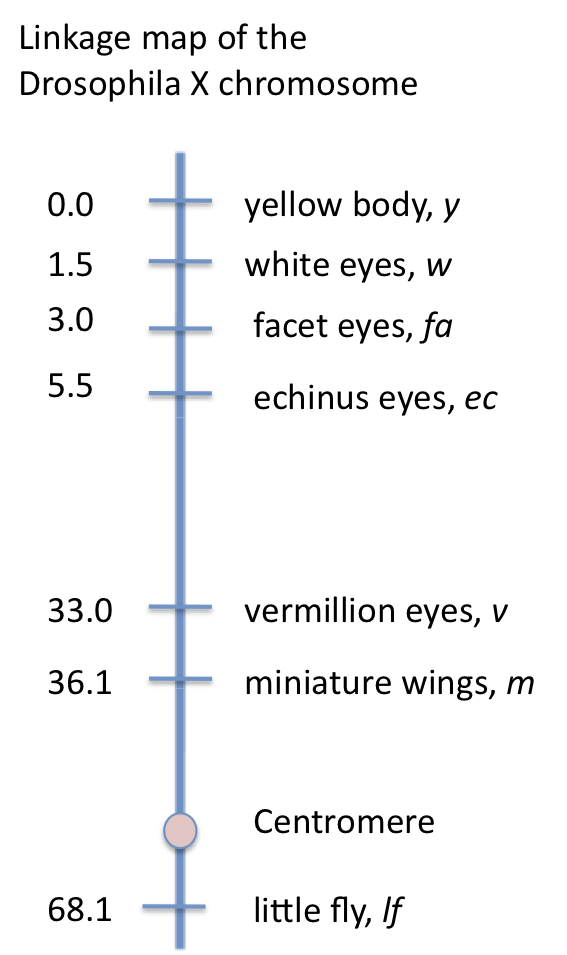
Reading a linkage map allows you to determine RF (1% RF = 1 cM) for any genes on the map. For example, below is a linkage map for the X chromosome from Drosophila melanogaster.
On the left is given the distance of the gene (in cM) from a defined point near the chromosome end. (For this chromosome they have set this point at the location of the y gene.) So, the distance between genes is simply the difference in these values. From the w gene to the fa gene the distance is 1.5 cM, while between ec and v it is 27.5 cM.
You can use these estimates of RF when making calculations of expected progeny numbers as described in Applying Recombination Frequencies.
It is important to see that the further apart two genes are, the less accurate the estimate of RF is. This is a result of multiple crossovers that can occur and the further apart the genes are, the more likely it is that these will occur. There are ways to estimate the frequency of multiple crossovers and thus to "correct" the recombination frequency but these methods are not covered in this course.
|
|